
Cardarine,
does it really help with Improved endurance and exercise performance in humans?
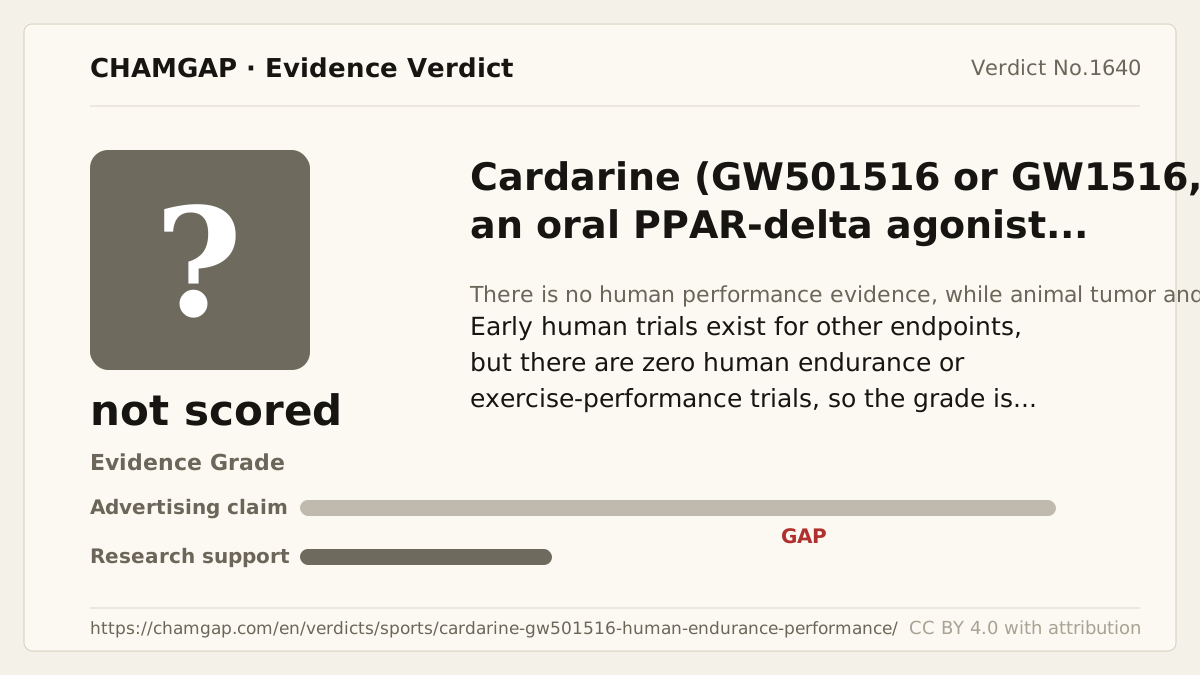
research showsCardarine is rated ? because no human trial has tested endurance or exercise performance as its primary endpoint. Early human studies do exist, but even the 12-week trial with an actual analysis of 268 participants targeted lipid and metabolic measures, not endurance. Performance evidence comes only from cells and mouse running experiments. In contrast, multi-organ tumors in animals, development termination, WADA prohibition, and black-market distribution create major safety warnings.
ads claimBlack-market sellers advertise an exercise pill or dramatic endurance boost as if human efficacy had been demonstrated. Human studies addressed lipid and metabolic endpoints only, not athletic performance.
Useful facts when choosing a product
- GW501516 is a selective PPAR-delta agonist that was developed for metabolic disease but is not an approved human medicine.
- A 12-week human study used 2.5 to 10 mg and measured lipid changes without assessing endurance or exercise performance.
- WADA classifies GW1516 and GW501516 as prohibited metabolic modulators and separately warned about black-market distribution and serious preclinical toxicity.
- The Geiger SOT conference abstract reported tumors in multiple organs in a 104-week rat carcinogenicity study; the magnitude of long-term human cancer risk is unknown, which does not establish safety.
Chamgap Semantic Classification Code
Candidate index · review held
UNK.cardarine.oral.endurance-and-exercise-performance-in-humans.improve.placeboUnknown > Cardarine > Oral > endurance and exercise performance in humans > Improvement claim > Placebo
An automated migration candidate, not an issued permanent code; exact claim scope remains under review. This machine-generated migration candidate helps retrieval but is not a permanent assignment. The original verdict ID and URL remain authoritative.
What the research actually shows
The peer-reviewed human original article by Olson and colleagues reported a 12-week randomized trial with an actual analysis population of 268 adults with low HDL cholesterol. Its primary purpose and endpoints were lipid, apolipoprotein, and metabolic laboratory changes, which were positive; it did not measure endurance, running time, power, or maximal oxygen uptake. The performance publication was a peer-reviewed 2008 Cell cell-and-mouse original article with zero human participants. Thus, primary-endpoint success or failure for human endurance is not applicable because no such trial exists. Geiger et al., Toxicologist 2009;108(1), abstract 895, was an SOT conference abstract supporting multi-organ tumors in a 104-week rat carcinogenicity study only; the separate mouse endurance evidence is cited to Narkar et al. WADA warned in 2013 that development had been terminated for serious preclinical toxicities and continues to prohibit the substance in 2026.
Why this is classified as ?
Human trials for other endpoints exist, but zero human trials have tested endurance or exercise performance as a primary endpoint. The definition therefore requires ? with no score.
Counterpoint. Human lipid changes are not evidence of improved human exercise capacity. WADA prohibition and preclinical tumor findings also make self-experimentation unjustifiable.
Rejudgment record. Cross-check applied — Early human trials exist for lipid and metabolic endpoints, but zero human trials assessed endurance or exercise-performance efficacy as a primary endpoint, requiring ?
Sub-claim grades by effect
This ingredient is marketed for several effects. A single overall grade blends strong and weak claims together, so each effect is graded separately here. The overall grade reflects the strongest disconfirming or core claim.
| Effect (sub-claim) | Grade | Basis |
|---|---|---|
| Improved endurance in humans | ? | No human trial has assessed this as a primary endpoint. |
| Improved exercise performance in humans | ? | No human trial has tested power, time, maximal oxygen uptake, or another performance endpoint. |
| Improved competitive performance in humans | ? | Evidence is limited to cells and mice, and human competitive outcomes have not been tested. |
Cross-check — AI research and Codex final gate
Evidence Table
| Study | Design | Sample | Funding | Endpoint | Result | Weight |
|---|---|---|---|---|---|---|
| Olson EJ et al. 2012 | Peer-reviewed randomized placebo-controlled human original article | Actual analysis of 268 participants; separate exploratory study of 37 | GlaxoSmithKline manufacturer research with company-affiliated authors | Lipid and metabolic measures including HDL, LDL, triglycerides, and apolipoproteins | Lipid changes were positive, but endurance and exercise-performance outcomes were not measured. | Confirms human trials for other endpoints |
| Narkar VA et al. 2008 | Peer-reviewed cell and mouse preclinical original article | Zero humans; mouse experiments | Academic and public research support | Mouse running endurance and muscular metabolic adaptations | Mouse endurance signals occurred with training plus GW501516, but no human data were included. | Preclinical mechanistic and efficacy signal |
| Geiger LE et al. 2009 SOT abstract 895 | 104-week rat carcinogenicity study reported as an SOT conference abstract | 104-week rat carcinogenicity study; zero humans | GlaxoSmithKline preclinical development data | Multi-organ neoplasms and mortality in rats | Treatment-related neoplasms across multiple tissues were reported in the 104-week rat study. | Major preclinical safety signal in rats; SOT conference abstract |
Receipt — 5 References
All 5 cited sources were verified for existence at the original page (as of 2026-07-24).
Final verification and publication gate: Codex · Evidence date: 2026-07-24 · Corrections: none
Cite this verdict
[Chamgap] Cardarine x improved endurance and exercise performance in humans — Evidence Grade ?. 5 cited sources checked. Source: https://chamgap.com/en/verdicts/sports/cardarine-gw501516-human-endurance-performance/ · CC BY 4.0CC BY 4.0 — free to use with attribution; do not distort grades, numbers, or verdict meaning.
What this document does and does not do
Chamgap is an information source. It reports what research has and has not confirmed; it does not tell readers what to take or buy. That decision belongs to readers and, when needed, medical or legal professionals. This verdict reflects literature available up to the search date and may change as new research appears. Nothing here is medical advice.