
Ashwagandha root extract,
does it really help with Improved strength and aerobic capacity measured by VO2max in healthy adults performing resistance training?
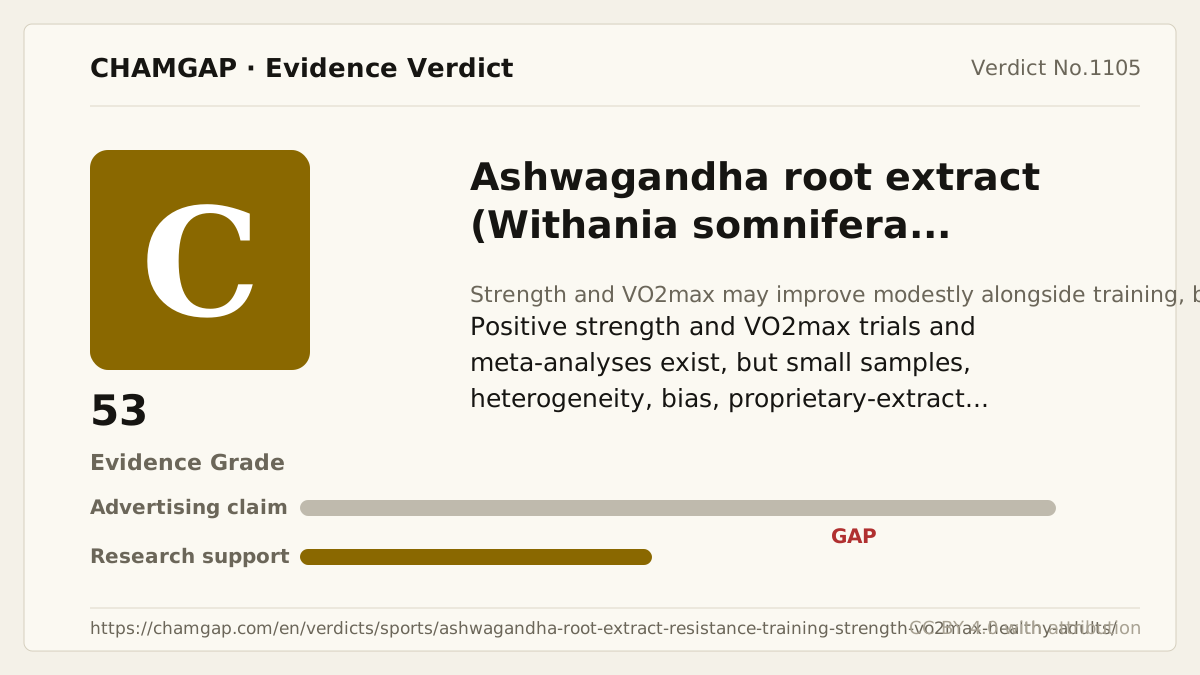
research showsAshwagandha root extract is rated C because it has positive signals for strength and VO2max in healthy adults training with resistance exercise. A 2021 Bayesian meta-analysis found strength, cardiorespiratory-fitness, and recovery measures favorable to placebo across 12 quantitatively synthesized trials, while acknowledging low-to-moderate risk of bias and preparation heterogeneity. An updated 2026 three-level meta-analysis of 13 studies and 599 participants found an overall Hedges g of 0.47, but I-squared was 60% and the 95% prediction interval ranged from -0.40 to 1.33, including a null result in a new study; strength effects were positive but uncertain. A VO2max-specific meta-analysis of four randomized trials and 142 participants found a 3.00 mL/kg/min mean gain with high heterogeneity. Small proprietary-extract studies and product variability put this far below A-rated creatine in verdict 65 and align it with C-rated ashwagandha sleep and testosterone verdicts 408 and 926, yielding 53 points.
ads claimPromotion can generalize a short proprietary-extract trial into natural creatine and definite strength and endurance gains for every exerciser. Study products differ across root-only, root-and-leaf, aqueous, and concentrated withanolide-standardized extracts and are not interchangeable with generic powder.
Useful facts when choosing a product
- A common research regimen in exercise trials is 300 mg of standardized root extract twice daily for about eight weeks, but no single dose applies to every marketed ashwagandha product.
- Root powder, root extract, and root-and-leaf extract differ in withanolide composition and concentration, so findings from a proprietary ingredient cannot be transferred unchanged to another product. Ingredient labeling and independent quality testing matter.
- Short-term use can cause stomach upset, diarrhea, vomiting, and drowsiness. Rare but repeatedly reported liver injury can present with jaundice, dark urine, and severe itching, which require discontinuation and medical evaluation.
- Ashwagandha should be avoided during pregnancy and is not recommended while breastfeeding. Thyroid, autoimmune, or liver disease, planned surgery, and use of sedatives, immunosuppressants, thyroid hormone, diabetes, or blood-pressure medicines warrant professional review.
Chamgap Semantic Classification Code
Candidate index · review held
S.ashwagandha-root-extract.UNK.strength-and-aerobic-capacity-measured-by-vo2max-performing-resistance-training.improve.placeboSupplements and nutraceuticals > Ashwagandha root extract > Unknown > strength and aerobic capacity measured by VO2max performing resistance training > Improvement claim > Placebo
An automated migration candidate, not an issued permanent code; exact claim scope remains under review. This machine-generated migration candidate helps retrieval but is not a permanent assignment. The original verdict ID and URL remain authoritative.
What the research actually shows
Wankhede and colleagues randomized 57 healthy men with little resistance-training experience to eight weeks of training plus ashwagandha root extract 300 mg twice daily or starch placebo. Bench-press gains were 46.0 kg versus 26.4 kg, and leg-extension gains were 14.5 kg versus 9.8 kg. The 2021 review by Bonilla and colleagues included 13 studies and quantitatively synthesized 12, finding favorable mean effects on strength, cardiorespiratory fitness, and fatigue or recovery while identifying low-to-moderate risk of bias and limited training standardization. The VO2max meta-analysis by Perez-Gomez and colleagues selected five studies with 162 participants and pooled four randomized trials with 142 participants, finding a mean difference of 3.00 mL/kg/min (95% CI 0.18 to 5.82) with high heterogeneity. The 2026 update by Li and colleagues included 13 studies and 599 participants, with overall g 0.47 (95% CI 0.25 to 0.69), I-squared 60%, and a prediction interval from -0.40 to 1.33; aerobic endurance was more consistent while strength remained positive but uncertain.
Why this is classified as C (53)
A resistance-training trial, a 2021 Bayesian synthesis of 12 trials, and a four-trial VO2max synthesis were positive on average. Total samples remain small, however, preparations, doses, and training status are heterogeneous, risk of bias is low to moderate, and proprietary ingredients and industry links are concentrated. The 2026 update still found g 0.47 but I-squared 60%, a prediction interval including no effect, and uncertain strength effects. The rule ②-b manufacturer and single-product ceiling, together with corpus parity with C-rated ashwagandha sleep and testosterone verdicts, yields C with 53 points. Rare liver injury, thyroid effects, and pregnancy precautions remain separate safety issues.
Counterpoint. A healthy adult with a well-established training, protein, and sleep program might obtain a small additional benefit from a standardized root extract similar to one studied for a short period. Training remains the foundation, and lack of response does not justify escalating dose or duration.
Rejudgment record. New verdict — Accepted positive average effects from a resistance-training trial, the twelve-trial Bayesian meta-analysis indexed as PMID 33670194, and a VO2max randomized-trial synthesis, while applying the rule ②-b ceiling for small samples, preparation heterogeneity, proprietary extracts and industry links, and the 2026 update with I-squared 60%, a null-inclusive prediction interval, and uncertain strength effects
Sub-claim grades by effect
This ingredient is marketed for several effects. A single overall grade blends strong and weak claims together, so each effect is graded separately here. The overall grade reflects the strongest disconfirming or core claim.
| Effect (sub-claim) | Grade | Basis |
|---|---|---|
| Improved strength in healthy adults performing resistance training | C | Small randomized trials and average meta-analytic effects were positive, but strength was uncertain in the 2026 update and evidence is concentrated in proprietary extracts. |
| Improved VO2max and aerobic capacity in healthy adults and exercisers | C | Four pooled trials found a 3.00 mL/kg/min mean gain and the updated aerobic subgroup was positive, but samples were small and heterogeneous. |
| Improved overall exercise performance with ashwagandha supplementation | C | The updated overall g of 0.47 was positive, but I-squared of 60% and a prediction interval from -0.40 to 1.33 do not exclude no effect in a new study. |
Cross-check — AI research and Codex final gate
Evidence Table
| Study | Design | Sample | Funding | Endpoint | Result | Weight |
|---|---|---|---|---|---|---|
| Li X et al. 2026 | Systematic review and three-level meta-analysis of randomized controlled trials | Thirteen studies, 599 participants, and 79 effect sizes | Academic synthesis; many included trials involved proprietary ingredients or industry links | Overall exercise performance, aerobic endurance, strength, power, and muscular endurance | Overall g was 0.47 (95% CI 0.25 to 0.69), I-squared was 60%, and the 95% prediction interval was -0.40 to 1.33. Aerobic endurance was positive at g 0.54, while strength effects were uncertain. | Most current synthesis as of verification |
| Bonilla DA et al. 2021 | Systematic review and Bayesian hierarchical meta-analysis | Thirteen studies included and twelve quantitatively synthesized | Academic research; some authors disclosed supplement-industry consulting or research relationships | Strength and power, cardiorespiratory fitness, and fatigue and recovery | Average effects favored ashwagandha over placebo, but overall risk of bias was low to moderate and more comparable exercise-training studies were needed. | Requested pivotal synthesis of twelve trials |
| Pérez-Gómez J et al. 2020 | Systematic review and meta-analysis of randomized VO2max trials | Five studies and 162 participants; four randomized trials and 142 participants in quantitative synthesis | Academic research; authors reported no conflicts of interest | Maximum oxygen consumption measured as VO2max | The mean difference was 3.00 mL/kg/min (95% CI 0.18 to 5.82), statistically significant but based on few studies with high heterogeneity. | Direct aerobic-capacity synthesis with limited precision |
| Wankhede S et al. 2015 | Eight-week randomized double-blind placebo-controlled resistance-training trial | Fifty-seven healthy men with little resistance-training experience | Used a proprietary standardized root extract with potential industry involvement | Bench-press and leg-extension one-repetition maximum, muscle size, and recovery | Bench-press gains were 46.0 kg versus 26.4 kg and leg-extension gains were 14.5 kg versus 9.8 kg, favoring ashwagandha over placebo. | Direct strength trial with a small proprietary-ingredient sample |
Receipt — 5 References
All 5 cited sources were verified for existence at the original page (as of 2026-07-22).
Final verification and publication gate: Codex · Evidence date: 2026-07-22 · Corrections: none
Cite this verdict
[Chamgap] Ashwagandha root extract x strength and VO2max in healthy adults performing resistance training — Evidence Grade C·53. 5 cited sources checked. Source: https://chamgap.com/en/verdicts/sports/ashwagandha-root-extract-resistance-training-strength-vo2max-healthy-adults/ · CC BY 4.0CC BY 4.0 — free to use with attribution; do not distort grades, numbers, or verdict meaning.
What this document does and does not do
Chamgap is an information source. It reports what research has and has not confirmed; it does not tell readers what to take or buy. That decision belongs to readers and, when needed, medical or legal professionals. This verdict reflects literature available up to the search date and may change as new research appears. Nothing here is medical advice.