
AAKG,
does it really help with Improved bench-press and leg-press maximal strength and repetition performance when taken before exercise?
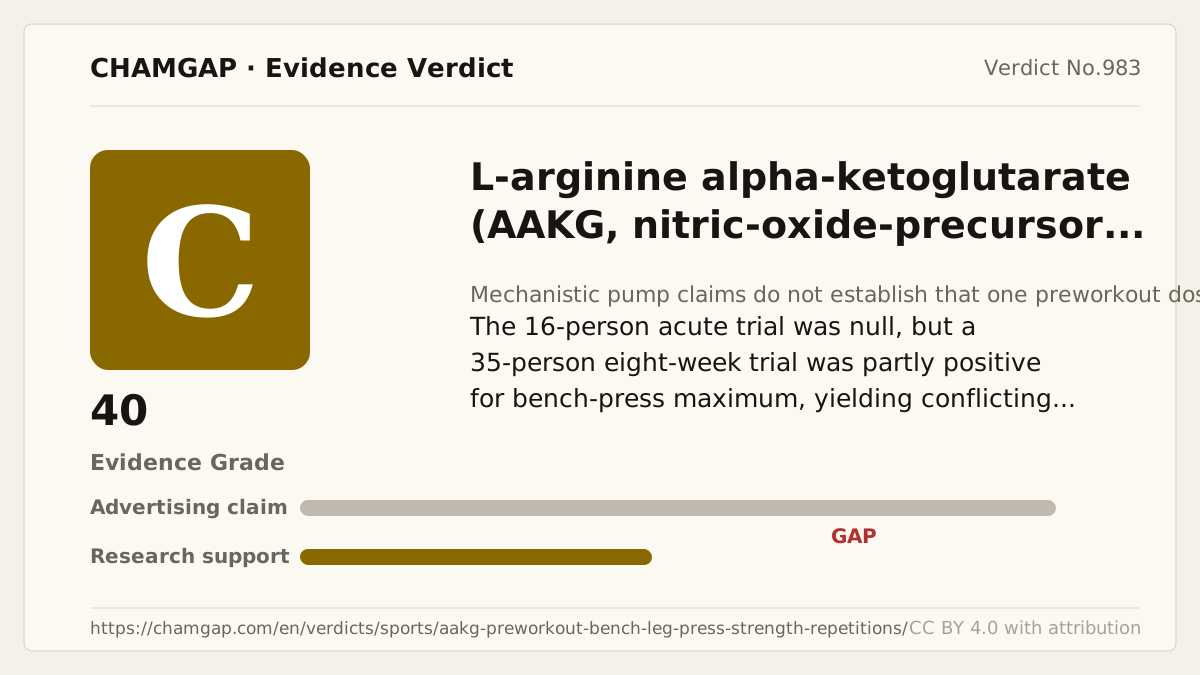
research showsThis claim is rated C. A randomized double-blind crossover trial in 16 men found that 3 g of AAKG taken 45 minutes before exercise did not improve bench-press or leg-press one-repetition maximum or total load to failure at 60% of maximum. However, an eight-week trial of 12 g daily in 35 men reported partial positive results for bench-press maximum and Wingate peak power. The directly matched acute trial was null, but the small longer trial was positive on selected outcomes, making the evidence conflicting and limited rather than a large human null result; the verdict therefore sits at the bottom of C. Leg-press maximal strength and repetition performance remain D as individual subclaims because their direct results were null. Gastrointestinal upset, diarrhea, nausea, possible blood-pressure lowering, and variation in product content and mixtures are safety and product-quality issues separate from efficacy.
ads claimMarketing converts nitric-oxide explosion, pump, or blood-flow language directly into heavier maximum lifts and more repetitions. Even if plasma arginine or the sensation of a pump changes, actual bench-press or leg-press performance does not necessarily improve, and the direct trial did not establish that link.
Useful facts when choosing a product
- AAKG is a salt of L-arginine and alpha-ketoglutarate sold as a sports supplement and is not a medicine approved to improve exercise performance.
- Research doses range from an acute 3 g to 12 g daily for eight weeks, while commercial preworkouts often add caffeine, citrulline, creatine, and other ingredients whose effects cannot be attributed to AAKG.
- Actual AAKG content, ingredient ratio, and third-party quality testing vary among products, so results from one research formulation cannot be generalized to every supplement.
- Nausea, abdominal pain, bloating, diarrhea, and headache can occur, and additive blood-pressure lowering may occur with antihypertensives, nitrates, or erectile-dysfunction medicines; people with disease or medication use should seek clinical advice.
Chamgap Semantic Classification Code
Candidate index · review held
S.l-arginine-alpha-ketoglutarate.UNK.bench-press-and-leg-press-maximal-strength-and-repetition-performance-when-taken-before-exercise.improve.placeboSupplements and nutraceuticals > L-arginine alpha-ketoglutarate > Unknown > bench-press and leg-press maximal strength and repetition performance when taken before exercise > Improvement claim > Placebo
An automated migration candidate, not an issued permanent code; exact claim scope remains under review. This machine-generated migration candidate helps retrieval but is not a permanent assignment. The original verdict ID and URL remain authoritative.
What the research actually shows
Wax and colleagues gave 3 g AAKG or placebo 45 minutes before testing in a crossover study of eight resistance-trained and eight untrained men. Bench-press and leg-press one-repetition maximum and total load performed to failure at 60% of maximum did not differ by supplementation condition. Campbell and colleagues assigned 35 resistance-trained men to 12 g AAKG daily or placebo during eight weeks of training; bench-press maximum and Wingate peak power were positive, but isokinetic quadriceps endurance, body composition, and aerobic capacity were not. The acute maximal-strength and repetition claim is therefore directly null, while the longer high-dose partial signal requires replication. Prior verdict 526 on arginine silicate and pump or blood-flow outcomes concerns a different endpoint and branded ingredient axis, not AAKG bench- and leg-press performance.
Why this is classified as C (40)
The precisely matched 16-person acute randomized crossover trial was null for bench-press and leg-press maximum and repetition load. A 35-person eight-week trial nevertheless reported a partial positive result for bench-press maximum, so the human evidence cannot be classified as a large null result. Small samples, different dosing and endpoints, and lack of independent replication make the evidence conflicting and limited, yielding C with 40 points. Gastrointestinal effects and product variation remain independent safety and quality issues.
Counterpoint. Progressive resistance training, adequate protein and energy, sleep, and evidence-based use of creatine where appropriate have a firmer basis and should not be replaced by AAKG.
Rejudgment record. Cross-check revision — The directly matched acute trial was null in 16 participants for bench-press and leg-press one-repetition maximum and total repetition load, but the 35-person eight-week trial was partly positive for bench-press maximum. This is conflicting and limited evidence at the bottom of C, not the large human null evidence required for D
Sub-claim grades by effect
This ingredient is marketed for several effects. A single overall grade blends strong and weak claims together, so each effect is graded separately here. The overall grade reflects the strongest disconfirming or core claim.
| Effect (sub-claim) | Grade | Basis |
|---|---|---|
| Improved bench-press maximal strength from preworkout AAKG | C | The acute direct trial was null, but a small eight-week high-dose trial was partly positive for bench-press maximum, supporting C. |
| Improved leg-press maximal strength from preworkout AAKG | D | Remains D because leg-press one-repetition maximum did not differ from placebo in the direct crossover trial. |
| Improved bench- and leg-press repetition performance from preworkout AAKG | D | Remains D because total load to failure at 60% of maximum did not improve versus placebo for either exercise. |
Cross-check — AI research and Codex final gate
Evidence Table
| Study | Design | Sample | Funding | Endpoint | Result | Weight |
|---|---|---|---|---|---|---|
| Wax B et al. 2012 | Randomized double-blind placebo-controlled crossover trial | 16 men; 8 resistance-trained and 8 untrained | Funding source not stated in the PubMed record | Bench- and leg-press one-repetition maximum and total load to failure at 60% of maximum 45 minutes after 3 g AAKG | Neither one-repetition maximum nor total load differed between AAKG and placebo regardless of training status. | Most directly matched null randomized trial |
| Campbell B et al. 2006 | Eight-week randomized double-blind placebo-controlled trial | 35 resistance-trained men; 20 AAKG and 15 placebo | Specific funding source not stated in the PubMed abstract; product-focused study | Bench-press one-repetition maximum, isokinetic quadriceps endurance, Wingate power, and body composition | Bench-press maximum and Wingate peak power were positive, while quadriceps endurance, body composition, and aerobic capacity were null. | Small partial positive evidence on an indirect dosing axis |
Receipt — 2 References
All 2 cited sources were verified for existence at the original page (as of 2026-07-21).
Final verification and publication gate: Codex · Evidence date: 2026-07-21 · Corrections: none
Cite this verdict
[Chamgap] AAKG x preworkout bench-press and leg-press strength and repetitions — Evidence Grade C·40. 2 cited sources checked. Source: https://chamgap.com/en/verdicts/sports/aakg-preworkout-bench-leg-press-strength-repetitions/ · CC BY 4.0CC BY 4.0 — free to use with attribution; do not distort grades, numbers, or verdict meaning.
What this document does and does not do
Chamgap is an information source. It reports what research has and has not confirmed; it does not tell readers what to take or buy. That decision belongs to readers and, when needed, medical or legal professionals. This verdict reflects literature available up to the search date and may change as new research appears. Nothing here is medical advice.