
Vitamin D,
does it really help with Prevention of depression and improvement of mood in generally healthy adults?
research showsThe claim that long-term vitamin D prevents depression or improves mood in generally healthy adults is rated D. VITAL-DEP followed 18,353 adults aged 50 years or older without clinically relevant depressive symptoms for a median of 5.3 years, but vitamin D3 2,000 IU/day did not improve depression incidence or recurrence or PHQ-8 mood scores. Correction of vitamin D deficiency and adjunctive treatment in people who already have depression are separate questions and must not be merged with this null prevention verdict.
ads claimClaims that the sunshine vitamin raises happiness hormones to prevent depression or that raising a blood level necessarily restores mood confuse observational association with supplementation efficacy. This verdict is separate from the immune claim in verdict 012 and the bone-health claim in verdict 353 and does not negate vitamin D's established functions elsewhere.
Useful facts when choosing a product
- Vitamin D is widely sold in standalone and combination products in South Korea, commonly from 400 to 5,000 IU. Depression prevention is not a recognized functionality.
- VITAL-DEP used vitamin D3 2,000 IU/day. Its long-term null result does not evaluate every deficiency-treatment regimen or other disease indication.
- One microgram of vitamin D equals 40 IU. A commonly cited Korean adult upper intake of 100 micrograms/day equals 4,000 IU/day; research or therapeutic high doses are not personal recommendations.
- Excess intake can cause hypercalcemia and kidney stones, while deficiency should be corrected according to laboratory results and clinical context.
Chamgap Semantic Classification Code
Candidate index · review held
S.vitamin-d.UNK.depression-and-improvement-of-mood-in-generally-healthy-adults.prevent.placeboSupplements and nutraceuticals > Vitamin D > Unknown > depression and improvement of mood in generally healthy adults > Occurrence-prevention claim > Placebo
An automated migration candidate, not an issued permanent code; exact claim scope remains under review. This machine-generated migration candidate helps retrieval but is not a permanent assignment. The original verdict ID and URL remain authoritative.
What the research actually shows
The 2020 Okereke VITAL-DEP trial randomized 18,353 participants to vitamin D3 2,000 IU/day or placebo for a median of 5.3 years. Depression or clinically relevant symptoms occurred in 609 versus 625 participants, HR 0.97 (95% CI 0.87-1.09), and the difference in PHQ-8 change was 0.01 points (95% CI -0.04 to 0.05). The 2013 Anglin meta-analysis found an observational association between low 25-hydroxyvitamin D and depression but explicitly called for randomized trials to determine causality. The 2023 Mikola meta-analysis of 41 trials and 53,235 participants reported a small favorable symptom effect, but heterogeneity was 88.16%, GRADE certainty was very low, and general, clinical, and systemic-disease populations were pooled.
Why this is classified as D (24)
Both primary outcomes were null in an independent long-term trial of 18,353 participants that precisely matched the target claim of prevention and mood in generally healthy adults, yielding D with 24 points. F was not assigned because it would require repeated large-scale refutation or a regulatory no-efficacy conclusion.
Counterpoint. Adjunctive treatment in deficient people or patients with diagnosed depression lies outside this verdict and remains a separate question with limited and mixed evidence around C level.
Rejudgment record. New verdict — The assessment prioritized VITAL-DEP outcomes for incident or recurrent depression and long-term PHQ-8 in generally healthy adults while separating observational association, deficiency correction, and adjunctive treatment of diagnosed depression.
Sub-claim grades by effect
This ingredient is marketed for several effects. A single overall grade blends strong and weak claims together, so each effect is graded separately here. The overall grade reflects the strongest disconfirming or core claim.
| Effect (sub-claim) | Grade | Basis |
|---|---|---|
| Prevention of incident or recurrent depression in generally healthy adults | D | VITAL-DEP was null in 18,353 participants, with a hazard ratio of 0.97. |
| Improvement of long-term mood scores in generally healthy adults | D | The between-group difference in PHQ-8 change in VITAL-DEP was 0.01 points, showing neither clinical nor statistical benefit. |
| Adjunctive treatment in vitamin D deficiency or diagnosed depression | C | Positive signals appear in meta-analyses of small trials, but certainty is very low and heterogeneity high; this is separate from prevention in the general population. |
Cross-check — AI research and Codex final gate
Evidence Table
| Study | Design | Sample | Funding | Endpoint | Result | Weight |
|---|---|---|---|---|---|---|
| Okereke et al. 2020 VITAL-DEP | Large double-blind randomized placebo-controlled long-term trial | 3 | Multicenter public support from the US NIH; some study agents supplied by industry | Incident or recurrent depression or clinically relevant symptoms and PHQ-8 mood scores | Depression-event HR was 0.97 (95% CI 0.87-1.09), and the PHQ-8 change difference was 0.01 points (95% CI -0.04 to 0.05); both were null. | Decisive counterevidence |
| Study 2 | Systematic review and meta-analysis of randomized placebo-controlled trials | 53,235 | Academic institutions; funding varied across original trials | Depressive symptom scores | A favorable Hedges' g of -0.317 was reported, but heterogeneity was 88.16%, GRADE certainty was very low, and risk-of-bias concerns were common. | Supportive; very low certainty |
| Study 3 | Systematic review and meta-analysis centered on observational studies | Academic institutions | Association between low 25-hydroxyvitamin D and depression | An association was reported, but the authors concluded that randomized trials were needed to determine causality and preventive or treatment efficacy. | Mechanistic and observational background |
Receipt — 4 References
All 4 cited sources were verified for existence at the original page (as of 2026-07-18).
Final verification and publication gate: Codex · Evidence date: 2026-07-18 · Corrections: none
Cite this verdict
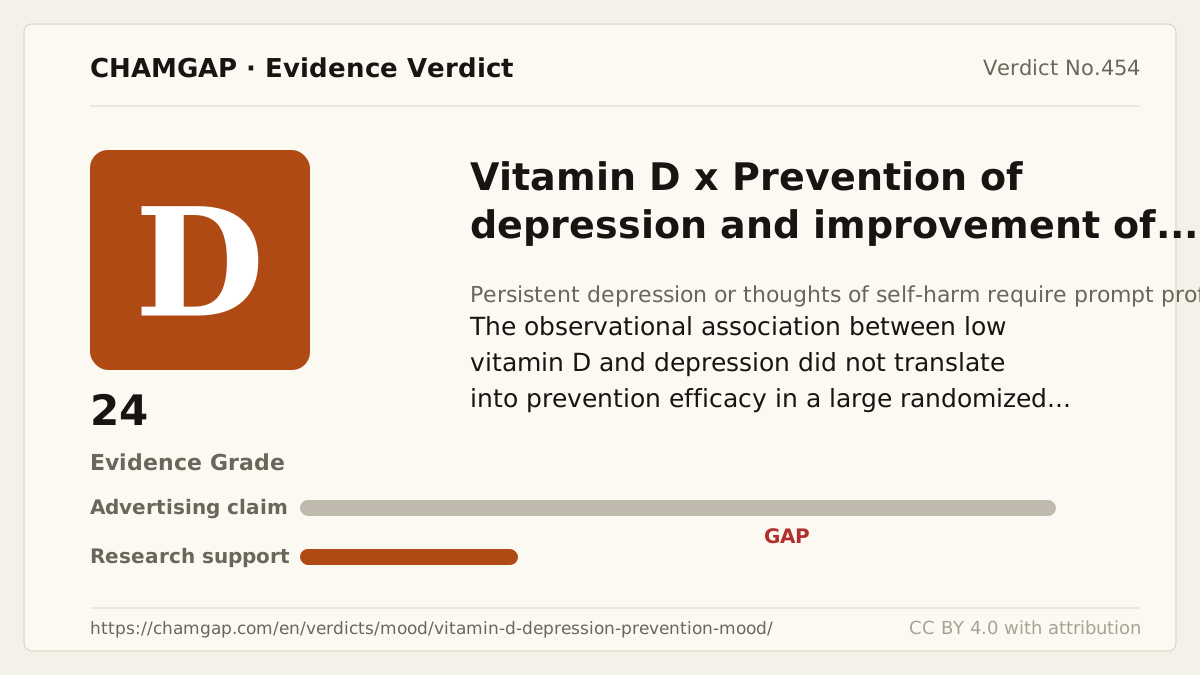
[Chamgap] Vitamin D x depression prevention and mood improvement in generally healthy adults — Evidence Grade D·24. 4 cited sources checked. Source: https://chamgap.com/en/verdicts/mood/vitamin-d-depression-prevention-mood/ · CC BY 4.0CC BY 4.0 — free to use with attribution; do not distort grades, numbers, or verdict meaning.
What this document does and does not do
Chamgap is an information source. It reports what research has and has not confirmed; it does not tell readers what to take or buy. That decision belongs to readers and, when needed, medical or legal professionals. This verdict reflects literature available up to the search date and may change as new research appears. Nothing here is medical advice.