
Tianeptine,
does it really help with Improvement in depressive symptoms, response, and remission in major depressive disorder?
research showsTianeptine is rated B because multiple clinical trials support improvement in symptoms and treatment response in major depressive disorder. Only two of three older double-blind placebo-controlled trials were positive on the MADRS (P=0.007 and P=0.012), while one was nonsignificant. A meta-analysis of five randomized SSRI-comparison trials involving 1,348 patients supports noninferiority to established drugs but does not independently replicate the absolute effect versus placebo. Depression scales, response, and remission are patient-relevant direct clinical outcomes, so B remains possible, but reliance on bundled summaries of 1990s development literature places it at the bottom of B with 61 points. High-dose misuse, dependence, withdrawal, and opioid-like toxicity are separate safety issues.
ads claimPrescription efficacy can be expanded into rapid happiness, safe mood elevation, or an antidepressant without dependence. The evidence applies to prescribed doses under medical supervision for major depressive disorder, not high-dose self-medication for euphoria or energy.
Useful facts when choosing a product
- Tianeptine products such as Stiarone are prescription antidepressants used after clinical diagnosis; self-escalation or unregulated online products do not match trial conditions.
- Antidepressant efficacy means improvement in depression scales, functioning, and response after a therapeutic course, not immediate euphoria or stimulation.
- Frequent high dosing can produce tolerance, dependence, withdrawal, sedation, and respiratory depression through mu-opioid receptor activity, so it should be taken as prescribed and not stopped abruptly.
- Early worsening, suicidal thoughts, a switch to mania, symptoms of liver injury, or urges to misuse the drug require prompt clinical review, and combination with opioids or other sedatives warrants particular caution.
Chamgap Semantic Classification Code
Candidate index · review held
M.tianeptine.UNK.depressive-symptoms-response-and-remission-in-major-depressive-disorder.improve.placeboMedicinal interventions > Tianeptine > Unknown > depressive symptoms, response, and remission in major depressive disorder > Improvement claim > Placebo
An automated migration candidate, not an issued permanent code; exact claim scope remains under review. This machine-generated migration candidate helps retrieval but is not a permanent assignment. The original verdict ID and URL remain authoritative.
What the research actually shows
Lôo and colleagues reported three double-blind placebo-controlled studies as a bundled development-program summary. Tianeptine 37.5 mg daily significantly improved six-week MADRS scores in two trials (P=0.007 and P=0.012), while the third failed to separate from placebo amid a large placebo response. The Kasper and Olié meta-analysis included two fluoxetine comparisons, two paroxetine comparisons, and one sertraline comparison, totaling 1,348 patients, with few differences on depression scales and clinical global ratings. This active-comparator synthesis supports noninferiority to established antidepressants, not independent replication of the absolute effect versus placebo. A maintenance study randomized 185 responders after an open tianeptine lead-in and found fewer relapses than placebo, but its enriched design and old development-era reporting limit weight. Dependence and withdrawal from high-dose mu-opioid receptor activity are distinct from antidepressant efficacy.
Why this is classified as B (61)
Two of three placebo-controlled trials were positive on direct clinical outcomes (P=0.007 and P=0.012), while one was nonsignificant. The five-trial, 1,348-patient SSRI-comparison meta-analysis supports noninferiority to established drugs but does not independently replicate the absolute effect versus placebo. Symptoms, response, and remission permit B, but reliance on bundled 1990s development literature and limited independence and reporting transparency yield the bottom of B with 61 points. Dependence and high-dose misuse remain separate safety concerns.
Counterpoint. At standard prescribed doses with monitoring, tianeptine can be an antidepressant option for appropriately diagnosed major depressive disorder. Lack of response or worsening calls for reassessment, not self-escalation.
Rejudgment record. New verdict — Kept B because symptoms, response, and remission are direct clinical outcomes, but placed it at the bottom of B because only two of three placebo-controlled trials were positive, the 1,348-patient SSRI-comparison meta-analysis does not independently replicate the absolute placebo effect, and reporting relies on bundled 1990s development literature
Sub-claim grades by effect
This ingredient is marketed for several effects. A single overall grade blends strong and weak claims together, so each effect is graded separately here. The overall grade reflects the strongest disconfirming or core claim.
| Effect (sub-claim) | Grade | Basis |
|---|---|---|
| Improvement in depressive symptoms, response, and remission in major depressive disorder | B | Two of three placebo-controlled trials were positive and one was nonsignificant; SSRI comparisons support noninferiority, but the evidence relies on old bundled development literature. |
| Old, small studies with limited independence | ? | This is a methodological limitation that lowers certainty, not a separate efficacy outcome. |
| Risk of high-dose misuse and dependence | ? | This belongs to a separate safety and regulatory assessment rather than the efficacy grade. |
Cross-check — AI research and Codex final gate
Evidence Table
| Study | Design | Sample | Funding | Endpoint | Result | Weight |
|---|---|---|---|---|---|---|
| Lôo H et al. 1997 | Combined report of three double-blind placebo-controlled acute depression trials | 126 participants in study 1; the abstract incompletely reports the total across the other studies | Inadequately reported; older development-program trials | Six-week final MADRS score and depressive symptoms | Tianeptine was significantly superior to placebo in two trials (P=0.007 and P=0.012), while a third showed no significant difference amid a high placebo response. | Direct placebo-controlled efficacy with incomplete consistency |
| Kasper S and Olié JP. 2002/2004 | Meta-analysis of randomized tianeptine-versus-SSRI trials | Five trials and 1,348 participants; 667 received tianeptine and 681 received an SSRI | Limited reporting and independence; older product-development literature | Short-term depression scales, Clinical Global Impression, and response | Tianeptine was noninferior or broadly similar to fluoxetine, paroxetine, and sertraline, but the active comparisons did not independently replicate the absolute effect versus placebo. | Active-comparator synthesis without direct placebo contrast |
| Daléry J and D'Amato T. 1997 | Open lead-in followed by randomized double-blind placebo-controlled maintenance trial in responders | 286 in the open phase; 185 responders randomized | Inadequately reported older product trial | Relapse and recurrence-free maintenance | Relapse was significantly more frequent with placebo, but the enriched design included only open-label responders. | Maintenance support with enriched-design limitations |
Receipt — 4 References
All 4 cited sources were verified for existence at the original page (as of 2026-07-19).
Final verification and publication gate: Codex · Evidence date: 2026-07-19 · Corrections: none
Cite this verdict
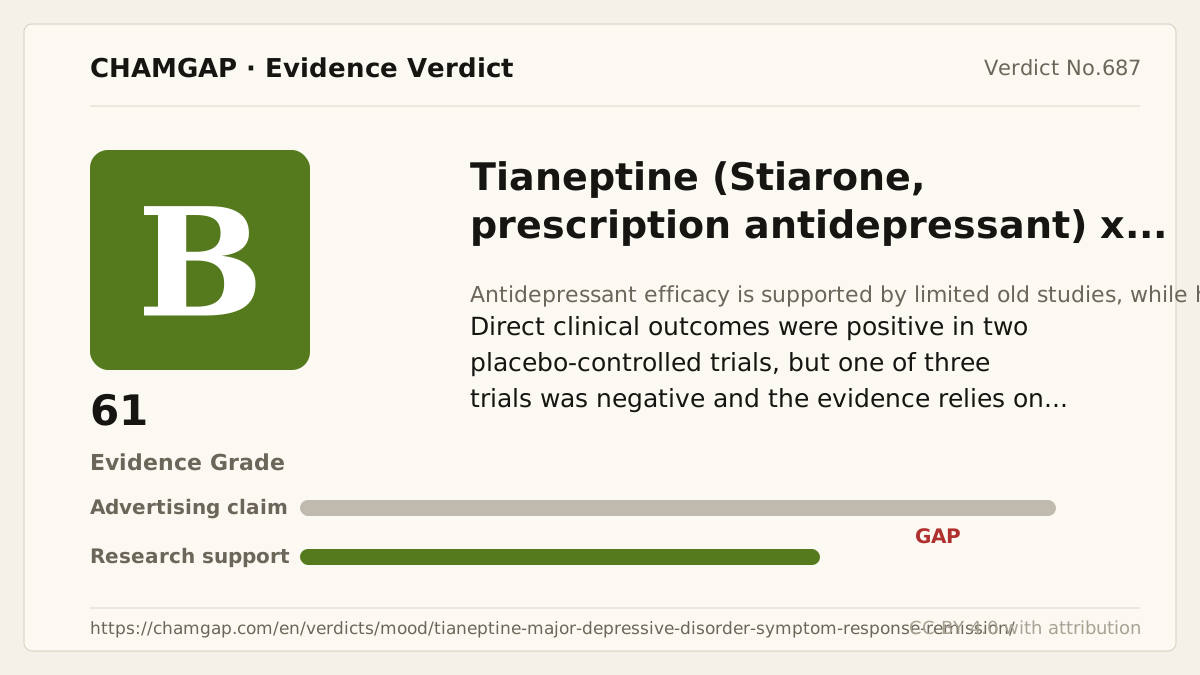
[Chamgap] Tianeptine x depressive symptoms, response, and remission in major depressive disorder — Evidence Grade B·61. 4 cited sources checked. Source: https://chamgap.com/en/verdicts/mood/tianeptine-major-depressive-disorder-symptom-response-remission/ · CC BY 4.0CC BY 4.0 — free to use with attribution; do not distort grades, numbers, or verdict meaning.
What this document does and does not do
Chamgap is an information source. It reports what research has and has not confirmed; it does not tell readers what to take or buy. That decision belongs to readers and, when needed, medical or legal professionals. This verdict reflects literature available up to the search date and may change as new research appears. Nothing here is medical advice.