
Escitalopram,
does it really help with Symptom response and remission in major depressive disorder?
research showsEscitalopram is rated B because repeated randomized-trial evidence shows higher acute symptom response and remission than placebo in adults with major depressive disorder. The 2018 Cipriani network meta-analysis of 522 trials and 116,477 participants found all 21 antidepressants, including escitalopram, more effective than placebo for response, with an escitalopram effect size of SMD -0.29 versus placebo. Certainty for many comparisons was moderate or lower, however, and trials relied heavily on short-term and industry data; an individual-data analysis of 232 FDA-submitted trials likewise found a modest mean drug-specific effect of SMD 0.24 and estimated that about 15% of participants gained a large additional response. Symptom response and remission are direct clinical outcomes, but the limited average effect gives B with 68 points.
ads claimMarketing simplifies serotonin modulation into correction of a chemical imbalance or near-universal remission. Response varies greatly, the mean placebo-adjusted difference is limited, and medication, psychotherapy, lifestyle, and social factors often need joint adjustment.
Useful facts when choosing a product
- Lexapro is prescription escitalopram, an SSRI used for major depressive disorder. A common adult starting dose is 10 mg once daily, but a clinician adjusts it for age, liver function, other medicines, and response.
- It is not an immediate stimulant and benefit can take weeks. Anxiety, insomnia, or nausea can worsen initially, and mania can emerge, so diagnosis and follow-up matter.
- Abrupt stopping can cause dizziness, sensory disturbances, anxiety, insomnia, and other discontinuation symptoms. Tapering should be planned with a clinician.
- Risks include the warning for suicidal thoughts and behavior in younger people, sexual dysfunction, hyponatremia, bleeding, QT prolongation, and serotonin syndrome. New or worsening suicidal thoughts require immediate help.
Chamgap Semantic Classification Code
Candidate index · review held
UNK.escitalopram.UNK.symptom-response-and-remission-in-major-depressive-disorder.treat.placeboUnknown > Escitalopram > Unknown > Symptom response and remission in major depressive disorder > Treatment or remission claim > Placebo
An automated migration candidate, not an issued permanent code; exact claim scope remains under review. This machine-generated migration candidate helps retrieval but is not a permanent assignment. The original verdict ID and URL remain authoritative.
What the research actually shows
Cipriani 2018 combined published and unpublished data from 522 double-blind trials and found all antidepressants more effective than placebo for eight-week response, with escitalopram among drugs with a favorable balance. Risk of bias and uncertainty in direct and indirect comparisons left much evidence at moderate certainty or lower. Stone 2022 analyzed individual data from 232 placebo-controlled FDA-submitted trials and 73,388 participants, finding large average improvement with both drug and placebo and interpreting the small mean drug advantage as an increased chance of a large response for a minority. In the industry-sponsored Rapaport 2004 randomized discontinuation trial, relapse among 274 acute responders was 26% with continued escitalopram versus 40% after switching to placebo.
Why this is classified as B (68)
Acute response and remission in major depressive disorder are direct clinical outcomes supported by a large randomized network, and a responder-enriched relapse-prevention trial is positive. The Cipriani effect size of SMD -0.29 versus placebo and the FDA individual-data mean of SMD 0.24 show that the average drug-specific effect is modest. Evidence is concentrated in short-term and industry data, certainty is often moderate or lower, and individual response varies. This supports B with 68 points rather than A. Discontinuation, suicidality, and sexual adverse effects remain separate safety issues.
Counterpoint. Assessing suicide risk, possible bipolar disorder, prior response, and preferences before treatment and monitoring response and adverse effects every few weeks can identify meaningful individual benefit. If an adequate dose and duration fail, diagnosis, adherence, psychotherapy, switching, and augmentation should be reassessed.
Rejudgment record. New verdict — Accepted placebo-superior acute response and remission in a 522-trial double-blind network meta-analysis and positive randomized-discontinuation relapse prevention, but applied B rather than A because of short-term symptom-scale endpoints, industry-data concentration, moderate-or-lower certainty across comparisons, and the modest average drug-specific effect in FDA individual data
Sub-claim grades by effect
This ingredient is marketed for several effects. A single overall grade blends strong and weak claims together, so each effect is graded separately here. The overall grade reflects the strongest disconfirming or core claim.
| Effect (sub-claim) | Grade | Basis |
|---|---|---|
| Acute symptom response and remission in major depressive disorder | B | Large randomized syntheses support superiority to placebo, but the average effect is modest and certainty and bias limitations remain. |
| Mild depression or general mood enhancement | ? | No direct efficacy literature supports extending major-depression treatment evidence to general mood enhancement. |
| Long-term relapse prevention among responders | B | A randomized placebo-switch trial reduced relapse, but used an enriched-responder and industry-sponsored design. |
Cross-check — AI research and Codex final gate
Evidence Table
| Study | Design | Sample | Funding | Endpoint | Result | Weight |
|---|---|---|---|---|---|---|
| Cipriani A et al. 2018 | Systematic review and network meta-analysis of double-blind randomized trials | 522 trials, 116,477 participants, and 21 antidepressants | United Kingdom NIHR and public-academic support | Approximately eight-week 50% symptom response and all-cause discontinuation | All antidepressants had higher response than placebo and the escitalopram effect size versus placebo was SMD -0.29, but certainty ranged from moderate to very low. | Key large acute-efficacy synthesis |
| Stone MB et al. 2022 | Individual-participant analysis of placebo-controlled randomized trials submitted to FDA | 232 trials and 73,388 participants | Public analysis led by FDA-affiliated investigators | HAMD17-equivalent symptom change and response distributions | Both drug and placebo groups improved substantially; the mean drug-specific effect was modest at SMD 0.24 and was interpreted as an increased chance of a large additional response in about 15%. | Effect-size calibration |
| Rapaport MH et al. 2004 | Responder-enriched randomized double-blind placebo-switch relapse-prevention trial | 274 randomized; 181 escitalopram and 93 placebo | Supported by Forest Laboratories with company authors | Time to relapse and cumulative relapse through 36 weeks | Relapse was 26% with continuation and 40% after placebo switching, with a hazard ratio of 0.56. | Direct longer-term subclaim evidence with enrichment design |
Receipt — 4 References
All 4 cited sources were verified for existence at the original page (as of 2026-07-19).
Final verification and publication gate: Codex · Evidence date: 2026-07-19 · Corrections: none
Cite this verdict
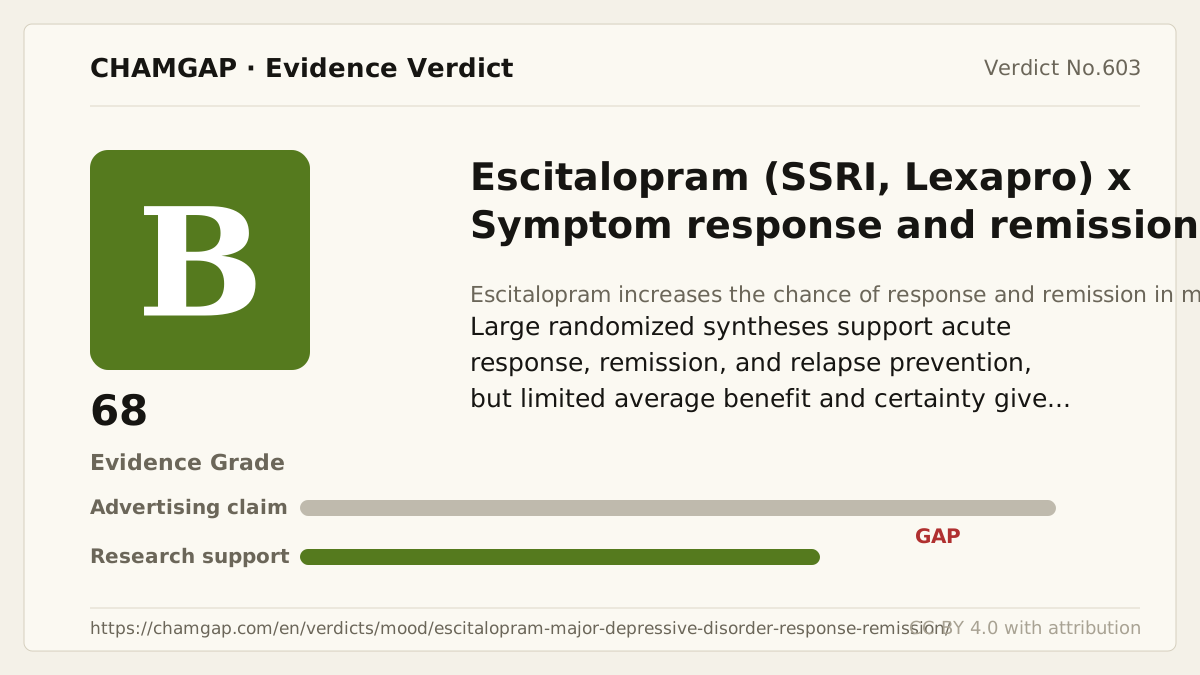
[Chamgap] Escitalopram x symptom response and remission in major depressive disorder — Evidence Grade B·68. 4 cited sources checked. Source: https://chamgap.com/en/verdicts/mood/escitalopram-major-depressive-disorder-response-remission/ · CC BY 4.0CC BY 4.0 — free to use with attribution; do not distort grades, numbers, or verdict meaning.
What this document does and does not do
Chamgap is an information source. It reports what research has and has not confirmed; it does not tell readers what to take or buy. That decision belongs to readers and, when needed, medical or legal professionals. This verdict reflects literature available up to the search date and may change as new research appears. Nothing here is medical advice.