
Lactobacillus helveticus R0052 plus Bifidobacterium longum R0175,
does it really help with Improved stress, anxiety, and mood?
research showsStrain-specific human RCTs of the exact R0052 and R0175 combination exist, and a 55-participant trial found signals in psychological distress, anxiety, and urinary cortisol. However, the evidence is small, short, centered on subjective scales, and linked to the branded manufacturer, while trials in 79 people with low mood and 135 healthy adults were null for overall psychological outcomes, resulting in C.
ads claimMarketing may use category terms such as 'gut-brain axis,' 'psychobiotic,' and 'stress probiotic' to imply the same effect for other Lactobacillus and Bifidobacterium products, or attribute results from combinations containing ashwagandha or other ingredients to R0052 and R0175. The evidence is limited to a specific ratio and dose of the two registered strains.
Useful facts when choosing a product
- South Korean availability is mainly through imported finished probiotics and combination health products; label confirmation of the R0052 and R0175 strain codes determines comparability more than the product name.
- The main human trials used a combined dose of 3×10^9 CFU/day, and the Messaoudi product was a 1.5 g sachet.
- A general Korean probiotic functional standard or total-CFU label does not establish stress or anxiety efficacy or the presence of these two strains.
- Products that also contain ashwagandha, magnesium, or other probiotics differ from the R0052-plus-R0175-only evidence in attribution.
Chamgap Semantic Classification Code
Candidate index · review held
UNK.lactobacillus-helveticus-r0052-plus-bifidobacterium-longum-r0175.UNK.stress-anxiety-and-mood.improve.placeboUnknown > Lactobacillus helveticus R0052 plus Bifidobacterium longum R0175 > Unknown > stress, anxiety, and mood > Improvement claim > Placebo
An automated migration candidate, not an issued permanent code; exact claim scope remains under review. This machine-generated migration candidate helps retrieval but is not a permanent assignment. The original verdict ID and URL remain authoritative.
What the research actually shows
The manufacturer-linked Messaoudi trial gave 55 healthy adults R0052 plus R0175 totaling 3×10^9 CFU/day or placebo for 30 days and reported signals in selected psychological measures and 24-hour urinary free cortisol, but results were not consistently positive across outcomes. Romijn and colleagues gave the same strain combination for eight weeks to 79 people with low mood and found all psychological outcomes and blood biomarkers null. Morales-Torres and colleagues tested 135 healthy adults for four weeks and found no full-sample effect on well-being, anxiety, or emotional regulation, reporting only a post hoc interaction. Thus only the conflicting evidence for this specific strain combination supports C.
Why this is classified as C (52)
The existence of strain-specific placebo-controlled human trials excludes an unknown grade or a preclinical-only D. However, the key positive trial involved 55 participants for 30 days with a proprietary industry-linked product and subjective scales, while the full-sample results of 79- and 135-participant trials were null. The strain-specific stress and anxiety signal is C, low mood and depressive symptoms are D after repeated null results, and the overall grade is C with 52 points. General probiotic safety is separated from efficacy.
Counterpoint. The simultaneous psychological-distress and cortisol signals in the 30-day trial of the exact R0052-plus-R0175 combination are stronger than preclinical evidence alone. Independent, adequately powered replication remains absent.
Rejudgment record. Reassessment (cross-check reflected) — A strain-specific 55-person RCT was positive, but it used a proprietary industry-linked product and subjective outcomes, while overall psychological outcomes were null in 79- and 135-person trials, invoking boundary rules ① and ②-b
Sub-claim grades by effect
This ingredient is marketed for several effects. A single overall grade blends strong and weak claims together, so each effect is graded separately here. The overall grade reflects the strongest disconfirming or core claim.
| Effect (sub-claim) | Grade | Basis |
|---|---|---|
| Stress and anxiety in healthy adults | C | A positive short-term 55-person trial exists, but it was industry-linked and centered on subjective scales, while the full-sample result of a 135-person trial was null. |
| Improvement in low mood and depressive symptoms | D | All psychological outcomes were null in a 79-person low-mood trial, and the healthy-adult trial was also null in the full sample. |
Cross-check — AI research and Codex final gate
Evidence Table
| Study | Design | Sample | Funding | Endpoint | Result | Weight |
|---|---|---|---|---|---|---|
| Messaoudi M et al. 2011 | Thirty-day randomized double-blind placebo-controlled trial | 29 | Proprietary Institut Rosell-Lallemand product; industry-linked | HSCL-90, HADS, PSS, coping scale, and 24-hour urinary free cortisol | The global HSCL-90 score and selected subscales, a coping measure, and urinary cortisol were positive; HADS anxiety was a trend and not all scales were consistently positive. | Key, industry-linked |
| Romijn AR et al. 2017 | Eight-week randomized double-blind placebo-controlled trial | 10 | Lallemand supplied the study product; an investigator disclosed research funding from the company | Depression, anxiety, and stress scales and blood biomarkers | There was no significant difference from placebo on any psychological outcome or blood biomarker. | Key negative |
| Morales-Torres R et al. 2023 | Four-week randomized double-blind placebo-controlled trial | 135 | Chilean public research support; product details as reported in the paper | Well-being, quality of life, anxiety, emotional regulation, and mindfulness | There was no probiotic main effect in the full sample; only an exploratory interaction with healthy-behavior scores was positive. | Key negative with post hoc subgroup signal |
Receipt — 4 References
All 4 cited sources were verified for existence at the original page (as of 2026-07-17).
Final verification and publication gate: Codex · Evidence date: 2026-07-17 · Corrections: none
Cite this verdict
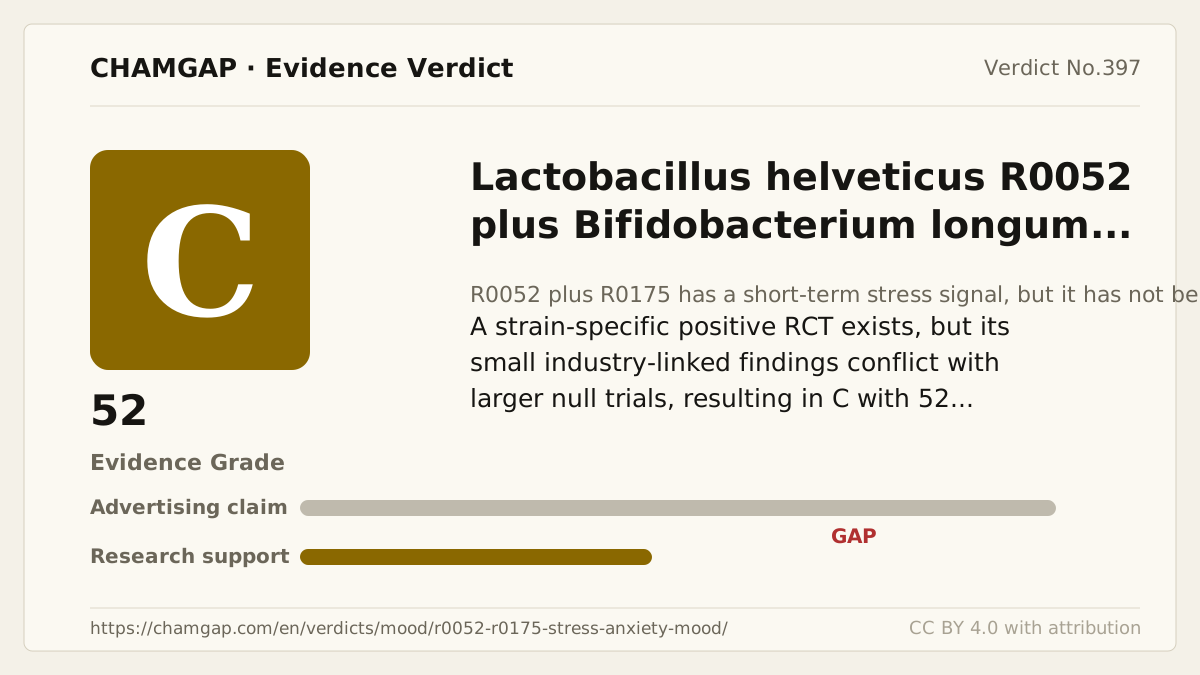
[Chamgap] Lactobacillus helveticus R0052 plus Bifidobacterium longum R0175 x improved stress, anxiety, and mood — Evidence Grade C·52. 4 cited sources checked. Source: https://chamgap.com/en/verdicts/mood/r0052-r0175-stress-anxiety-mood/ · CC BY 4.0CC BY 4.0 — free to use with attribution; do not distort grades, numbers, or verdict meaning.
What this document does and does not do
Chamgap is an information source. It reports what research has and has not confirmed; it does not tell readers what to take or buy. That decision belongs to readers and, when needed, medical or legal professionals. This verdict reflects literature available up to the search date and may change as new research appears. Nothing here is medical advice.