
Ignatia amara 30C,
does it really help with Relief of emotional stress, irritability, and depressed mood?
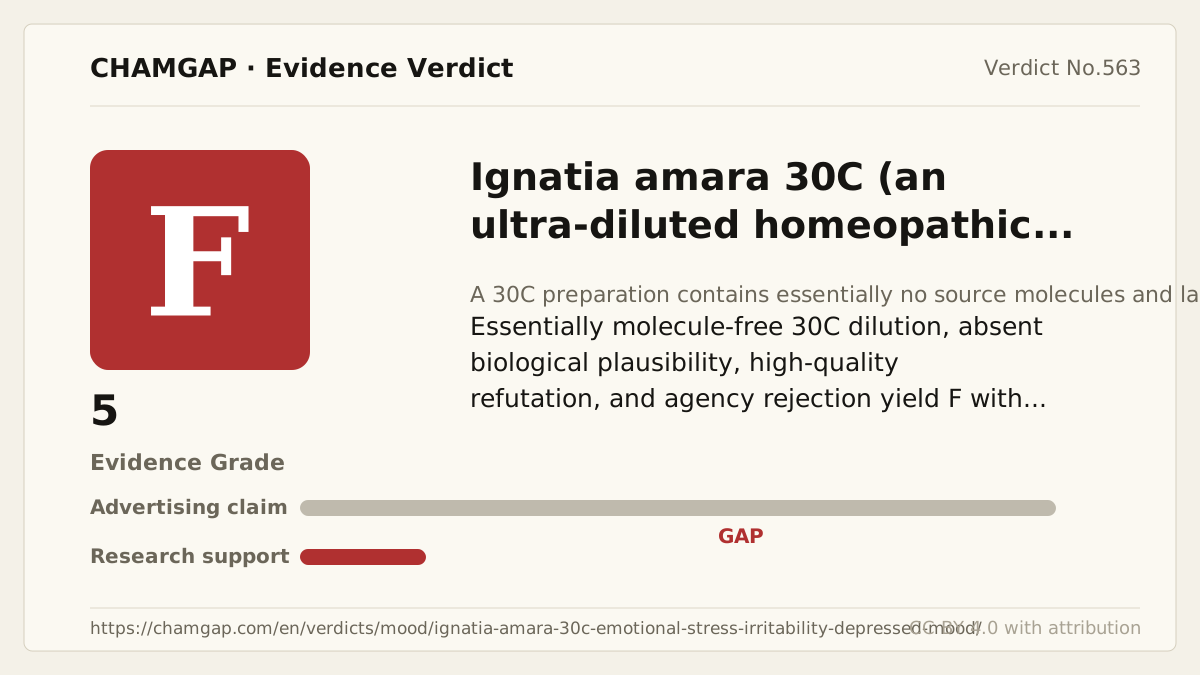
research showsIgnatia amara 30C is rated F. A 30C preparation repeats a 100-fold dilution 30 times, producing a theoretical 10^-60 dilution far beyond the Avogadro limit, so essentially no source molecules remain. NCCIH states that little evidence supports homeopathy for any specific health condition, and the Australian NHMRC assessment found no reliable evidence of effectiveness. A systematic review of psychiatric homeopathy found no efficacy for anxiety or stress; depression evidence was absent at that time, and a later small under-recruited trial found no consistent clinical benefit. No credible direct trial of Ignatia 30C for the claimed mood outcomes was found, meeting the F standard for repeated refutation and agency rejection of efficacy.
ads claimMarketing links broad symptoms such as grief, sighing, and sensitivity to individualized homeopathic theory. Support obtained from a lengthy consultation must be separated from pharmacologic efficacy of a sugar pill, and homeopathy cannot replace effective care for depression or anxiety.
Useful facts when choosing a product
- The 30C label means repeating a 1:100 dilution and shaking process 30 times. Its theoretical dilution is 10^-60, far beyond the Avogadro limit, so essentially no source molecules remain.
- The starting material for Ignatia amara comes from Strychnos ignatii seeds, but a properly manufactured 30C finished product usually consists mainly of sugars or carrier liquid. Lower dilutions or manufacturing errors present a different risk.
- Homeopathic products in the United States are not medicines approved by the FDA for efficacy, and NCCIH states that little evidence supports homeopathy for any specific condition. Sale or pharmacopoeial listing does not prove effectiveness.
- A highly diluted pellet may have low direct toxicity, but contamination, labeling errors, alcohol-containing liquids, and delay of effective counseling, medication, or crisis care can cause harm. Suicidal thoughts or severe depression or anxiety require prompt professional care.
Chamgap Semantic Classification Code
Candidate index · review held
K.ignatia-amara-30c.UNK.emotional-stress-irritability-and-depressed-mood.relieve.placeboFolk and alternative interventions > Ignatia amara 30C > Unknown > emotional stress, irritability, and depressed mood > Symptom-relief claim > Placebo
An automated migration candidate, not an issued permanent code; exact claim scope remains under review. This machine-generated migration candidate helps retrieval but is not a permanent assignment. The original verdict ID and URL remain authoritative.
What the research actually shows
Shang et al. 2005 analyzed 110 placebo-controlled homeopathy trials; the pooled estimate from the eight larger higher-quality studies was OR 0.88 (95% CI 0.65 to 1.19), compatible with no specific effect. Davidson et al. 2011 reviewed 25 placebo-controlled psychiatric homeopathy studies, found no efficacy for anxiety or stress, and identified no placebo-controlled depression study at that time. Adler et al. 2013 later enrolled only 44 of 228 planned participants in an individualized Q-potency depression trial, terminated early, and found no consistent or clinically relevant benefit over placebo. None is positive evidence for Ignatia 30C, and no credible direct randomized trial of this product and dilution was identified.
Why this is classified as F (5)
The problem is not merely an absence of a direct Ignatia 30C trial: 30C lacks material plausibility, and higher-quality homeopathy comparisons and public-agency assessments repeatedly reject a specific effect. This meets the F standard rather than an unknown grade and yields 5 points. Direct product toxicity and delay of effective care are separated under safety.
Counterpoint. Emotional support or a long consultation can help, but that benefit does not demonstrate pharmacologic activity of a 30C pellet. Sleep, exercise, social support, and evidence-based psychotherapy should be prioritized, and persistent depressed mood deserves assessment.
Rejudgment record. New verdict — Applied the F standard to absent plausibility at 30C, high-quality placebo-controlled refutation, public-agency rejection of efficacy, and no direct product evidence
Sub-claim grades by effect
This ingredient is marketed for several effects. A single overall grade blends strong and weak claims together, so each effect is graded separately here. The overall grade reflects the strongest disconfirming or core claim.
| Effect (sub-claim) | Grade | Basis |
|---|---|---|
| Relief of emotional stress, irritability, and mood symptoms | F | A 30C preparation lacks plausibility, psychiatric homeopathy review found no anxiety or stress efficacy, and no direct product trial exists. |
| Clinical improvement in anxiety or depression | F | Higher-quality homeopathy evidence is indistinguishable from placebo, and the small depression trial found no consistent clinical benefit. |
Cross-check — AI research and Codex final gate
Evidence Table
| Study | Design | Sample | Funding | Endpoint | Result | Weight |
|---|---|---|---|---|---|---|
| Shang A et al. 2005 | Comparative meta-analysis of placebo-controlled homeopathy and conventional-medicine trials | 110 homeopathy and 110 conventional-medicine trials | Swiss National Science Foundation and public academic support | Specific effects in larger higher-quality trials less prone to bias | Eight larger higher-quality homeopathy trials produced OR 0.88 (95% CI 0.65 to 1.19), not supporting a specific effect. | Key repeated-refutation evidence |
| Davidson JRT et al. 2011 | Systematic review of randomized placebo-controlled psychiatric homeopathy trials | 25 eligible trials | Samueli Institute and academic research; homeopathy-research interests among authors | Psychiatric symptoms including anxiety, stress, and depression | No efficacy was found for anxiety or stress, and no placebo-controlled depression study was identified at that time. | Direct review of the claim domain |
| Adler UC et al. 2013 | Partially double-blind randomized four-arm placebo-controlled depression trial | 44 of 228 planned participants; terminated early | German public and academic support involving complementary-medicine researchers | Six-week Hamilton depression score and clinical outcomes | No consistent or clinically relevant benefit of homeopathic Q-potencies over placebo was found. | Direct null depression evidence, not specific to Ignatia |
| NCCIH homeopathy evidence summary | Evidence and safety assessment by a United States NIH agency | Incorporates the NHMRC assessment of 57 reviews and 176 studies | United States federal public agency | Effectiveness and safety of homeopathy for specific health conditions | Concluded that little evidence supports effectiveness for any specific condition and that many products contain no source molecules. | Public-agency rejection of efficacy |
Receipt — 4 References
All 4 cited sources were verified for existence at the original page (as of 2026-07-18).
Final verification and publication gate: Codex · Evidence date: 2026-07-18 · Corrections: none
Cite this verdict
[Chamgap] Ignatia amara 30C x relief of emotional stress, irritability, and depressed mood — Evidence Grade F·5. 4 cited sources checked. Source: https://chamgap.com/en/verdicts/mood/ignatia-amara-30c-emotional-stress-irritability-depressed-mood/ · CC BY 4.0CC BY 4.0 — free to use with attribution; do not distort grades, numbers, or verdict meaning.
What this document does and does not do
Chamgap is an information source. It reports what research has and has not confirmed; it does not tell readers what to take or buy. That decision belongs to readers and, when needed, medical or legal professionals. This verdict reflects literature available up to the search date and may change as new research appears. Nothing here is medical advice.