
High-EPA omega-3 fatty acids,
does it really help with Reduction of depressive symptoms and adjunctive use with antidepressants?
research showsWhen trials in diagnosed depression, particularly adjunctive trials, are pooled, formulations containing at least 60% EPA or pure EPA repeatedly show a small to moderate efficacy signal. Certainty across the broader omega-3 literature is very low, heterogeneity and publication bias are substantial, and a large long-term trial did not support depression prevention or general mood improvement in people without depression.
ads claimClaims that more EPA works like an antidepressant, improves everyone's mood, or replaces medication exceed the evidence. The supported axis is adjunctive use under clinical supervision in diagnosed depression; wellness and prevention marketing for healthy adults is separate.
Useful facts when choosing a product
- Daily EPA plus DHA amounts and EPA:DHA ratios vary widely across products sold in South Korea.
- Research and expert guidance often discuss formulations in which EPA is at least 60% of EPA plus DHA or the EPA:DHA ratio exceeds 2:1, with roughly 1 to 2 g of net EPA per day.
- Fish-oil weight, total omega-3 weight, and EPA weight are different quantities, so the EPA milligrams on the label matter.
Chamgap Semantic Classification Code
Candidate index · review held
UNK.high-epa-omega-3-fatty-acids.UNK.depressive-symptoms-and-adjunctive-use-with-antidepressants.reduce.placeboUnknown > High-EPA omega-3 fatty acids > Unknown > depressive symptoms and adjunctive use with antidepressants > Reduction claim > Placebo
An automated migration candidate, not an issued permanent code; exact claim scope remains under review. This machine-generated migration candidate helps retrieval but is not a permanent assignment. The original verdict ID and URL remain authoritative.
What the research actually shows
A 2019 meta-analysis of 26 studies and 2,160 participants found significant signals for pure EPA and formulations containing at least 60% EPA. A 2016 analysis of 13 major-depression studies with 1,233 participants found larger effects with antidepressant use and higher EPA dose, but heterogeneity was substantial. The 2021 Cochrane review of 35 studies emphasized very low certainty and an average effect that may not be clinically important.
Why this is classified as B (63)
Independent meta-analyses and multiple randomized trials support B for adjunctive clinical depression, while low certainty, heterogeneity, formulation-dependent subgroups, and debate over clinical magnitude keep the score near the bottom of B.
Counterpoint. The large VITAL-DEP trial was null for prevention and mood in older adults without depression, but it used a formulation below 60% EPA and therefore does not directly refute high-EPA adjunctive treatment in clinical depression. It does refute broad general-mood extrapolation.
Rejudgment record. New verdict — The assessment separated adjunctive treatment in diagnosed depression from general mood in healthy adults and evaluated EPA proportion, net dose, co-treatment, overall versus subgroup effects, and clinical importance.
Sub-claim grades by effect
This ingredient is marketed for several effects. A single overall grade blends strong and weak claims together, so each effect is graded separately here. The overall grade reflects the strongest disconfirming or core claim.
| Effect (sub-claim) | Grade | Basis |
|---|---|---|
| High-EPA formulations as adjuncts to antidepressants in diagnosed clinical depression | B | Randomized-trial meta-analyses repeatedly find a signal for formulations containing at least 60% EPA or predominantly EPA, but certainty and clinical magnitude remain limited. |
| General mood improvement or depression prevention in healthy adults | D | A long-term randomized trial in 18,353 adults without depression found no improvement in depression risk or mood scores, and clinical high-EPA findings cannot be generalized to healthy adults. |
Cross-check — AI research and Codex final gate
Evidence Table
| Study | Design | Sample | Funding | Endpoint | Result | Weight |
|---|---|---|---|---|---|---|
| Study 1 | Meta-analysis of 26 randomized trials | 2160 | Academic funding; funding and bias varied among included trials | Standardized mean difference in depressive-symptom scales | The analysis reported an overall SMD of -0.28, -0.50 for pure EPA, and -1.03 in the subgroup containing at least 60% EPA, with heterogeneity and possible publication bias. | Moderate to high |
| Study 2 | Meta-analysis and meta-regression of 13 randomized trials in major depressive disorder | 1233 | Academic research support; quality and funding varied across original trials | Change in depressive symptoms and moderation by EPA dose and antidepressant co-treatment | A small to moderate effect remained after bias adjustment, with larger effects at higher EPA doses and during antidepressant use, but heterogeneity was high at about 73%. | Moderate to high |
| Study 3 | Systematic review of randomized trials in adults with depression | 1924 | Cochrane systematic review; many original studies had risk-of-bias concerns | Depressive symptoms, response, remission, and adverse events | The average SMD was -0.40, corresponding to about 2.5 HDRS points, below a commonly used three-point minimum important difference; certainty was very low and response or remission benefits were unclear. | High |
| Study 4 | Multicenter, double-blind, placebo-controlled randomized trial lasting eight weeks | 432 | Public and foundation support with product provision; investigator conflicts were reported | IDS-SR and MADRS depressive symptoms | A formulation containing 1,050 mg EPA and 150 mg DHA did not reach significance in the overall primary analysis, with a signal confined to a prespecified subgroup without anxiety disorders. | High |
| Study 5 | Double-blind, placebo-controlled long-term randomized trial with a median 5.3-year follow-up | 18,353 | Public support including the US National Institutes of Health; products were donated | Incident depression or clinically relevant depressive symptoms and mood scores | Depression risk was not reduced and mood scores did not improve. The formulation contained 465 mg EPA and 375 mg DHA and did not meet the 60% EPA threshold. | High |
Receipt — 7 References
All 7 cited sources were verified for existence at the original page (as of 2026-07-17).
Final verification and publication gate: Codex · Evidence date: 2026-07-17 · Corrections: none
Cite this verdict
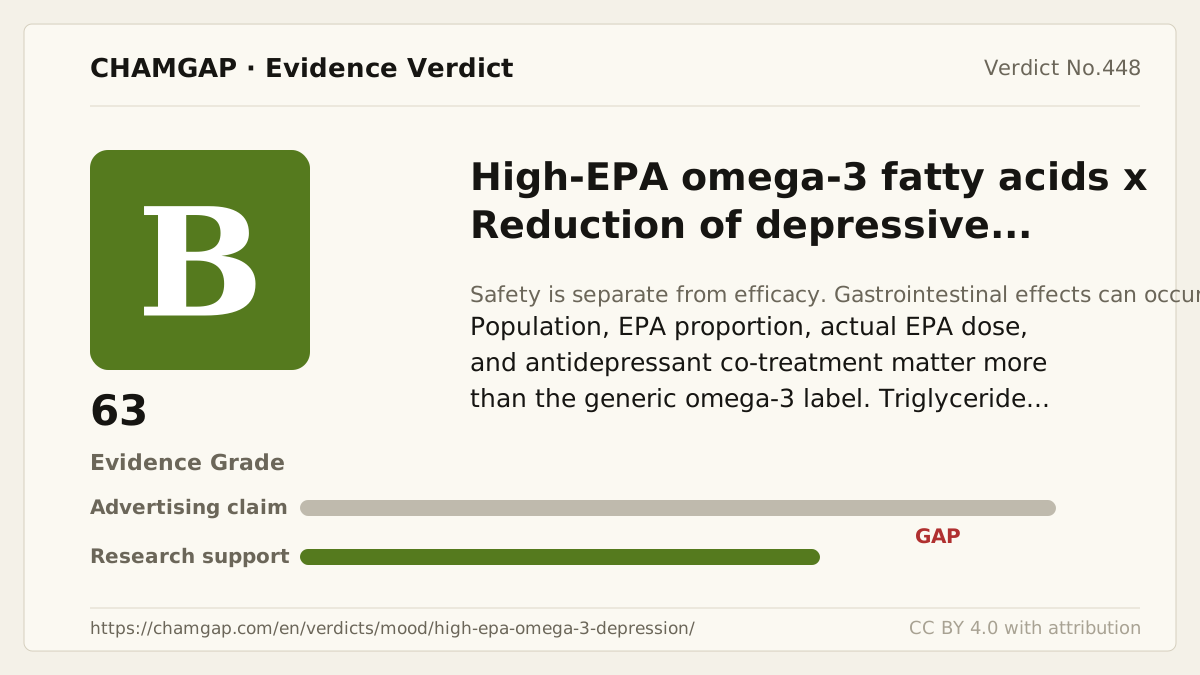
[Chamgap] High-EPA omega-3 for depression: a signal in adjunctive clinical depression, not general mood enhancement — Evidence Grade B·63. 7 cited sources checked. Source: https://chamgap.com/en/verdicts/mood/high-epa-omega-3-depression/ · CC BY 4.0CC BY 4.0 — free to use with attribution; do not distort grades, numbers, or verdict meaning.
What this document does and does not do
Chamgap is an information source. It reports what research has and has not confirmed; it does not tell readers what to take or buy. That decision belongs to readers and, when needed, medical or legal professionals. This verdict reflects literature available up to the search date and may change as new research appears. Nothing here is medical advice.