
Esketamine nasal spray,
does it really help with Rapid improvement of treatment-resistant depression?
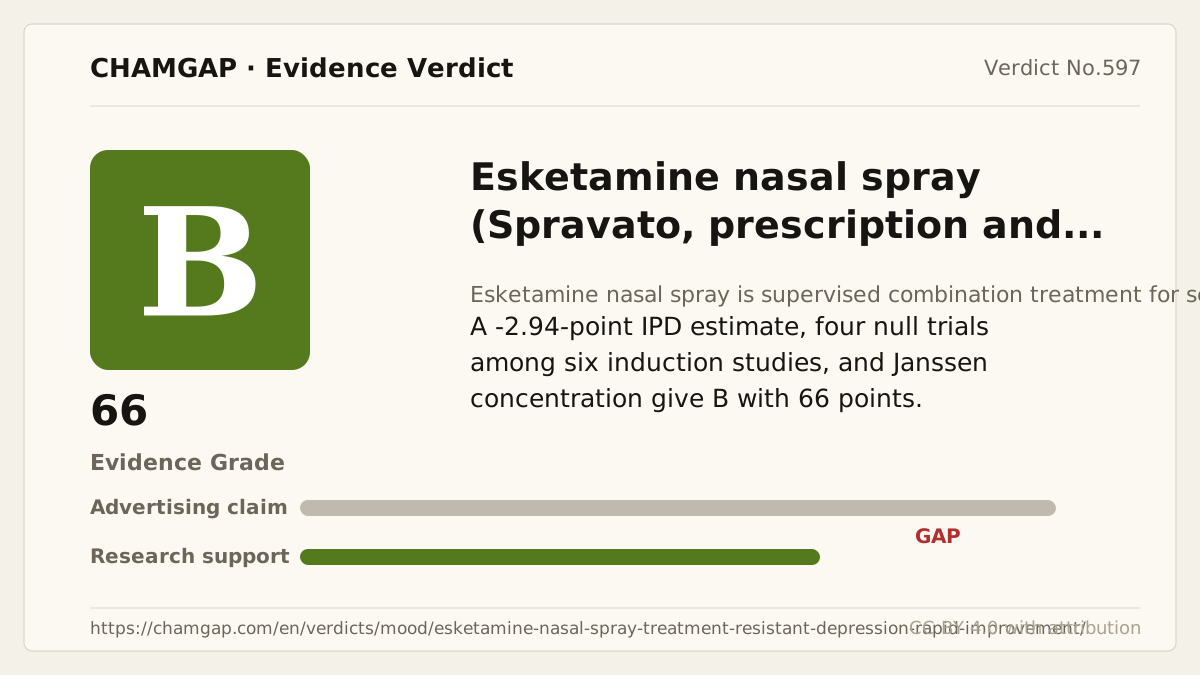
research showsSupervised esketamine nasal spray is rated B for adjunctive induction in treatment-resistant depression. An independent individual-participant-data meta-analysis of seven trials and 1,505 participants found a modest MADRS difference of -2.94 points. Four of six induction trials, including two pivotal trials, were null. Relapse reduction comes from an enriched randomized-withdrawal design selecting responders, and the 2025 monotherapy evidence is one Janssen trial. Multiple trials do not by themselves establish independence, giving 66 points.
ads claimPhrases such as curing depression in hours, resetting mood, or a nasal-spray mood booster convert selected, repeated, supervised combination treatment for TRD into general self-use. Early score separation does not mean immediate remission for every patient or proven suicide prevention.
Useful facts when choosing a product
- Spravato is prescription esketamine rather than an ordinary nasal spray; it is administered by the patient under a healthcare provider's supervision at a certified clinical site and followed by observation until clinically stable.
- The pivotal TRD formulation and regimen use repeated intranasal doses, generally with a concurrent oral antidepressant. Intravenous ketamine, oral or compounded ketamine, and supplements are not equivalent.
- United States prescribing information requires a REMS and at least two hours of monitoring because of sedation, dissociation, respiratory depression, and abuse or misuse risk, with blood pressure checked before and after dosing.
- Patients must not drive on the treatment day and should avoid driving or operating machinery until the next day after a restful sleep. A mental-health specialist must reassess benefit and the need to continue.
Chamgap Semantic Classification Code
Candidate index · review held
M.esketamine-nasal-spray.intranasal.rapid-improvement-of-treatment-resistant-depression.improve.MULTIMedicinal interventions > Esketamine nasal spray > Intranasal > Rapid improvement of treatment-resistant depression > Improvement claim > Multiple: primary unresolved
An automated migration candidate, not an issued permanent code; exact claim scope remains under review. This machine-generated migration candidate helps retrieval but is not a permanent assignment. The original verdict ID and URL remain authoritative.
What the research actually shows
An independent individual-participant-data meta-analysis of seven adjunctive induction trials and 1,505 participants estimated a modest MADRS difference of -2.94 points. Four of six induction trials were null, including two pivotal studies. SUSTAIN-1 selected patients who had already achieved stable response or remission before randomized withdrawal, and long-term pooled evidence depends mainly on that source. Positive 2025 monotherapy evidence is also a single Janssen trial. All pivotal dosing involved supervised clinical administration and repeated observation.
Why this is classified as B (66)
The independent IPD estimate across seven trials and 1,505 participants was a modest -2.94 MADRS points, while four of six induction studies, including two pivotal trials, were null. Relapse evidence uses responder enrichment, and the 2025 monotherapy result is one Janssen trial, so multiple trials do not establish independent confirmation. The verdict is B with 66 points; dissociation, blood-pressure, and abuse risks remain separate safety issues.
Counterpoint. A mental-health specialist may consider esketamine after adequate standard treatments have failed in properly diagnosed TRD. There is no evidence for unsupervised self-use for ordinary low mood, fatigue, or energy.
Rejudgment record. New verdict — Accepted a -2.94-point MADRS estimate from an independent seven-trial, 1,505-participant IPD synthesis and direct clinical benefit while accounting for four null induction trials among six, two null pivotal trials, responder-enriched relapse evidence, and a single Janssen 2025 monotherapy trial
Sub-claim grades by effect
This ingredient is marketed for several effects. A single overall grade blends strong and weak claims together, so each effect is graded separately here. The overall grade reflects the strongest disconfirming or core claim.
| Effect (sub-claim) | Grade | Basis |
|---|---|---|
| Adjunctive treatment of treatment-resistant depression under supervision | B | Randomized combination trials support symptoms, remission, and relapse prevention, but results are mixed and sponsor-concentrated. |
| Mood or energy booster for the general public | ? | No efficacy trial exists for people outside diagnosed depression, treatment-resistance selection, and supervised administration. |
| Rapid symptom improvement | B | Separation by day 2 and a positive four-week trial exist, but two short-term phase 3 primary endpoints were null. |
| Reduced relapse during maintenance treatment | B | Randomized withdrawal and active-comparator long-term data support benefit, with responder enrichment and combination-treatment conditions. |
Cross-check — AI research and Codex final gate
Evidence Table
| Study | Design | Sample | Funding | Endpoint | Result | Weight |
|---|---|---|---|---|---|---|
| TRANSFORM-2, Popova V et al. 2019 | Phase 3 randomized double-blind placebo-spray and active-treatment-controlled trial | 223 adults with TRD | Janssen Research & Development | Change in MADRS at day 28 and early time points | Esketamine plus a new antidepressant lowered day-28 MADRS by 4.0 points more than control, with early separation observed at day 2. | Key positive short-term randomized trial |
| TRANSFORM-1 and TRANSFORM-3, Fedgchin 2019; Ochs-Ross 2020 | Phase 3 randomized double-blind trials | 346 adults and 138 adults aged 65 years or older | Janssen Research & Development | Primary endpoint of change in MADRS at day 28 | The prespecified primary endpoints were not statistically significant for the 84-mg arm of TRANSFORM-1 or for TRANSFORM-3. | Key null evidence limiting consistency |
| SUSTAIN-1, Daly EJ et al. 2019 | Randomized double-blind withdrawal relapse-prevention trial | 176 patients in stable remission and 121 in stable response randomized | Janssen Research & Development | Time to relapse of depression | Relapse risk was lower with continued esketamine than after switching to placebo spray. | Direct maintenance evidence with responder-enriched design |
| ESCAPE-TRD, Reif A et al. 2023 | Randomized open-label rater-masked active-controlled phase 3b trial | 676 adults with TRD | Janssen EMEA | MADRS remission at week 8 and relapse-free remission through week 32 | Eight-week remission was higher with esketamine than quetiapine XR, 27.1% versus 17.6%, with favorable longer-term results. | Large active-comparator direct evidence with open treatment |
| Wang Z et al. 2025 | Meta-analysis of randomized trials of intranasal esketamine | Short- and long-term randomized trials in MDD and TRD | Academic research; no industry funding reported in the abstract | MADRS at days 2 and 28 and long-term relapse | Long-term relapse was lower with RR 0.60 (95% CI 0.45 to 0.80), but long-term evidence depended on a limited source-trial base. | Independent synthesis with source-trial concentration retained |
Receipt — 7 References
All 7 cited sources were verified for existence at the original page (as of 2026-07-19).
Final verification and publication gate: Codex · Evidence date: 2026-07-19 · Corrections: none
Cite this verdict
[Chamgap] Esketamine nasal spray x rapid improvement of treatment-resistant depression — Evidence Grade B·66. 7 cited sources checked. Source: https://chamgap.com/en/verdicts/mood/esketamine-nasal-spray-treatment-resistant-depression-rapid-improvement/ · CC BY 4.0CC BY 4.0 — free to use with attribution; do not distort grades, numbers, or verdict meaning.
What this document does and does not do
Chamgap is an information source. It reports what research has and has not confirmed; it does not tell readers what to take or buy. That decision belongs to readers and, when needed, medical or legal professionals. This verdict reflects literature available up to the search date and may change as new research appears. Nothing here is medical advice.