
Buspirone,
does it really help with Relief of persistent anxiety and tension in generalized anxiety disorder?
research showsBuspirone is rated B because randomized evidence supports reductions in persistent anxiety and tension versus placebo in generalized anxiety disorder. A 2006 Cochrane review of 36 azapirone trials with 5,908 participants and a 2023 meta-analysis of 22 generalized-anxiety comparisons with 2,567 participants favored treatment over placebo. Most studies were older four-to-nine-week symptom-scale trials, pooled related drugs, and did not establish immediate sedation or efficacy for acute panic attacks. B-level efficacy and safety concerns such as dizziness, nausea, and interactions are separate judgments.
ads claimCalling buspirone an immediate calming pill or a general stress reliever exceeds the evidence. The supported scope is persistent anxiety in diagnosed generalized anxiety disorder after regular use over several weeks.
Useful facts when choosing a product
- Buspirone is a prescription 5-HT1A partial agonist used for anxiety disorders including generalized anxiety disorder. Unlike a benzodiazepine, it is not intended for immediate sedation or withdrawal treatment.
- Treatment usually starts low and is divided across daily doses. It should be taken consistently either always with food or always without food, and the dose should not be changed without guidance.
- Dizziness, nausea, headache, nervousness, and drowsiness can occur, and monoamine oxidase inhibitors should not be combined with it. Other serotonergic medicines, strong CYP3A4 inhibitors or inducers, and grapefruit should be disclosed.
- Buspirone does not prevent benzodiazepine dependence or withdrawal and should not replace an established sedative during abrupt discontinuation. Pregnancy, breastfeeding, and liver or kidney disease require individualized review.
Chamgap Semantic Classification Code
Candidate index · review held
M.buspirone.UNK.persistent-anxiety-and-tension-in-generalized-anxiety-disorder.relieve.placeboMedicinal interventions > Buspirone > Unknown > persistent anxiety and tension in generalized anxiety disorder > Symptom-relief claim > Placebo
An automated migration candidate, not an issued permanent code; exact claim scope remains under review. This machine-generated migration candidate helps retrieval but is not a permanent assignment. The original verdict ID and URL remain authoritative.
What the research actually shows
Chessick 2006 synthesized 36 azapirone trials with 5,908 participants and favored treatment over placebo, while studies generally lasted four to nine weeks. Rossano 2023 reported a Hamilton Anxiety mean difference of -4.91 and response risk ratio of 1.64 across 22 comparisons and 2,567 participants, but analyzed the drug class. Imai 2014 could not establish efficacy from small buspirone panic-disorder trials.
Why this is classified as B (65)
Trials and two syntheses consistently signal symptom relief in generalized anxiety disorder. Older four-to-nine-week symptom scales, class pooling, and absent strong long-term functional or immediate effects give B with 65 points; adverse effects and interactions remain separate safety issues.
Counterpoint. Regular treatment over several weeks can be useful in diagnosed generalized anxiety disorder, but absent response or worsening calls for reassessment.
Rejudgment record. New verdict — Accepted superiority to placebo in generalized anxiety disorder from the Cochrane and 2023 meta-analyses, but assigned B for older four-to-nine-week symptom scales, pooling of the azapirone class, limited long-term functional outcomes, and uncertain panic-disorder efficacy
Sub-claim grades by effect
This ingredient is marketed for several effects. A single overall grade blends strong and weak claims together, so each effect is graded separately here. The overall grade reflects the strongest disconfirming or core claim.
| Effect (sub-claim) | Grade | Basis |
|---|---|---|
| Relief of persistent anxiety and tension in generalized anxiety disorder | B | Randomized syntheses are positive, but old short-term symptom scales and class analyses limit certainty. |
| Acute anxiety attacks or immediate sedation | ? | No direct efficacy literature establishes an immediate effect. |
| Relief of ordinary stress in people without an anxiety disorder | ? | No direct trial extends generalized-anxiety results to ordinary stress. |
Cross-check — AI research and Codex final gate
Evidence Table
| Study | Design | Sample | Funding | Endpoint | Result | Weight |
|---|---|---|---|---|---|---|
| Chessick CA et al. 2006 Cochrane review | Systematic review and meta-analysis of azapirone randomized trials in generalized anxiety disorder | 36 trials and 5,908 participants | Academic Cochrane review; sponsorship varied across included trials | Anxiety scales, Clinical Global Impression response, and discontinuation | Treatment outperformed placebo with a Clinical Global Impression NNT of 4.4, but trials generally lasted four to nine weeks. | Key synthesis with class and duration limitations |
| Rossano F et al. 2023 | Systematic review and meta-analysis of azapirone randomized trials in anxiety disorders | 22 generalized-anxiety comparisons and 2,567 participants | No specific study funding reported | Hamilton Anxiety score, response, discontinuation, and adverse events | The Hamilton Anxiety mean difference was -4.91 and response risk ratio was 1.64 versus placebo. | Updated replicating synthesis |
| Imai H et al. 2014 Cochrane review | Systematic review of azapirone randomized trials in adult panic disorder | Three buspirone trials with up to 170 participants | Academic Cochrane review | Panic symptoms, general anxiety, and discontinuation | Efficacy estimates were uncertain. | Limits extrapolation across indications |
Receipt — 4 References
All 4 cited sources were verified for existence at the original page (as of 2026-07-19).
Final verification and publication gate: Codex · Evidence date: 2026-07-19 · Corrections: none
Cite this verdict
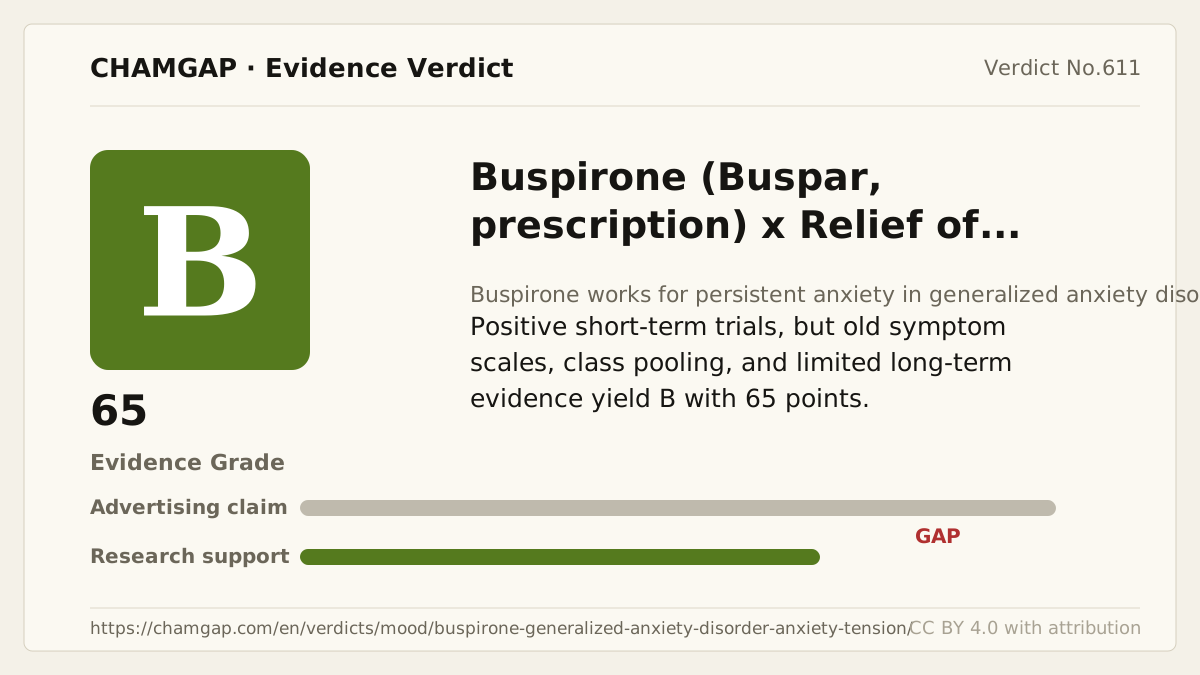
[Chamgap] Buspirone x relief of persistent anxiety and tension in generalized anxiety disorder — Evidence Grade B·65. 4 cited sources checked. Source: https://chamgap.com/en/verdicts/mood/buspirone-generalized-anxiety-disorder-anxiety-tension/ · CC BY 4.0CC BY 4.0 — free to use with attribution; do not distort grades, numbers, or verdict meaning.
What this document does and does not do
Chamgap is an information source. It reports what research has and has not confirmed; it does not tell readers what to take or buy. That decision belongs to readers and, when needed, medical or legal professionals. This verdict reflects literature available up to the search date and may change as new research appears. Nothing here is medical advice.