
Bifidobacterium longum 1714,
does it really help with Reduction of stress and anxiety responses and cortisol?
research showsB. longum 1714 is rated C because small human studies changed acute-stress cortisol, anxiety, and some brain-imaging signals. The initial crossover study included only 22 healthy adults and always administered placebo first, leaving sequence effects unresolved. A 40-person parallel randomized trial found magnetoencephalographic and vitality signals but no clear benefit on the key subjective response to social stress, and the strain-owning company supplied products or participated in the studies. Cortisol and brain imaging are surrogates, and B6 or B12 in finished Zenflore products prevents attribution to the strain alone. These limits yield C with 42 points.
ads claimMarketing can turn acute laboratory cortisol and brain signals into normalized stress hormones, anxiety treatment, and guaranteed focus. When Zenflore also contains vitamins B6 and B12, assigning any finished-product effect to strain 1714 alone is an attribution error.
Useful facts when choosing a product
- B. longum 1714 is a strain-specific probiotic, and findings from other B. longum strains cannot be transferred automatically.
- Depending on the market, Zenflore may combine strain 1714 with vitamins including B6 and B12, so the exact label should be checked.
- Reported adverse events in healthy adults have generally been mild, but most trials are small and short, leaving limited evidence for rare harms.
- People with severe immunocompromise, central venous catheters, or critical illness should consult a clinician before using probiotics, and the product should not replace treatment for anxiety or depression.
Chamgap Semantic Classification Code
Candidate index · review held
S.bifidobacterium-longum-1714.UNK.stress-and-anxiety-responses-and-cortisol.reduce.placeboSupplements and nutraceuticals > Bifidobacterium longum 1714 > Unknown > stress and anxiety responses and cortisol > Reduction claim > Placebo
An automated migration candidate, not an issued permanent code; exact claim scope remains under review. This machine-generated migration candidate helps retrieval but is not a permanent assignment. The original verdict ID and URL remain authoritative.
What the research actually shows
Allen and colleagues gave 22 healthy adults four weeks of placebo followed by four weeks of B. longum 1714 and used a socially evaluated cold-pressor test. Cortisol output, state-anxiety increase, and daily stress fell, but the within-person sequence was fixed. Wang and colleagues randomized 40 healthy adults to the strain or placebo for four weeks; resting and social-exclusion magnetoencephalographic oscillations and some vitality measures changed, while subjective social-stress outcomes were not clearly improved. Seamans and colleagues randomized 168 adults with mild to moderate depression for eight weeks and found no significant difference on the primary BDI-II outcome, with only selected secondary benefits at four weeks. This literature does not establish treatment of an anxiety disorder or sustained reduction in everyday cortisol.
Why this is classified as C (42)
Positive acute cortisol, anxiety, and imaging signals are offset by design limitations in samples of 22 and 40 and inconsistent subjective stress effects. In the 168-person follow-up, primary BDI-II differences were null at four weeks, −0.30 (P=.718), and eight weeks, −1.43 (P=.132), while vitamins B6 and B12 prevent clean attribution to the strain. Because depression is not fully identical to the stress claim, the result remains at the bottom of C with 42 points rather than falling to D.
Counterpoint. A small short-term change in perceived stress, sleep, or vitality may occur in some healthy adults. Persistent anxiety or depression calls for validated psychotherapy, medication when indicated, and professional assessment rather than probiotic substitution.
Rejudgment record. New verdict — Accepted small-study signals for acute cortisol, anxiety, and brain activity, while applying the surrogate and manufacturer ceilings for fixed sequence, inconsistent subjective stress outcomes, a null larger-trial primary outcome, corporate links, and vitamin complexity in finished products
Sub-claim grades by effect
This ingredient is marketed for several effects. A single overall grade blends strong and weak claims together, so each effect is graded separately here. The overall grade reflects the strongest disconfirming or core claim.
| Effect (sub-claim) | Grade | Basis |
|---|---|---|
| Improvement in subjective stress and anxiety responses | C | A small initial study was positive, but design limitations and inconsistent later subjective outcomes remain. |
| Reduction or modulation of cortisol and brain-imaging signals | ? | Some positive signals exist, but they are surrogate measures not established to translate into sustained clinical improvement. |
| Attribution of a finished Zenflore product effect to strain 1714 alone | ? | When vitamins such as B6 and B12 are co-formulated, a finished-product effect cannot be attributed to the strain alone. |
Cross-check — AI research and Codex final gate
Evidence Table
| Study | Design | Sample | Funding | Endpoint | Result | Weight |
|---|---|---|---|---|---|---|
| Allen AP et al. 2016 | Within-participant controlled study with fixed placebo-then-strain sequence | 22 healthy adults | Product supplied by Alimentary Health; company research director was a coauthor | Cortisol and state anxiety during a socially evaluated cold-pressor test, daily stress, EEG, and cognition | Acute cortisol and anxiety increases and daily stress fell, but the sample was small and treatment order was not randomized. | Initial positive human signal with major design limitations |
| Wang H et al. 2019 | Randomized double-blind placebo-controlled parallel trial | 40 healthy adults | Company-affiliated author and linkage to Alimentary Health Group | Resting and social-exclusion magnetoencephalography and SF-36 after four weeks | Several neural oscillation and vitality signals changed, but subjective social-stress improvement was not clear. | Positive surrogate signals with unclear subjective clinical benefit |
| Seamans KM et al. 2026 | Randomized double-blind placebo-controlled trial | 168 adults with mild to moderate depression | Novozymes and PrecisionBiotics; multiple authors employed by Novonesis | Eight-week primary BDI-II outcome and secondary stress, sleep, and wellness outcomes | BDI-II did not differ at weeks four or eight, while selected secondary outcomes were positive at week four only. | Null primary outcome in a larger sponsor-funded trial, with a low-mood population |
Receipt — 3 References
All 3 cited sources were verified for existence at the original page (as of 2026-07-19).
Final verification and publication gate: Codex · Evidence date: 2026-07-19 · Corrections: none
Cite this verdict
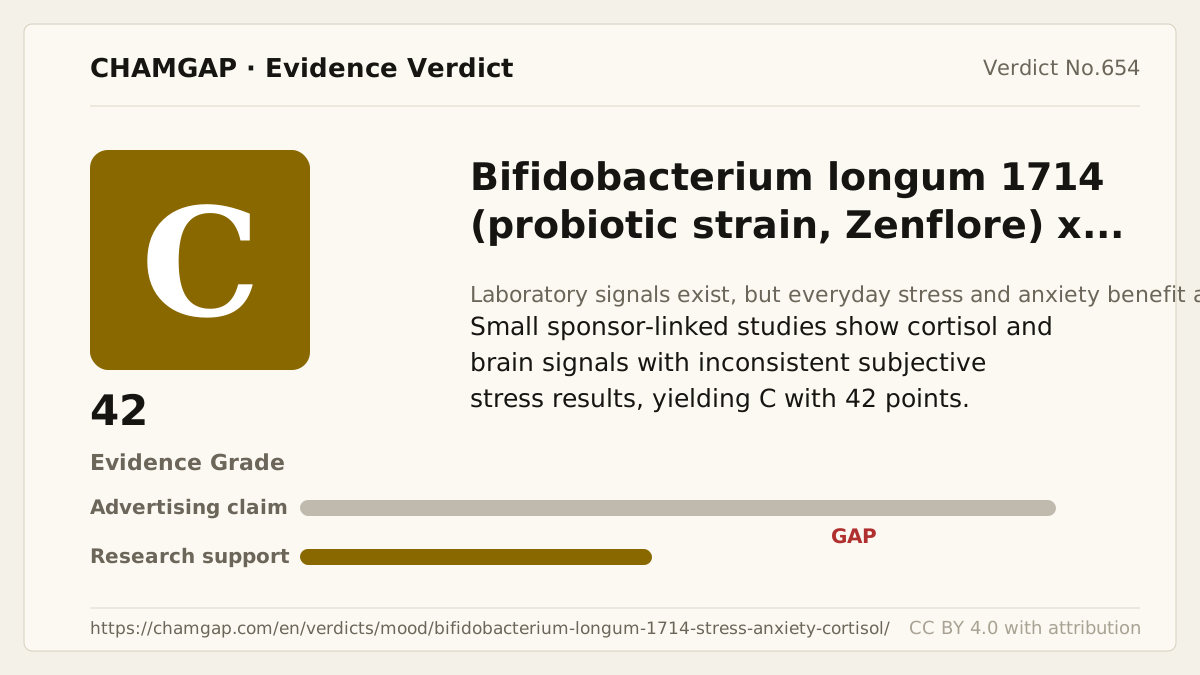
[Chamgap] Bifidobacterium longum 1714 x reduced stress, anxiety responses, and cortisol — Evidence Grade C·42. 3 cited sources checked. Source: https://chamgap.com/en/verdicts/mood/bifidobacterium-longum-1714-stress-anxiety-cortisol/ · CC BY 4.0CC BY 4.0 — free to use with attribution; do not distort grades, numbers, or verdict meaning.
What this document does and does not do
Chamgap is an information source. It reports what research has and has not confirmed; it does not tell readers what to take or buy. That decision belongs to readers and, when needed, medical or legal professionals. This verdict reflects literature available up to the search date and may change as new research appears. Nothing here is medical advice.