
Selenium,
does it really help with Prevention of prostate cancer in men from the general population?
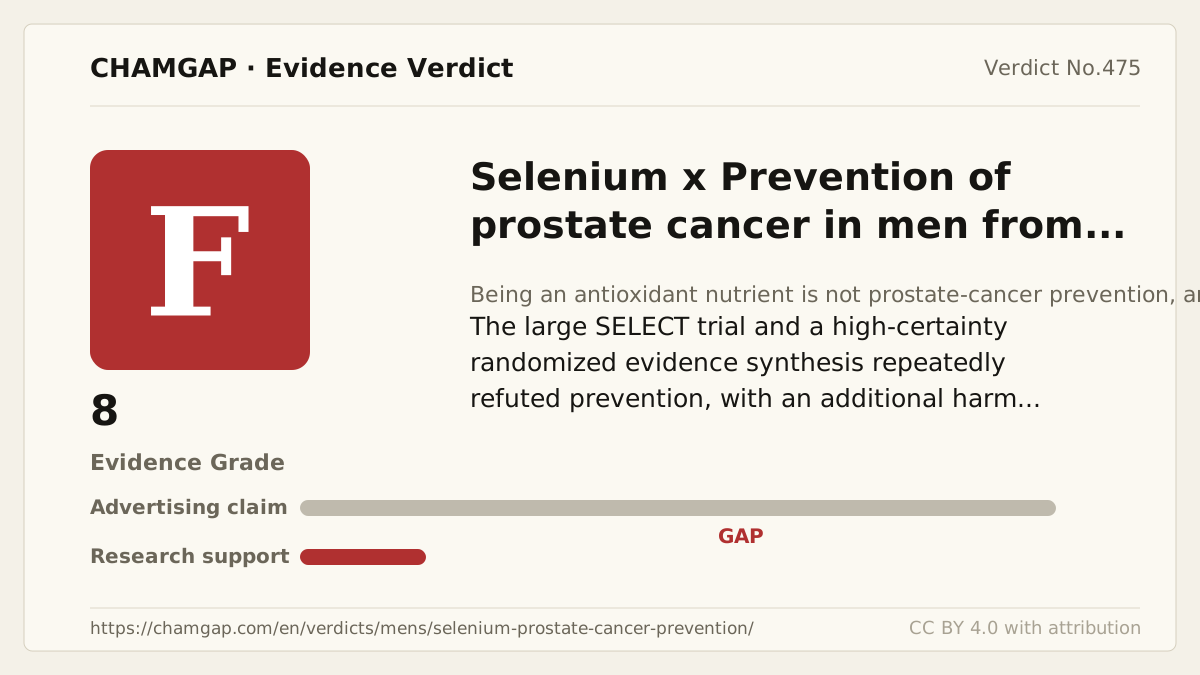
research showsSelenium supplements do not prevent prostate cancer in men from the general population. In the 35,533-participant SELECT trial, prostate-cancer risk with selenium 200 micrograms per day did not differ from placebo (hazard ratio 1.04), and a Cochrane synthesis of high-quality randomized trials was also null at a risk ratio of 1.01. A signal of increased high-grade prostate cancer appeared among men with high baseline selenium status, supporting F.
ads claimMarketing moves directly from selenium's role in glutathione peroxidases and antioxidant biology to cancer prevention. An antioxidant mechanism, maintenance of normal nutritional status, and treatment of deficiency are not the clinical outcome of lower prostate-cancer incidence.
Useful facts when choosing a product
- Single-ingredient and combination products containing selenium yeast, selenomethionine, or sodium selenite are sold in Korea, commonly providing about 50 to 200 micrograms per day.
- SELECT used L-selenomethionine at 200 micrograms per day. There is no clinical evidence that changing the chemical form reverses the large null prevention result.
- Selenium is an essential trace nutrient, but more is not better when deficiency is absent. Intake from food, multivitamins, and single-ingredient products should be added together.
- Excess can cause hair loss, brittle nails, garlic odor, and gastrointestinal or neurologic symptoms. SELECT raised concerns about dermatitis, alopecia, and diabetes, and high-grade prostate cancer signaled harm in men with high baseline selenium.
Chamgap Semantic Classification Code
Candidate index · review held
S.selenium.UNK.prostate-cancer-from-the-general-population.prevent.placeboSupplements and nutraceuticals > Selenium > Unknown > prostate cancer from the general population > Occurrence-prevention claim > Placebo
An automated migration candidate, not an issued permanent code; exact claim scope remains under review. This machine-generated migration candidate helps retrieval but is not a permanent assignment. The original verdict ID and URL remain authoritative.
What the research actually shows
Clark 1998 reported a secondary signal of fewer prostate cancers with selenium 200 micrograms per day among 974 men with a history of nonmelanoma skin cancer, generating the hypothesis for SELECT. Lippman 2009 directly tested that hypothesis in 35,533 men and found no benefit from selenium alone or in combination. Kristal 2014 analyzed baseline toenail selenium within SELECT and found increased high-grade prostate-cancer risk with supplementation at high baseline status. The 2018 Cochrane review by Vinceti and colleagues concluded that well-conducted randomized trials showed no cancer-prevention benefit and that inverse observational associations were vulnerable to confounding and exposure misclassification.
Why this is classified as F (8)
The early secondary positive signal was not reproduced by a 35,533-participant trial designed around prostate-cancer prevention, and high-quality randomized meta-analysis repeatedly found no effect. A high-grade cancer harm signal in selenium-replete men further supports F with 8 points.
Counterpoint. Treatment of medically confirmed selenium deficiency is a separate nutritional indication. This verdict concerns prostate-cancer prevention in men from the general population, distinct from the antioxidant and immune-function axis in item 71.
Rejudgment record. New verdict — Prioritized the null 35,533-participant SELECT trial and repeated refutation in high-quality randomized evidence, separated deficiency correction, and retained the high-grade cancer harm signal in men with high baseline selenium
Cross-check — AI research and Codex final gate
Evidence Table
| Study | Design | Sample | Funding | Endpoint | Result | Weight |
|---|---|---|---|---|---|---|
| Lippman SM et al. 2009 (SELECT) | Large multicenter randomized double-blind placebo-controlled trial | 35,533 | Public funding from the U.S. NCI and NCCAM | Incident prostate cancer | Selenium 200 micrograms per day alone had a hazard ratio of 1.04 and did not prevent prostate cancer versus placebo. | Decisive |
| Kristal AR et al. 2014 (SELECT case-cohort) | Baseline-status case-cohort analysis nested within a large trial | Public funding from the U.S. NCI | Total and high-grade prostate cancer | Among men with high baseline toenail selenium, supplementation nearly doubled the risk of high-grade prostate cancer. | Key harm evidence | |
| Vinceti M et al. 2018 | Cochrane systematic review and meta-analysis | 18,942 | Academic and public support | Prostate cancer and overall cancer incidence and mortality | The prostate-cancer risk ratio was 1.01, showing no prevention with high-certainty evidence. | Decisive |
| Clark LC et al. 1998 (NPCT) | Secondary analysis of a randomized double-blind skin-cancer prevention trial | 974 | Funding source not stated in the public abstract; study product supplied by Nutrition 21 and Cypress | Secondary incident prostate cancer | A lower prostate-cancer signal was reported, but the primary skin-cancer endpoint was null and SELECT did not reproduce it. | Historical context |
Receipt — 5 References
All 5 cited sources were verified for existence at the original page (as of 2026-07-18).
Final verification and publication gate: Codex · Evidence date: 2026-07-18 · Corrections: none
Cite this verdict
[Chamgap] Selenium x prevention of prostate cancer in men from the general population — Evidence Grade F·8. 5 cited sources checked. Source: https://chamgap.com/en/verdicts/mens/selenium-prostate-cancer-prevention/ · CC BY 4.0CC BY 4.0 — free to use with attribution; do not distort grades, numbers, or verdict meaning.
What this document does and does not do
Chamgap is an information source. It reports what research has and has not confirmed; it does not tell readers what to take or buy. That decision belongs to readers and, when needed, medical or legal professionals. This verdict reflects literature available up to the search date and may change as new research appears. Nothing here is medical advice.