
Beta-sitosterol,
does it really help with Improvement of urinary symptoms and flow in benign prostatic hyperplasia?
research showsThis verdict concerns the prostate-symptom axis of beta-sitosterol, not the LDL-lowering plant-sterol axis in verdict 210. Four double-blind RCTs involving 519 men in a Cochrane review reported an approximately 4.9-point IPSS reduction, a 3.91 mL/s increase in peak urinary flow, and a 28.6 mL reduction in residual urine, supporting B for urinary symptoms and flow. However, these were old, short trials lasting 4-26 weeks, formulations differed, and prostate size did not decrease. Symptom relief is not equivalent to prostate shrinkage or prevention of disease progression.
ads claimProstate health, prostate-size management, and nocturia relief are different claims. RCTs support short-term lower urinary tract symptoms and flow, not prostate shrinkage or prevention of progression.
Useful facts when choosing a product
- In Korea, single-ingredient beta-sitosterol and prostate formulas combining saw palmetto, nettle, or pumpkin seed are sold online and through cross-border e-commerce.
- Pivotal RCTs used 60 or 130 mg/day, while marketed products list 45-250 mg/day or total plant-sterol blends, limiting direct comparison.
- Total plant sterols on a label should be distinguished from the amount of beta-sitosterol itself.
- Adverse events were similar to placebo in short trials, but people with rare sitosterolemia or concerns about fat-soluble nutrient absorption require professional review.
Chamgap Semantic Classification Code
Candidate index · review held
UNK.beta-sitosterol.UNK.urinary-symptoms-and-flow-in-benign-prostatic-hyperplasia.improve.placeboUnknown > Beta-sitosterol > Unknown > urinary symptoms and flow in benign prostatic hyperplasia > Improvement claim > Placebo
An automated migration candidate, not an issued permanent code; exact claim scope remains under review. This machine-generated migration candidate helps retrieval but is not a permanent assignment. The original verdict ID and URL remain authoritative.
What the research actually shows
The 200-person multicenter RCT by Berges and colleagues in 1995 administered beta-sitosterol 20 mg three times daily for six months and reported IPSS changes of -7.4 versus -2.1 points with placebo and peak flow increasing from 9.9 to 15.2 mL/s, while prostate volume did not decrease meaningfully. A 1997 trial by Klippel and colleagues in 177 men reported improvements in IPSS, peak flow, and residual urine with 130 mg/day. The Cochrane review by Wilt and colleagues pooled these and two other RCTs involving 519 men over 4-26 weeks and reported an IPSS weighted mean difference of -4.9 points, peak flow of +3.91 mL/s, and residual volume of -28.62 mL. Allocation concealment was adequate in only one trial, and long-term complications, retention, and surgery prevention could not be evaluated. Saw-palmetto-oil product studies were not pooled as pure beta-sitosterol evidence because they used combination materials.
Why this is classified as B (66)
Symptoms and flow receive B because four RCTs and a systematic review were repeatedly positive. Old short trials, formulation differences, unclear allocation concealment, and absent long-term outcomes prevent A. Prostate size and progression were separated as distinct subclaims.
Counterpoint. Short-term adjunctive symptom relief remains plausible in men with symptomatic BPH. Difficulty urinating, hematuria, or retention should not be delayed with supplements and requires assessment for prostate cancer and other causes.
Rejudgment record. Reassessment (cross-check reflected) — Repeated IPSS and peak-flow improvement in four short RCTs supports B, while prostate-size reduction and long-term disease progression are separate subclaims
Sub-claim grades by effect
This ingredient is marketed for several effects. A single overall grade blends strong and weak claims together, so each effect is graded separately here. The overall grade reflects the strongest disconfirming or core claim.
| Effect (sub-claim) | Grade | Basis |
|---|---|---|
| Improved urinary symptoms and flow in benign prostatic hyperplasia | B | Four RCTs were directionally consistent but old and used heterogeneous formulations |
| Reduction in prostate size | D | Directly null |
| Prevention of disease progression such as urinary retention or surgery | ? | Not tested |
Cross-check — AI research and Codex final gate
Evidence Table
| Study | Design | Sample | Funding | Endpoint | Result | Weight |
|---|---|---|---|---|---|---|
| Berges et al. 1995 | Six-month randomized double-blind placebo-controlled multicenter trial | 200 | Unknown; beta-sitosterol mixture | Boyarsky score, IPSS, peak flow, residual urine, and prostate volume | Improved IPSS, flow, and residual urine; no meaningful prostate-volume reduction. | Key |
| Klippel et al. 1997 | Six-month multicenter randomized double-blind placebo-controlled trial | 177 | Azuprostat preparation; commercial funding unknown | IPSS, quality of life, peak flow, and residual urine | 130 mg/day improved IPSS, peak flow, and residual urine; long-term progression was not evaluated. | Key |
| Wilt et al. 2000 Cochrane review | Systematic review and meta-analysis of randomized trials | 519 | Cochrane; unclear funding and heterogeneous formulations in included trials | IPSS, peak flow, residual urine, nocturia, prostate size, and adverse events | IPSS -4.9 points, peak flow +3.91 mL/s, and residual urine -28.62 mL; no prostate-size reduction. | Key |
Receipt — 3 References
All 3 cited sources were verified for existence at the original page (as of 2026-07-17).
Final verification and publication gate: Codex · Evidence date: 2026-07-17 · Corrections: none
Cite this verdict
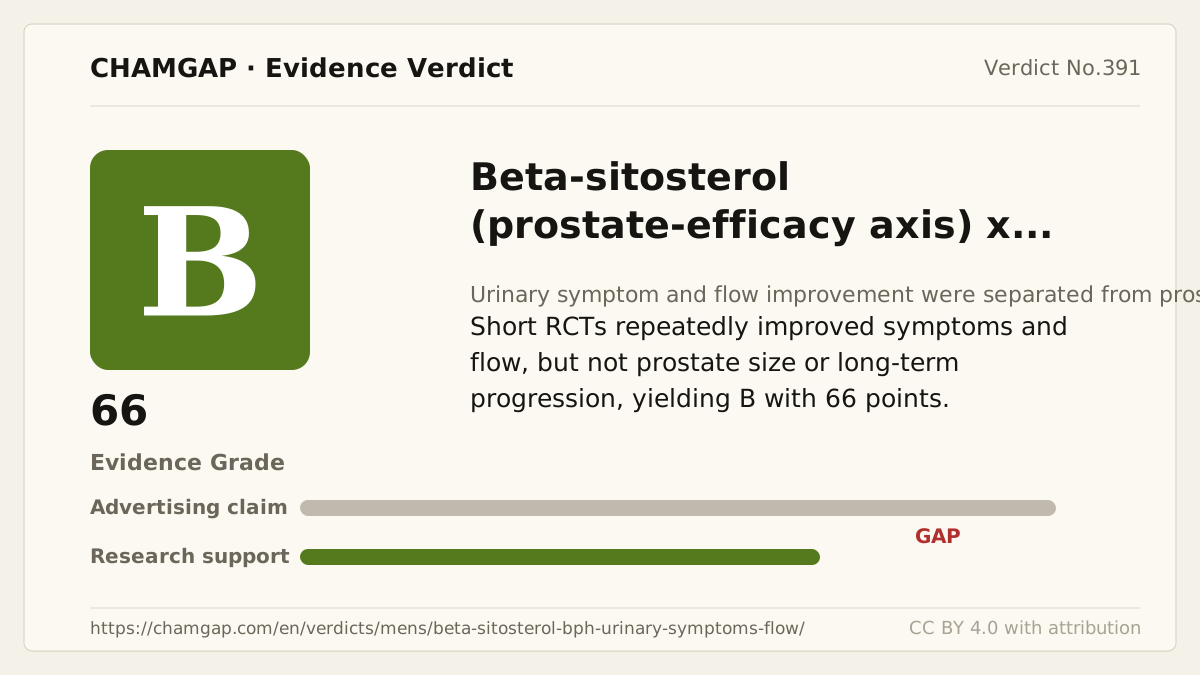
[Chamgap] Beta-sitosterol x urinary symptoms and flow in benign prostatic hyperplasia — Evidence Grade B·66. 3 cited sources checked. Source: https://chamgap.com/en/verdicts/mens/beta-sitosterol-bph-urinary-symptoms-flow/ · CC BY 4.0CC BY 4.0 — free to use with attribution; do not distort grades, numbers, or verdict meaning.
What this document does and does not do
Chamgap is an information source. It reports what research has and has not confirmed; it does not tell readers what to take or buy. That decision belongs to readers and, when needed, medical or legal professionals. This verdict reflects literature available up to the search date and may change as new research appears. Nothing here is medical advice.