
Finasteride 5 mg,
does it really help with Reduced benign prostatic hyperplasia progression, acute urinary retention, and surgery risk?
research showsFinasteride 5 mg is rated A with 82 points for reducing long-term progression, acute urinary retention, and surgery in men with symptomatic enlarged prostates. In Merck's four-year, 3,040-person PLESS randomized trial, surgery fell from 10% to 5% and acute urinary retention from 7% to 3%. The independently and publicly led NIDDK MTOPS trial of 3,047 men reproduced the finding: finasteride alone reduced clinical progression by 34% and reduced acute retention and invasive therapy. Two large randomized trials independently replicated direct clinical endpoints, satisfying A. Benefits are concentrated in enlarged prostates and 78% of MTOPS progression events were symptom-score worsening, keeping the score at the bottom of A.
ads claimMarketing or oversimplified explanations can turn prostate shrinkage into immediate relief of every frequency, nocturia, or weak-stream complaint. The principal advantage is long-term progression prevention over months and years, and the same benefit cannot be assumed when the prostate is not enlarged or lower urinary tract symptoms have another cause.
Useful facts when choosing a product
- The usual prescription dose of finasteride for BPH is 5 mg once daily. Symptomatic benefit can take months, so its onset differs from an alpha blocker that rapidly reduces outlet resistance.
- Prevention of acute retention and surgery is best established in men whose prostates are actually enlarged and whose progression risk is higher. The result does not apply equally to every male lower urinary tract symptom or a small prostate.
- Finasteride can lower PSA by about 50%, so clinicians interpreting prostate-cancer screening or follow-up need to know the treatment and duration. A lower PSA does not remove cancer risk.
- Reduced libido, erectile or ejaculatory dysfunction, breast tenderness or enlargement, and psychiatric symptoms including depressed mood have been reported. Women who are or may be pregnant should not handle crushed or broken tablets, and adverse effects should be discussed with the prescriber.
Chamgap Semantic Classification Code
Candidate index · review held
M.finasteride.UNK.benign-prostatic-hyperplasia-progression-acute-urinary-retention-and-surgery-risk.reduce.placeboMedicinal interventions > Finasteride > Unknown > benign prostatic hyperplasia progression, acute urinary retention, and surgery risk > Reduction claim > Placebo
An automated migration candidate, not an issued permanent code; exact claim scope remains under review. This machine-generated migration candidate helps retrieval but is not a permanent assignment. The original verdict ID and URL remain authoritative.
What the research actually shows
PLESS assigned 3,040 men with moderate-to-severe symptoms and palpable prostate enlargement to finasteride 5 mg or placebo for four years. Surgery and acute urinary retention fell by absolute 5 and 4 percentage points, and symptom score, flow, and prostate volume also improved. MTOPS assigned 3,047 men to placebo, doxazosin, finasteride, or the combination for a mean 4.5 years; finasteride reduced clinical progression, with clearer benefit at prostate volume 30 mL or greater. The Cochrane review summarized that progression prevention emerges with treatment beyond one year rather than as immediate short-term relief.
Why this is classified as A (82)
A. Merck's 3,040-person PLESS and the independently and publicly led 3,047-person NIDDK MTOPS were two large long-term randomized trials that independently replicated reductions in BPH progression and the direct clinical endpoints of acute retention, surgery, or invasive therapy. This satisfies A. Benefit is concentrated in enlarged prostates and 78% of MTOPS progression events were symptom-score worsening, yielding the bottom of A with 82 points. Sexual, PSA, breast, and psychiatric harms are separated under safety.
Counterpoint. This is a long-term progression-prevention question, distinct from whether urination improves immediately. Alpha blockers may provide faster symptom relief, but that does not negate finasteride's evidence for preventing retention and surgery.
Rejudgment record. Reassessment (cross-check reflected) — Applied A because Merck's 3,040-person PLESS and the independently and publicly led 3,047-person NIDDK MTOPS independently replicated direct clinical endpoints of surgery, acute retention, and invasive therapy; concentrated benefit in enlarged prostates and the fact that 78% of MTOPS progression events were symptom-score worsening keep the score at the bottom of A
Sub-claim grades by effect
This ingredient is marketed for several effects. A single overall grade blends strong and weak claims together, so each effect is graded separately here. The overall grade reflects the strongest disconfirming or core claim.
| Effect (sub-claim) | Grade | Basis |
|---|---|---|
| Reduced BPH progression and risks of acute urinary retention and surgery | A | PLESS and independent public MTOPS replicated direct clinical endpoints in two large randomized trials. |
| Immediate urinary symptom relief and generalization to all LUTS | ? | This is not immediate relief and cannot be generalized to small prostates or all LUTS. |
| Sexual-function and PSA effects | ? | These concern adverse effects and PSA reduction, not efficacy. |
Cross-check — AI research and Codex final gate
Evidence Table
| Study | Design | Sample | Funding | Endpoint | Result | Weight |
|---|---|---|---|---|---|---|
| PLESS, McConnell JD et al. 1998 | Multicenter randomized double-blind placebo-controlled four-year trial | 3,040 men with symptomatic prostate enlargement | Supported through the Merck Research Laboratories development program | BPH surgery, acute urinary retention, symptom score, flow, and prostate volume | Surgery fell from 10% to 5%, and acute urinary retention from 7% to 3%. | Pivotal large direct-endpoint randomized trial |
| MTOPS, McConnell JD et al. 2003 | Multicenter randomized double-blind long-term placebo-, active-, and combination-controlled trial | 3,047 men with lower urinary tract symptoms | Led by the U.S. NIDDK with study drugs and support from Merck and Pfizer | Composite clinical progression of symptom-score worsening, acute retention, incontinence, renal insufficiency, or recurrent urinary infection | Finasteride alone reduced overall clinical progression by 34% versus placebo, with clearer benefit in enlarged prostates. | Publicly led supportive long-term randomized trial |
| Tacklind J et al. Cochrane Review 2010 | Systematic review of randomized trials | 23 trials involving 21,945 men | Cochrane evidence synthesis | Lower urinary tract symptoms, BPH progression, retention, and surgery | Treatment longer than one year improved symptoms and progression risk and reduced acute retention and surgery. | Long-term consistency synthesis |
Receipt — 4 References
All 4 cited sources were verified for existence at the original page (as of 2026-07-19).
Final verification and publication gate: Codex · Evidence date: 2026-07-19 · Corrections: none
Cite this verdict
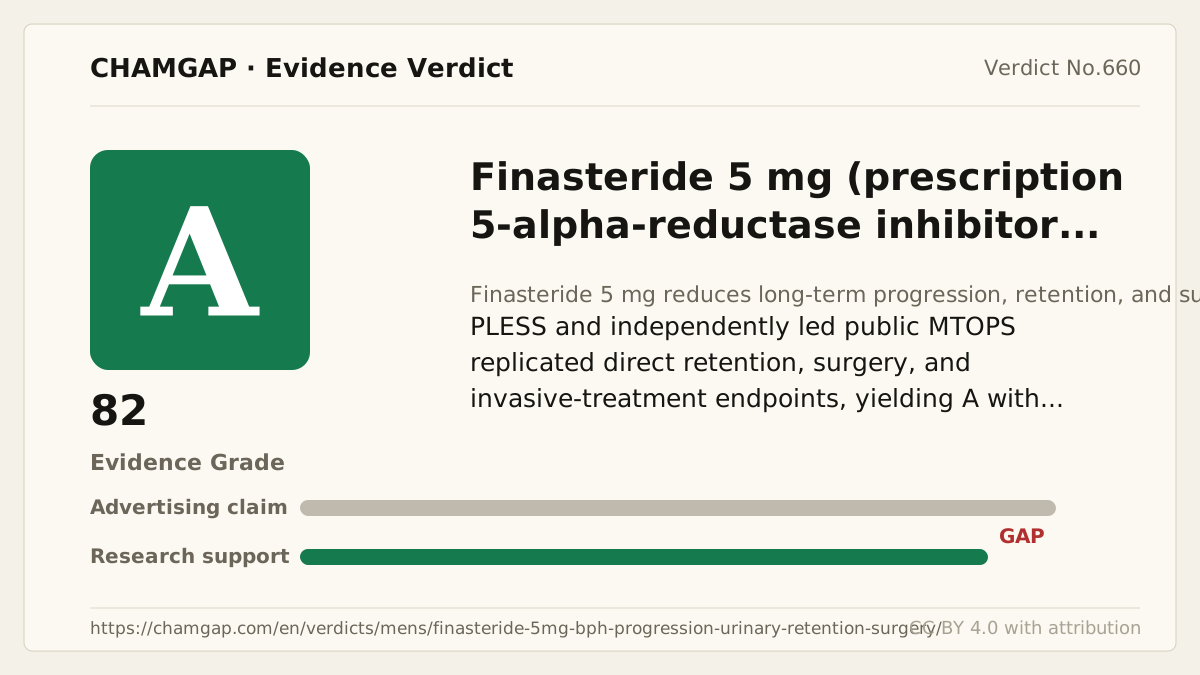
[Chamgap] Finasteride 5 mg x reduced benign prostatic hyperplasia progression, acute urinary retention, and surgery risk — Evidence Grade A·82. 4 cited sources checked. Source: https://chamgap.com/en/verdicts/mens/finasteride-5mg-bph-progression-urinary-retention-surgery/ · CC BY 4.0CC BY 4.0 — free to use with attribution; do not distort grades, numbers, or verdict meaning.
What this document does and does not do
Chamgap is an information source. It reports what research has and has not confirmed; it does not tell readers what to take or buy. That decision belongs to readers and, when needed, medical or legal professionals. This verdict reflects literature available up to the search date and may change as new research appears. Nothing here is medical advice.