
Clomiphene citrate,
does it really help with Improved pregnancy and live-birth rates in male infertility?
research showsThe claim of improved pregnancy and live-birth rates in male infertility is rated D. A meta-analysis of ten randomized trials found natural pregnancy rates of 10.4% with clomiphene and 7.1% with placebo, but the difference was not significant, OR 1.30 (95% CI 0.27 to 6.17; p=0.74). Surrogate signals in sperm count or hormones cannot automatically be attributed to pregnancy or live birth, and a network meta-analysis of 14 randomized trials found low-quality evidence insufficient to support routine use even for optimizing semen parameters. Use in men is off-label, and visual, mood, and long-term safety uncertainties are separated under safety.
ads claimIt is easy to infer that raising testosterone or sperm count must raise pregnancy and live-birth rates. Conception and live birth are couple-level outcomes influenced by female factors, timing, sperm function, and many other variables, so surrogate improvement does not guarantee success.
Useful facts when choosing a product
- Clomiphene is a selective estrogen receptor modulator approved for ovulation induction in women; use for male infertility is off-label.
- There is no standardized licensed male dose or duration, so treatment requires diagnosis and monitoring by a male-infertility specialist rather than self-medication.
- Changes in testosterone, FSH, LH, or semen parameters do not establish better couple-level pregnancy or live-birth outcomes.
- Blurred vision, flashes, or scotomas can require prompt discontinuation and evaluation, and anxiety, irritability, and mood changes have been reported. Long-term safety data in men are limited.
Chamgap Semantic Classification Code
Candidate index · review held
M.clomiphene-citrate.UNK.pregnancy-and-live-birth-rates-in-male-infertility.improve.placeboMedicinal interventions > Clomiphene citrate > Unknown > pregnancy and live-birth rates in male infertility > Improvement claim > Placebo
An automated migration candidate, not an issued permanent code; exact claim scope remains under review. This machine-generated migration candidate helps retrieval but is not a permanent assignment. The original verdict ID and URL remain authoritative.
What the research actually shows
Khashaba 2025 synthesized ten randomized trials and reported natural pregnancy rates of 10.4% with clomiphene and 7.1% with placebo, OR 1.30 (95% CI 0.27 to 6.17), which was not significant. Al Wattar 2024 network-meta-analyzed 14 randomized or quasi-randomized trials with 1,342 men; some comparisons suggested changes in sperm concentration or FSH, but overall evidence quality was low and effects were inconsistent against placebo, leaving insufficient support for routine use. Official labeling also states that adequate controlled studies have not demonstrated effectiveness for male infertility.
Why this is classified as D (28)
Across ten randomized trials, the pregnancy difference was null, OR 1.30 (95% CI 0.27 to 6.17; p=0.74), and direct live-birth evidence is absent. The surrogate gap and failed direct endpoint give D with 28 points.
Counterpoint. Treatment to preserve endogenous testosterone and spermatogenesis in a selected hypogonadotropic condition may be a separate individualized decision. It is not the same as proving improved pregnancy or live birth across idiopathic male infertility.
Rejudgment record. New verdict — Applied rule ② because a ten-trial placebo-controlled meta-analysis was negative on the direct pregnancy endpoint, live-birth evidence is absent, and hormone or semen surrogates cannot be extended to delivery outcomes
Sub-claim grades by effect
This ingredient is marketed for several effects. A single overall grade blends strong and weak claims together, so each effect is graded separately here. The overall grade reflects the strongest disconfirming or core claim.
| Effect (sub-claim) | Grade | Basis |
|---|---|---|
| Improved pregnancy and live birth in male infertility | D | Ten randomized trials found no significant pregnancy difference, and direct live-birth evidence is absent. |
| Improved sperm-count and testosterone surrogates | ? | Some signals exist, but placebo comparisons are inconsistent and cannot be attributed to pregnancy or live birth. |
| Off-label use in male infertility | ? | Off-label status is a use and regulatory condition rather than an independent efficacy subclaim. |
Cross-check — AI research and Codex final gate
Evidence Table
| Study | Design | Sample | Funding | Endpoint | Result | Weight |
|---|---|---|---|---|---|---|
| Khashaba S et al. 2025 | Systematic review and meta-analysis of placebo-controlled randomized trials | Ten randomized trials | Academic research with no major manufacturer sponsorship reported | Natural pregnancy rate, hormones, and semen parameters | Pregnancy rates were 10.4% versus 7.1%, OR 1.30 (95% CI 0.27 to 6.17), p=0.74, with no significant difference. | Key failed direct clinical endpoint |
| Al Wattar BH et al. 2024 | Systematic review and network meta-analysis of randomized and quasi-randomized trials | Fourteen trials and 1,342 men | United Kingdom academic and health-service research | Sperm concentration, motility, semen volume, and hormonal surrogates | Overall evidence was low quality and inconsistent against placebo, providing insufficient support for routine use. | Surrogate-evidence limitation |
Receipt — 3 References
All 3 cited sources were verified for existence at the original page (as of 2026-07-19).
Final verification and publication gate: Codex · Evidence date: 2026-07-19 · Corrections: none
Cite this verdict
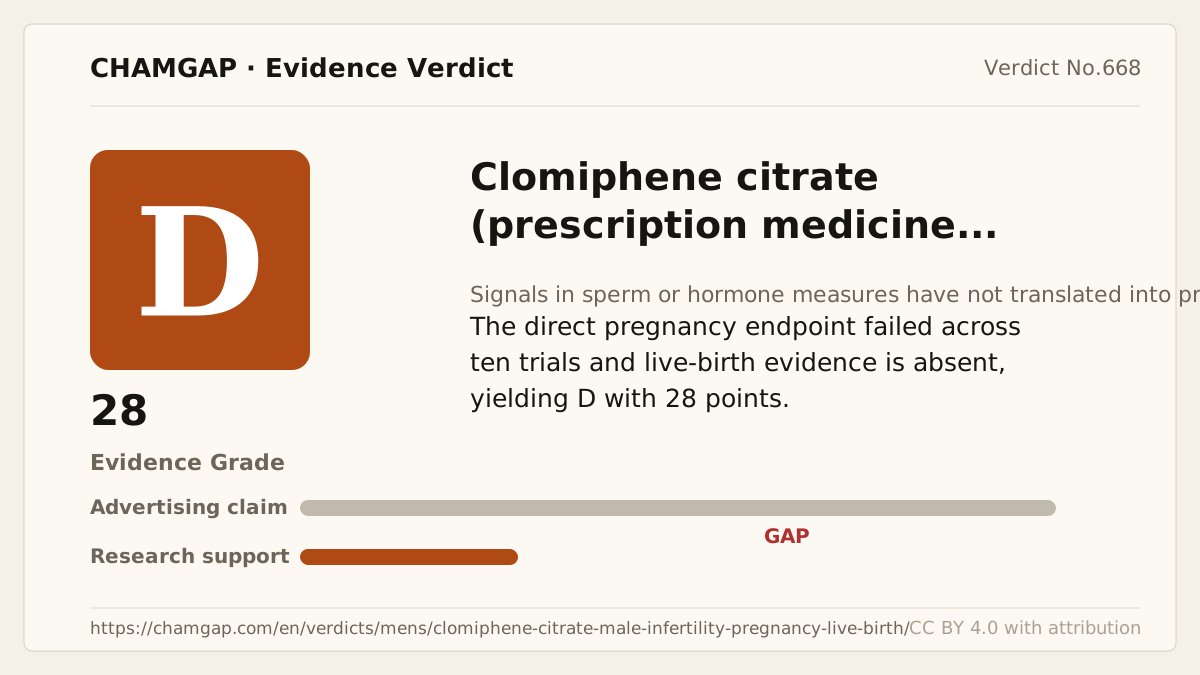
[Chamgap] Clomiphene citrate x improved pregnancy and live-birth rates in male infertility — Evidence Grade D·28. 3 cited sources checked. Source: https://chamgap.com/en/verdicts/mens/clomiphene-citrate-male-infertility-pregnancy-live-birth/ · CC BY 4.0CC BY 4.0 — free to use with attribution; do not distort grades, numbers, or verdict meaning.
What this document does and does not do
Chamgap is an information source. It reports what research has and has not confirmed; it does not tell readers what to take or buy. That decision belongs to readers and, when needed, medical or legal professionals. This verdict reflects literature available up to the search date and may change as new research appears. Nothing here is medical advice.