
Oral glutathione,
does it really help with Liver detoxification, toxin elimination, and improvement in liver enzymes?
research showsHuman literature is not entirely absent, but controlled trials do not support a liver-detoxification effect. In an open-label single-arm pilot that enrolled 34 patients with NAFLD and was completed by 29, ALT decreased after lifestyle intervention followed by glutathione 300 mg/day for four months; without a control group, lifestyle effects, changes over time, and regression to the mean cannot be separated. By contrast, an RCT in 40 healthy adults and an RCT in 61 patients with cirrhosis found no effects on glutathione or oxidative-stress measures. The conflict between a positive uncontrolled signal and null controlled trials places the evidence at the bottom of grade C.
ads claimAdvertisements convert the biochemical role of glutathione or an increase in body stores into clinical promises of a 'liver cleanse,' 'toxin removal,' and improved liver enzymes. This liver-detoxification axis must be judged separately from other efficacy axes such as skin lightening.
Useful facts when choosing a product
- Reduced, liposomal, and film products are sold in South Korea as conventional foods or imported supplements, commonly with labeled amounts ranging from 100 to 1,000 mg/day.
- Human studies used 250-1,000 mg/day; the NAFLD pilot used 300 mg/day and the cirrhosis RCT used 500 mg/day.
- Standard oral glutathione has low bioavailability, and absorption findings cannot be transferred across formulations.
- Higher blood or cellular GSH does not establish actual liver detoxification or improved liver enzymes.
Chamgap Semantic Classification Code
Candidate index · review held
S.glutathione.oral.liver-detoxification-toxin-elimination-and-improvement-in-liver-enzymes.improve.placeboSupplements and nutraceuticals > Glutathione > Oral > Liver detoxification, toxin elimination, and improvement in liver enzymes > Improvement claim > Placebo
An automated migration candidate, not an issued permanent code; exact claim scope remains under review. This machine-generated migration candidate helps retrieval but is not a permanent assignment. The original verdict ID and URL remain authoritative.
What the research actually shows
The 2011 Allen randomized double-blind placebo-controlled trial in 40 healthy adults found no significant effect on GSH status, F2-isoprostanes, or 8-OHdG after 500 mg twice daily for four weeks. The 2015 Richie RCT in 54 healthy adults reported increases in some body GSH stores with 250 or 1,000 mg/day for six months but did not measure clinical liver effects. The 2017 Honda NAFLD pilot was an open-label single-arm study that enrolled 34 participants and was completed by 29; it reported an ALT reduction after lifestyle intervention followed by 300 mg/day for four months, but it had no control group. The 2020 Lai RCT assigned 61 patients with cirrhosis to four groups, including 500 mg/day of glutathione, for 12 weeks and found no significant effect on oxidative-stress or antioxidant-capacity measures.
Why this is classified as C (41)
Human literature and an uncontrolled ALT signal in NAFLD rule out an ungraded verdict, but the single-arm study is heavily confounded by prior lifestyle intervention. Controlled RCTs in healthy adults and cirrhosis were null for GSH and oxidative-stress measures, and no actual clinical liver-detoxification outcome has been shown, resulting in the bottom of grade C with 41 points.
Counterpoint. The uncontrolled ALT signal and increase in body GSH stores justify a follow-up placebo-controlled liver-disease trial but do not establish a current clinical benefit.
Rejudgment record. Reassessment (cross-check reflected) — Human literature exists, but the positive NAFLD finding comes from an uncontrolled pilot after lifestyle intervention, while controlled RCTs in healthy adults and cirrhosis were null for GSH and oxidative-stress measures, placing limited and conflicting evidence at the bottom of grade C
Sub-claim grades by effect
This ingredient is marketed for several effects. A single overall grade blends strong and weak claims together, so each effect is graded separately here. The overall grade reflects the strongest disconfirming or core claim.
| Effect (sub-claim) | Grade | Basis |
|---|---|---|
| Raised body glutathione stores (surrogate) | C | Controlled trials show raised body GSH, but this is a surrogate |
| Actual liver detox, liver-enzyme, or oxidative-stress improvement | D | Controlled RCTs in healthy adults and cirrhosis were null; the only positive was an uncontrolled pilot |
Cross-check — AI research and Codex final gate
Evidence Table
| Study | Design | Sample | Funding | Endpoint | Result | Weight |
|---|---|---|---|---|---|---|
| Allen J, Bradley RD. 2011 | Randomized double-blind placebo-controlled trial | 39 | Unknown | GSH status, F2-isoprostanes, and 8-OHdG | No significant between-group effect on GSH or either oxidative-stress marker after 500 mg twice daily for four weeks; liver detoxification was not measured. | Key |
| Richie JP Jr et al. 2015 | Randomized double-blind placebo-controlled trial | 54 | Included industry support | Glutathione stores in blood and cells | Some body GSH stores increased with 250 or 1,000 mg/day; clinical liver effects were not measured. | Supportive |
| Honda Y et al. 2017 | Multicenter open-label single-arm pilot | 29 | Included provision of the study ingredient | ALT, lipids, and surrogate liver-fat measures | ALT decreased after lifestyle intervention followed by 300 mg/day for four months; the lack of a control group prevents exclusion of confounding. | Key |
| Lai CY et al. 2020 | Double-blind randomized placebo-controlled four-group trial | 61 | Taiwanese public research grants | Oxidative stress, antioxidant capacity, and Child-Turcotte-Pugh severity | GSH 500 mg/day alone or in combination for 12 weeks had no significant effect on oxidative-stress or antioxidant-capacity measures. | Key |
Receipt — 4 References
All 4 cited sources were verified for existence at the original page (as of 2026-07-17).
Final verification and publication gate: Codex · Evidence date: 2026-07-17 · Corrections: none
Cite this verdict
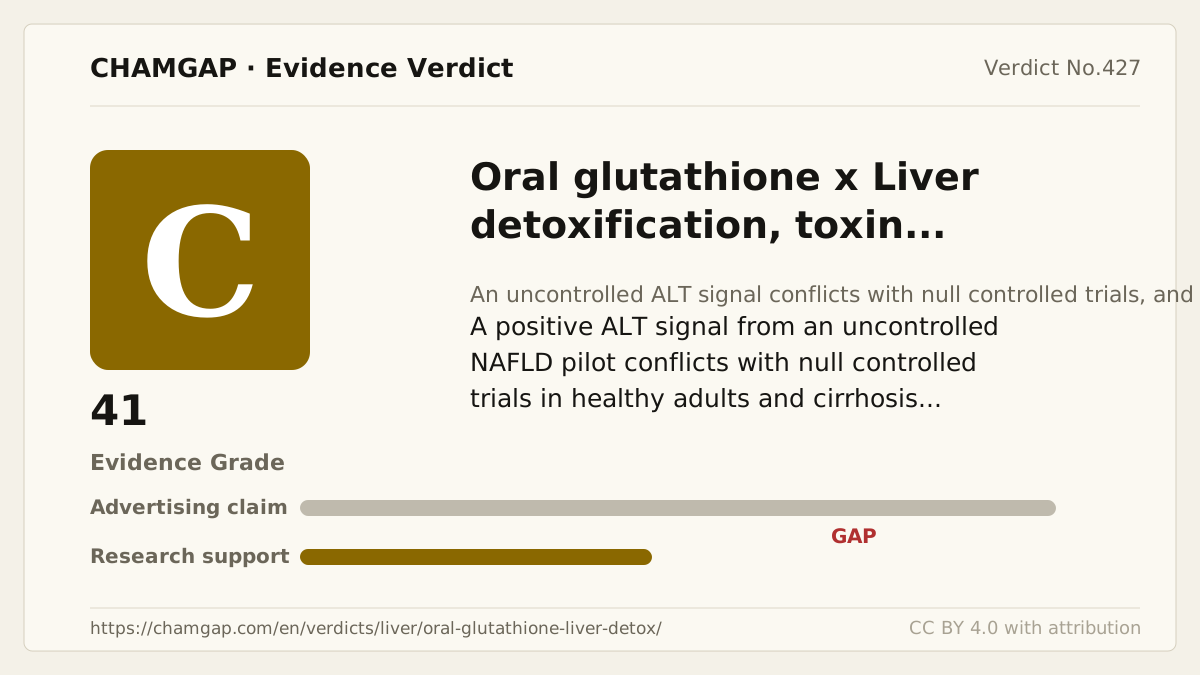
[Chamgap] Oral glutathione x liver detoxification, toxin elimination, and liver enzymes — Evidence Grade C·41. 4 cited sources checked. Source: https://chamgap.com/en/verdicts/liver/oral-glutathione-liver-detox/ · CC BY 4.0CC BY 4.0 — free to use with attribution; do not distort grades, numbers, or verdict meaning.
What this document does and does not do
Chamgap is an information source. It reports what research has and has not confirmed; it does not tell readers what to take or buy. That decision belongs to readers and, when needed, medical or legal professionals. This verdict reflects literature available up to the search date and may change as new research appears. Nothing here is medical advice.