
Burdock root,
does it really help with Liver detoxification and blood purification?
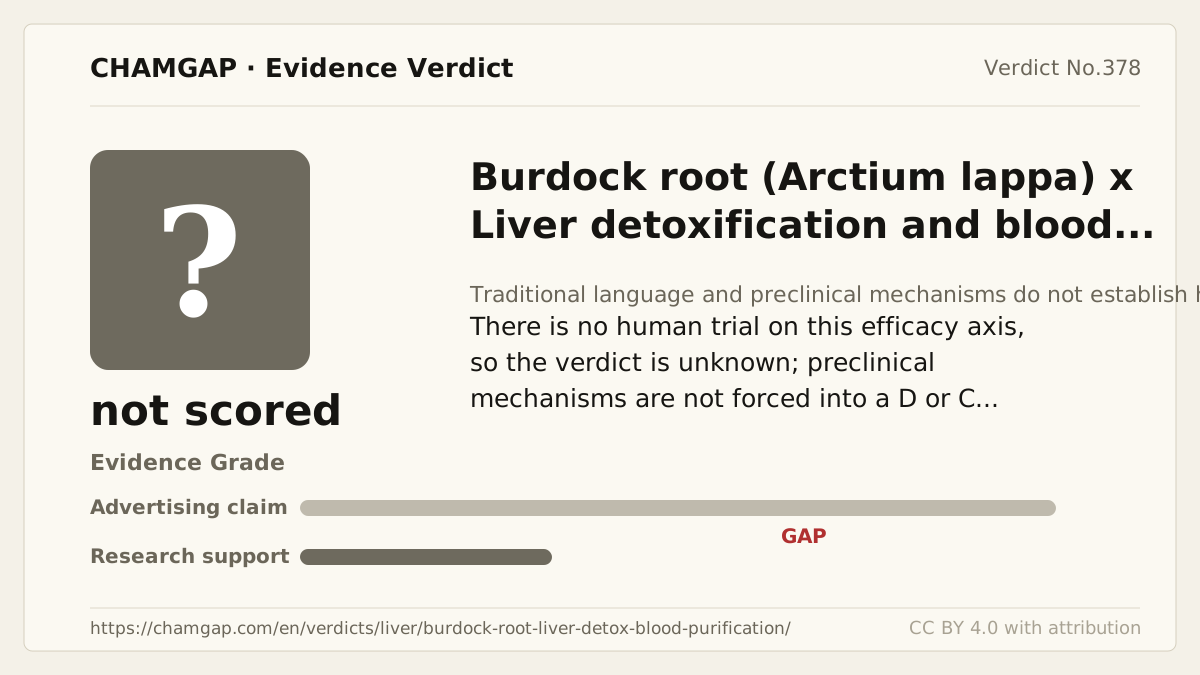
research showsThe verdict is unknown because no standalone human efficacy trial was identified showing that burdock root removes toxins, improves liver disease, or 'purifies blood.' Animal antioxidant or hepatoprotective experiments, traditional diuretic and digestive language, and biomarker studies in unrelated diseases do not establish this human claim.
ads claimMarketing combines traditional 'blood cleansing,' diuresis, and animal antioxidant or hepatoprotective mechanisms under the label 'liver detox.' Urine volume or digestive sensations are not evidence of hepatic detoxification.
Useful facts when choosing a product
- In Korea, burdock is sold as tea, roasted root, powder, concentrates, and mixed teas.
- There is no validated research dose for liver detoxification or blood purification.
- Tea and food are not equivalent to concentrated extracts, and constituent content is not standardized.
- Asteraceae allergy, concurrent diuretic or glucose-lowering medicines, pregnancy or lactation, and species substitution or contamination warrant caution separately from efficacy.
Chamgap Semantic Classification Code
Candidate index · review held
UNK.burdock-root.UNK.liver-detoxification-and-blood-purification.assess.placeboUnknown > Burdock root > Unknown > Liver detoxification and blood purification > Association or change assessment > Placebo
An automated migration candidate, not an issued permanent code; exact claim scope remains under review. This machine-generated migration candidate helps retrieval but is not a permanent assignment. The original verdict ID and URL remain authoritative.
What the research actually shows
No human liver-efficacy trial exists, so the verdict remains unknown. A 36-person knee-osteoarthritis study assessed IL-6, high-sensitivity C-reactive protein, and oxidative-stress markers, an unrelated indication. PMC4564434 was a preclinical study in 48 rats with acetaminophen hepatotoxicity. NCT07002762 is a registered asymptomatic-hyperuricemia trial, not a liver-detoxification study, and has no posted results. The record therefore contains only traditional, preclinical, and unrelated-indication evidence.
Why this is classified as ?
The relevant human efficacy literature was not identified, so the rating is unknown with a null score. Preclinical findings were not used to invent a numerical rating or a C grade.
Counterpoint. A future controlled trial of standardized standalone burdock root would require reassessment using objective disease-specific endpoints.
Rejudgment record. Reassessment (cross-check reflected) — No standalone human efficacy trial of burdock root for liver detoxification or blood purification; only unrelated, preclinical, and unpublished registered evidence was identified
Cross-check — AI research and Codex final gate
Evidence Table
| Study | Design | Sample | Funding | Endpoint | Result | Weight |
|---|---|---|---|---|---|---|
| Maghsoumi-Norouzabad et al. (2016) | Randomized controlled human trial in knee osteoarthritis | 36 | Academic research | IL-6, high-sensitivity C-reactive protein, and oxidative-stress markers | Selected inflammatory and oxidative-stress markers improved; liver detoxification and blood purification were not assessed | Indirect, unrelated indication |
| El-Kott and Bin-Meferij (2015) | Animal study of acetaminophen-induced hepatotoxicity | 48 | Academic research | ALT, AST, ALP, histopathology, and oxidative stress | Burdock-root extract mitigated selected liver-injury measures, but this was not human evidence | Indirect, preclinical |
| NCT07002762 | Registered multicenter double-blind randomized placebo-controlled trial | 100 | OMNIFARMA LLC | Uric acid and safety | Not a liver-detoxification trial; no results posted | Indirect, unrelated indication, unpublished |
Receipt — 3 References
All 3 cited sources were verified for existence at the original page (as of 2026-07-16).
Final verification and publication gate: Codex · Evidence date: 2026-07-16 · Corrections: none
Cite this verdict
[Chamgap] Burdock root x liver detoxification and blood purification — Evidence Grade ?. 3 cited sources checked. Source: https://chamgap.com/en/verdicts/liver/burdock-root-liver-detox-blood-purification/ · CC BY 4.0CC BY 4.0 — free to use with attribution; do not distort grades, numbers, or verdict meaning.
What this document does and does not do
Chamgap is an information source. It reports what research has and has not confirmed; it does not tell readers what to take or buy. That decision belongs to readers and, when needed, medical or legal professionals. This verdict reflects literature available up to the search date and may change as new research appears. Nothing here is medical advice.