
Regular xylitol gum, syrup, or lozenges in daycare children,
does it really help with Prevention of acute otitis media?
research showsGrade C with 54 points. A 1996 five-times-daily gum trial found 19/157 versus 31/149 acute otitis episodes, an 8.7-percentage-point difference. Later syrup trials using two or three daily doses or treatment only during respiratory infection did not confirm benefit. Frequency and timing matter more than the generic xylitol label.
ads claimAny formulation or frequency of xylitol is portrayed as preventing ear infections.
Useful facts when choosing a product
- The early positive gum regimen used five daily doses.
- Dental-caries verdict 748 is a different outcome.
- Actual use in the recent trial averaged roughly twice daily.
Chamgap Semantic Classification Code
Permanent code issued
S.xylitol.oral.acute-otitis-media-incidence.prevent.placeboSupplements and nutraceuticals > Regular xylitol gum, syrup, or lozenges in daycare children > Oral > Prevention of acute otitis media > Prevention claim > Placebo
Codex retrospectively verified the principal intervention, delivery, population, endpoint, and comparator from the existing reviewed verdict and issued a permanent semantic code. Secondary outcomes on the page are not transferred as separate claims. The code identifies the intervention and claim; it never contains the evidence grade, score, or safety result.
Exact Claim Classification
These independent facets prevent evidence from different forms, routes, populations, effects, and comparators from being mixed.
| Intervention class | S · Supplement or nutraceutical |
|---|---|
| Canonical ingredient or intervention | Regular xylitol gum, syrup, or lozenges in daycare children |
| Source or part used | Single supplement ingredient specified in the verdict; unreported manufacturing details remain unverified |
| Formulation or processing | Regular xylitol gum, syrup, or lozenges in daycare children |
| Route | Oral |
| Dose | Regular xylitol gum, syrup, or lozenges in daycare children |
| Duration | About two to three months across trials |
| Population | 306 analyzed in the 1996 gum trial |
| Effect or condition | Prevention of acute otitis media |
| Primary endpoint | Acute otitis media events |
| Comparator | Placebo |
| Duplicate-detection key | xylitol|oral|306 analyzed in the 1996 gum trial|acute-otitis-media-incidence|About two to three months across trials |
What the research actually shows
Older Finnish daycare trials providing xylitol five times daily were contrasted with US and Canadian studies using two or three daily doses or dosing during respiratory infection. Formulation and frequency changed together, preventing a clean formulation-only inference.
Why this is classified as C (54)
A direct event signal and public support are strengths, but regimen-dependent results, short trials, and treatment burden yield C with 54 points.
Counterpoint. Only nine events occurred in the 2024 trial, so its null estimate is neither proof of harm nor equivalence.
Rejudgment record. Cross-check applied — Separated early high-frequency gum and syrup, lozenges, infection-triggered use, and later low-frequency trials by formulation, frequency, and timing
| Endpoint | H | Hard endpoint - actual events such as death |
| Replication | R0 | Trials conflict in direction |
| Independence | I1 | Mixed funding sources |
| Effect size | E+ | Meets the clinically important threshold |
Stored derived and displayed grades match; this is not a current recalculation or validity check (C).
Sub-claim grades by effect
This ingredient is marketed for several effects. A single overall grade blends strong and weak claims together, so each effect is graded separately here. The overall grade reflects the strongest disconfirming or core claim.
| Effect (sub-claim) | Grade | Basis |
|---|---|---|
| Five-times-daily prophylaxis | C | Early gum and syrup trials were positive. |
| Two or three daily doses or infection-triggered use | D | Later direct trials did not confirm benefit. |
Cross-check — AI research and Codex final gate
Evidence Table
| Study | Design | Sample | Funding | Endpoint | Result | Weight |
|---|---|---|---|---|---|---|
| Uhari M et al. 1996 and 1998 | High-frequency randomized daycare trials | 306 analyzed in the 1996 gum trial | Indexed non-US government support; complete product involvement incompletely verified | Acute otitis media events | Gum 19/157 vs 31/149; difference 8.7 points (95% CI 0.4-17.0), P=.04 | Positive high-frequency evidence |
| Vernacchio L et al. 2014 | Pragmatic lower-frequency syrup trial | Trial in high-risk children | NIH and non-US government support | Acute otitis media occurrence | HR 0.88 (95% CI 0.61-1.30), null | Contrary lower-frequency evidence |
| Persaud N et al. 2024 | Twice-daily-target syrup randomized trial | 250 participants | Public research support | Acute otitis media events | 6 vs 3 events; OR 2.04 (0.43-12.92), P=.50 | Recent lower-frequency null trial |
Receipt — 4 References
All 4 cited sources were verified for existence at the original page (as of 2026-09-07).
Final verification and publication gate: Codex · Evidence date: 2026-09-07 · Corrections: none
Cite this verdict
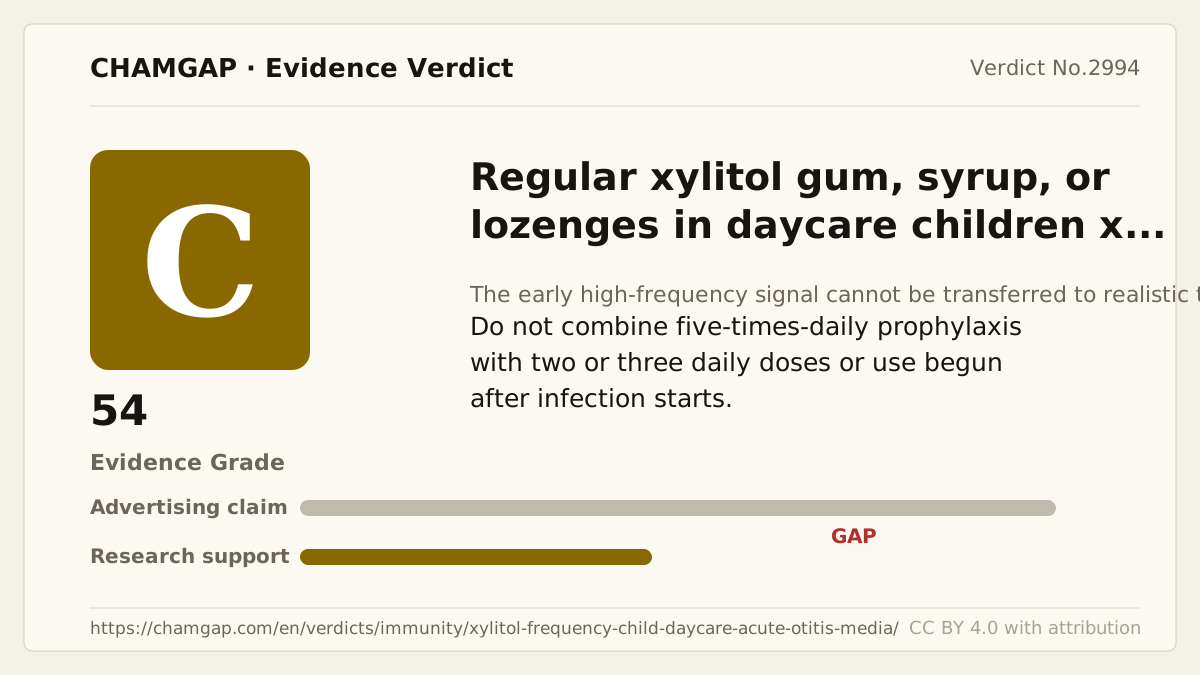
[Chamgap] Xylitol for Childhood Acute Otitis Media—Early Five-Times-Daily Signal, Null Lower-Frequency Trials — Evidence Grade C·54. 4 cited sources checked. Source: https://chamgap.com/en/verdicts/immunity/xylitol-frequency-child-daycare-acute-otitis-media/ · CC BY 4.0CC BY 4.0 — free to use with attribution; do not distort grades, numbers, or verdict meaning.
What this document does and does not do
Chamgap is an information source. It reports what research has and has not confirmed; it does not tell readers what to take or buy. That decision belongs to readers and, when needed, medical or legal professionals. This verdict reflects literature available up to the search date and may change as new research appears. Nothing here is medical advice.