
Area-wide deployment of wMel Wolbachia-infected Aedes aegypti,
does it really help with Reduced symptomatic virologically confirmed dengue?
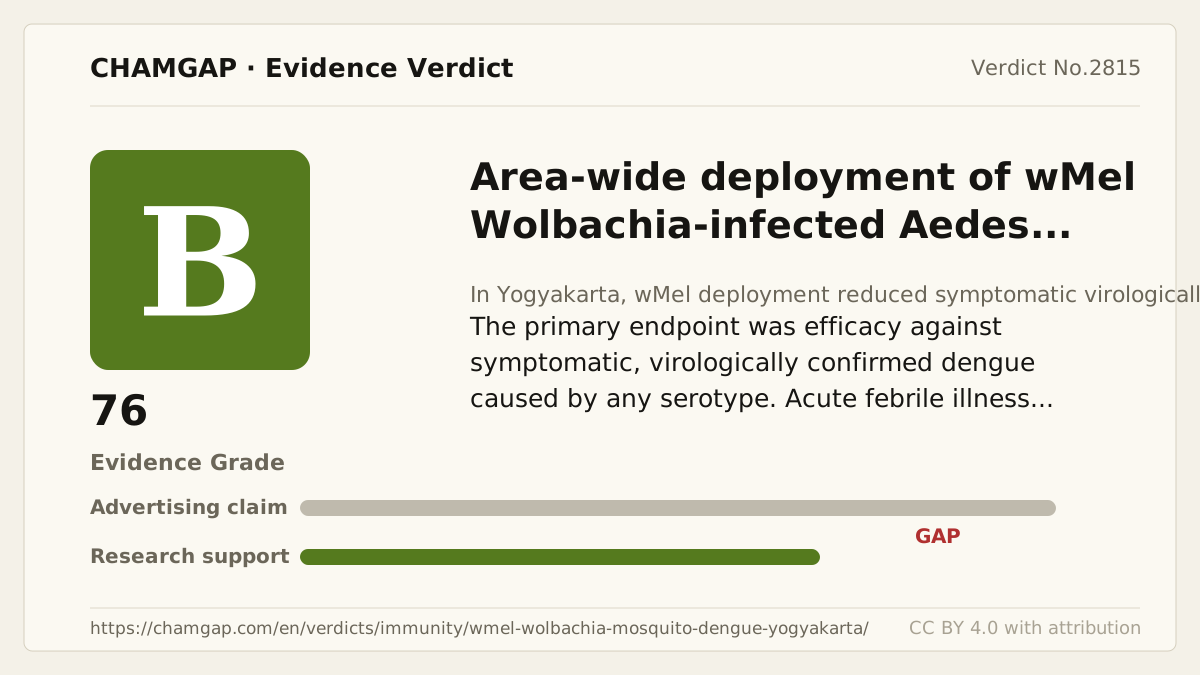
research showsThe grade is B. AWED cluster-randomized 24 urban areas in Yogyakarta. Symptomatic virologically confirmed dengue occurred in 67/2,905 (2.3%) from wMel clusters versus 318/3,401 (9.4%) from control clusters: OR 0.23 (95% CI 0.15 to 0.35), protective efficacy 77.1%, and an observed absolute difference of -7.1 points. The effect was large, but independent confirmation of the same question is absent.
ads claimSouth Korea currently has no endemic dengue transmission, so direct domestic deployment relevance is limited. The topic remains relevant to travel-associated infection and climate-change vector surveillance, while direct policy relevance is greatest in endemic regions.
Useful facts when choosing a product
- wMel becomes established in mosquito populations and reduces their capacity to transmit dengue virus.
- This is a community-wide public-health intervention, not a drug administered to individuals.
- Median monthly cluster-level wMel prevalence was 95.8% during 27 months of surveillance.
Chamgap Semantic Classification Code
Candidate index · review held
UNK.area-wide-deployment-of-wmel-wolbachia-infected-aedes-aegypti.UNK.symptomatic-virologically-confirmed-dengue.reduce.UNKUnknown > Area-wide deployment of wMel Wolbachia-infected Aedes aegypti > Unknown > symptomatic virologically confirmed dengue > Reduction claim > Unknown
An automated migration candidate, not an issued permanent code; exact claim scope remains under review. This machine-generated migration candidate helps retrieval but is not a permanent assignment. The original verdict ID and URL remain authoritative.
What the research actually shows
In a cluster trial, allocation concealment concerns fixing cluster boundaries and balance rules before treatment assignment so investigators cannot favor particular neighborhoods; it is not concealment of an individual's treatment. AWED prespecified 24 clusters and balance criteria, then randomly selected one eligible allocation. Releases were open after assignment, but most residents were unaware and research staff were kept unaware of participant exposure during follow-up, laboratory testing, and classification. Tahija Foundation funded World Mosquito Program activities in Indonesia, while Wellcome Trust and the Bill and Melinda Gates Foundation supported WMP. Universitas Gadjah Mada sponsored the trial, and funders had no role in analysis, manuscript preparation, or publication decisions.
Axis 6 B0 evidence ① Allocation concealment: "All potential allocations that satisfy these balancing criteria will be retained, and non-balanced possibilities rejected. Finally, a single allocation pattern will be randomly selected from within the restricted list of balanced possibilities." ② Masking: "Trial procedures, such as the concealment from research staff of the wolbachia exposure status of the participants, were designed to prevent bias in follow-up, laboratory testing, and outcome classification." ③ Analysis set and missing data: "The intention-to-treat (primary) analysis will consider Wolbachia exposure as a binary classification based on residence in a cluster allocated to Wolbachia deployment or not." ④ Prespecified primary endpoint: "Primary endpoint Symptomatic, virologically-confirmed dengue virus (DENV) infection of any severity." - consistent with NCT03055585 and INA-A7OB6TW
Why this is classified as B (76)
A nonprofit-funded cluster-randomized trial reduced symptomatic confirmed dengue from 9.4% to 2.3%, an observed 7.1-point difference, without an identified avoidable design defect. Lack of independent replication gives B with 76 points.
Counterpoint. B does not imply a small effect; it reflects the single-confirmatory-trial evidence structure, while the observed absolute effect was large.
Rejudgment record. Article, protocol, and registry cross-check — Virologically confirmed symptomatic dengue, relative and absolute effects, prespecified cluster allocation and masked analysis, nonprofit funding, and one confirmatory trial
| Endpoint | H | Hard endpoint - actual events such as death |
| Replication | R1 | Single confirmatory trial |
| Independence | I2 | Decisive evidence is publicly or non-profit funded |
| Effect size | E+ | Meets the clinically important threshold |
Stored derived and displayed grades match; this is not a current recalculation or validity check (B).
Sub-claim grades by effect
This ingredient is marketed for several effects. A single overall grade blends strong and weak claims together, so each effect is graded separately here. The overall grade reflects the strongest disconfirming or core claim.
| Effect (sub-claim) | Grade | Basis |
|---|---|---|
| Reduction in symptomatic virologically confirmed dengue | B | Rates were 2.3% versus 9.4%, an absolute difference of -7.1 points. |
| Reduction in hospitalization with confirmed dengue | B | Rates were 0.4% versus 3.0%, an absolute difference of -2.6 points. |
Cross-check — AI research and Codex final gate
Evidence Table
| Study | Design | Sample | Funding | Endpoint | Result | Weight |
|---|---|---|---|---|---|---|
| Utarini A et al. 2021 AWED | Urban cluster-randomized test-negative controlled trial | 24 clusters randomized (12/12); 8,144 enrolled; 6,306 in ITT analysis (2,905/3,401) | Tahija Foundation supported WMP activities in Indonesia; Wellcome Trust and Bill and Melinda Gates Foundation supported WMP; funders had no role in analysis, manuscript, or publication | Symptomatic virologically confirmed dengue virus infection of any serotype | 67/2,905 (2.3%) versus 318/3,401 (9.4%), absolute difference -7.1 points, OR 0.23 (95% CI 0.15 to 0.35), protective efficacy 77.1% (65.3 to 84.9) | Large nonprofit-funded cluster-randomized clinical infection evidence; Indonesian registration INA-A7OB6TW also confirmed |
Receipt — 1 References
All 1 cited sources were verified for existence at the original page (as of 2026-08-18).
Final verification and publication gate: Codex · Evidence date: 2026-08-18 · Corrections: none
Cite this verdict
[Chamgap] Efficacy of Wolbachia-Infected Mosquito Deployments for the Control of Dengue - Benefit — Evidence Grade B·76. 1 cited sources checked. Source: https://chamgap.com/en/verdicts/immunity/wmel-wolbachia-mosquito-dengue-yogyakarta/ · CC BY 4.0CC BY 4.0 — free to use with attribution; do not distort grades, numbers, or verdict meaning.
What this document does and does not do
Chamgap is an information source. It reports what research has and has not confirmed; it does not tell readers what to take or buy. That decision belongs to readers and, when needed, medical or legal professionals. This verdict reflects literature available up to the search date and may change as new research appears. Nothing here is medical advice.