
Whole sauerkraut,
does it really help with Reduction in systemic inflammation?
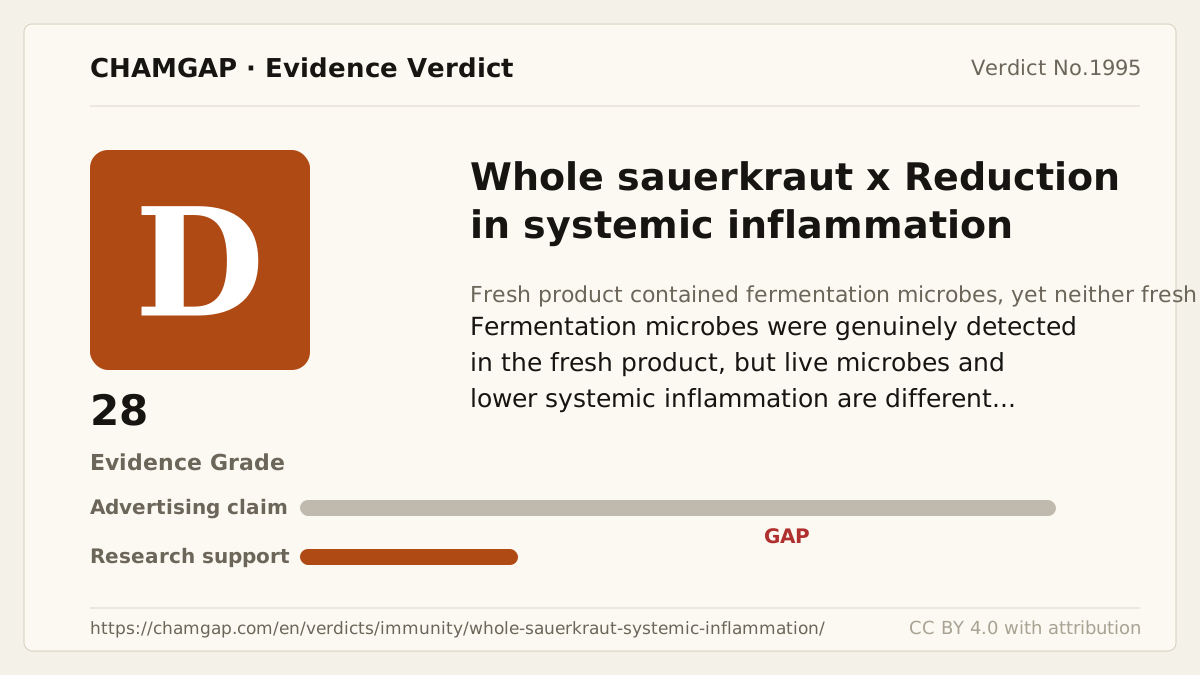
research showsThe grade is D with 30 points. In a 2026 crossover trial that randomized 102 adults and analyzed 87, eating 100 g/day fresh or pasteurized sauerkraut for four weeks each did not significantly improve hsCRP or other systemic inflammatory markers in the full population. An earlier 31-woman fermented-vegetable trial was also null for inflammatory markers, but the evidence did not fully exclude meaningful benefit.
ads claimThe presence of fermentation microbes in fresh sauerkraut should not be expanded into a systemic anti-inflammatory effect. Neither fresh nor pasteurized product lowered systemic inflammatory markers in the full trial population.
Useful facts when choosing a product
- Salt was 0.8% in the fresh product and 1.2% in the pasteurized product. Converted per 100 g, this is about 314 mg and 472 mg sodium, or roughly 16% and 24% of a 2,000 mg daily value.
- Histamine and tyramine in the specific trial batches were not confirmed.
- Nitrite and N-nitroso compounds in the specific trial batches were not confirmed.
- Fermentation microbes were detected in the fresh product, while the pasteurized product was below the detection limit. Neither product significantly reduced systemic inflammation in the full population.
- Sauerkraut belongs to Central and Eastern European fermented-vegetable traditions; an East Asian classical description was not confirmed.
Chamgap Semantic Classification Code
Candidate index · review held
F.whole-sauerkraut.food.systemic-inflammation.reduce.UNKFoods and beverages > Whole sauerkraut > Food consumption > systemic inflammation > Reduction claim > Unknown
An automated migration candidate, not an issued permanent code; exact claim scope remains under review. This machine-generated migration candidate helps retrieval but is not a permanent assignment. The original verdict ID and URL remain authoritative.
What the research actually shows
The 2026 European Journal of Clinical Nutrition paper was checked against DRKS00027007. Of 102 randomized participants, 87 entered the final analysis and 84 completed every period. The study started October 11, 2021 and was registered October 29, so registration was retrospective. The inflammatory markers were not registered primary or secondary outcomes. Fresh and pasteurized groups were two arms within one trial, not replications. A separate 2022 pilot combined fermented cabbage and cucumber and was not treated as an exact replication of whole sauerkraut.
Why this is classified as D (30)
Full-population inflammatory markers were null, but the available precision retained room for meaningful benefit. Fresh and pasteurized products were two arms of one trial, not replications, and the analyzed markers were not registered primary or secondary outcomes. Each exposure lasted only four weeks, yielding D with 30 points rather than F.
Counterpoint. The microbes and fermentation metabolites remain researchable, but this study did not demonstrate a systemic anti-inflammatory effect of whole sauerkraut.
Rejudgment record. Cross-check applied — Primary-paper review of Table 2 confidence intervals and analyzed sample, plus cross-checking the actual start date, retrospective registration date, and registered primary and secondary outcomes
| Endpoint | S | Surrogate marker - laboratory or imaging measures |
| Replication | R1 | Single confirmatory trial |
| Independence | I2 | Decisive evidence is publicly or non-profit funded |
| Effect size | E0 | Null |
| Precision | C0 | The confidence interval leaves room for benefit |
Stored derived and displayed grades match; this is not a current recalculation or validity check (D).
Sub-claim grades by effect
This ingredient is marketed for several effects. A single overall grade blends strong and weak claims together, so each effect is graded separately here. The overall grade reflects the strongest disconfirming or core claim.
| Effect (sub-claim) | Grade | Basis |
|---|---|---|
| Fermentation microbes are detectable in fresh sauerkraut | D | This was directly measured in the trial product and is separate from inflammation efficacy. |
| Whole sauerkraut lowers systemic inflammation | D | The direct full-population result was null, although confidence intervals left room for benefit. |
Cross-check — AI research and Codex final gate
Evidence Table
| Study | Design | Sample | Funding | Endpoint | Result | Weight |
|---|---|---|---|---|---|---|
| Schropp N et al., European Journal of Clinical Nutrition, 2026 | Randomized crossover trial, four weeks each of fresh and pasteurized product | 102 randomized, 87 in final analysis, 84 completed all periods | No study funding reported; open-access charges supported by Projekt DEAL; manufacturer unaware its product was used | Serum inflammatory markers including hsCRP | No significant improvement in the full population; Table 2 confidence intervals included no effect | Direct null result, but unregistered and exploratory with confidence intervals leaving room for benefit |
| Galena AE et al., PLOS ONE, 2022 | Three-arm randomized pilot and feasibility trial, six weeks | 34 randomized, 31 women completed | Internal Us Women and Girls' Health Endowed Research Professorship grant 764010 | CRP, TNF-alpha, and LBP | No inflammatory-marker improvement after 100 g/day fermented cabbage or cucumber | Independent but very small null pilot evidence for a related inflammation claim |
Receipt — 4 References
All 4 cited sources were verified for existence at the original page (as of 2026-08-02).
Final verification and publication gate: Codex · Evidence date: 2026-08-02 · Corrections: none
Cite this verdict
[Chamgap] Whole sauerkraut x systemic inflammation reduction — Evidence Grade D·30. 4 cited sources checked. Source: https://chamgap.com/en/verdicts/immunity/whole-sauerkraut-systemic-inflammation/ · CC BY 4.0CC BY 4.0 — free to use with attribution; do not distort grades, numbers, or verdict meaning.
What this document does and does not do
Chamgap is an information source. It reports what research has and has not confirmed; it does not tell readers what to take or buy. That decision belongs to readers and, when needed, medical or legal professionals. This verdict reflects literature available up to the search date and may change as new research appears. Nothing here is medical advice.