
Vitamin D3,
does it really help with Prevention of severe asthma exacerbations requiring systemic corticosteroids in children and adults?
research showsVitamin D3 is rated D because it did not prevent severe asthma exacerbations in children or adults. The 2023 Cochrane update reviewed 20 double-blind randomized trials, and the rate of exacerbations requiring systemic corticosteroids was not significantly reduced, with a rate ratio of 0.86 (95% CI 0.62 to 1.19). Secondary efficacy outcomes, including asthma control and lung function, also did not improve, and the earlier positive 2016 conclusion disappeared after additional trials were included. A null high-quality pivotal meta-analysis yields D with 28 points.
ads claimMarketing converts observational associations between low vitamin D status and asthma severity into a causal prevention claim for supplementation. Updated randomized evidence did not confirm benefits for systemic-corticosteroid exacerbations, routine control, or lung function.
Useful facts when choosing a product
- Cholecalciferol is the vitamin D3 form and is sold in many doses as a nonprescription medicine and dietary supplement.
- Most trials in the 2023 Cochrane review added vitamin D to established asthma treatment and did not replace inhalers or systemic corticosteroids.
- Ordinary supplement doses are generally well tolerated, but prolonged excessive intake can cause hypercalcemia, kidney stones, and kidney injury.
- The VDKA pediatric trial tested 4,000 IU per day even in participants with low vitamin D levels and did not establish prevention of severe exacerbations.
Chamgap Semantic Classification Code
Candidate index · review held
UNK.vitamin-d3.UNK.severe-asthma-exacerbations-requiring-systemic-corticosteroids-and-adults.prevent.placeboUnknown > Vitamin D3 (cholecalciferol) > Unknown > severe asthma exacerbations requiring systemic corticosteroids and adults > Occurrence-prevention claim > Placebo
An automated migration candidate, not an issued permanent code; exact claim scope remains under review. This machine-generated migration candidate helps retrieval but is not a permanent assignment. The original verdict ID and URL remain authoritative.
What the research actually shows
The 2023 Cochrane review by Williamson and colleagues included 20 double-blind randomized placebo-controlled trials, most of which tested cholecalciferol. It found no benefit for exacerbations requiring systemic corticosteroids, time to first exacerbation, asthma control, or lung function. The VDKA trial by Forno and colleagues assigned 192 children aged 6 to 16 years with low vitamin D levels who used inhaled corticosteroids to vitamin D3 at 4,000 IU per day or placebo for 48 weeks; time to severe exacerbation did not improve. This is an asthma-exacerbation claim distinct from prior immunity, fracture, depression, and cancer verdicts.
Why this is classified as D (28)
In the 2023 Cochrane review of 20 trials, high-quality evidence gave a rate ratio of 0.86 for systemic-corticosteroid exacerbations with a confidence interval crossing the null, while asthma control and lung function also failed to improve. Boundary rule ② for a null pivotal meta-analysis yields D with 28 points.
Counterpoint. This result addresses prevention of asthma exacerbations and does not evaluate correction of medically confirmed vitamin D deficiency.
Rejudgment record. New verdict — Applied boundary rule ② because the 2023 Cochrane update found high-quality null evidence for systemic-corticosteroid exacerbations, with a rate ratio of 0.86 (95% CI 0.62 to 1.19), and null findings for time to first exacerbation and secondary efficacy outcomes
Sub-claim grades by effect
This ingredient is marketed for several effects. A single overall grade blends strong and weak claims together, so each effect is graded separately here. The overall grade reflects the strongest disconfirming or core claim.
| Effect (sub-claim) | Grade | Basis |
|---|---|---|
| Prevention of severe exacerbations requiring systemic corticosteroids | D | The high-quality Cochrane analysis was null with a rate ratio of 0.86 (95% CI 0.62 to 1.19). |
| Improved asthma control | D | No improvement appeared in the meta-analyzable secondary efficacy outcomes of the 2023 update. |
| Improved lung function | D | No significant benefit was established for lung-function outcomes. |
Cross-check — AI research and Codex final gate
Evidence Table
| Study | Design | Sample | Funding | Endpoint | Result | Weight |
|---|---|---|---|---|---|---|
| Williamson A et al. Cochrane 2023 | Systematic review and meta-analysis of double-blind randomized placebo-controlled trials | 20 trials; 10 trials and 1,599 participants in the systemic-corticosteroid exacerbation-rate analysis | Academic Cochrane review with author disclosures | Exacerbations requiring systemic corticosteroids, time to first exacerbation, asthma control, and lung function | The exacerbation rate ratio was null at 0.86 (95% CI 0.62 to 1.19), and secondary efficacy outcomes did not improve. | Pivotal high-quality null synthesis |
| Forno E et al. VDKA 2020 | Randomized double-blind placebo-controlled trial | 192 children with asthma and low vitamin D levels | Public funding from the United States NHLBI | Time to severe asthma exacerbation over 48 weeks | Vitamin D3 did not improve time to severe exacerbation, with an adjusted HR of 1.13 (95% CI 0.69 to 1.85). | Representative direct null pediatric trial |
Receipt — 2 References
All 2 cited sources were verified for existence at the original page (as of 2026-07-23).
Final verification and publication gate: Codex · Evidence date: 2026-07-23 · Corrections: none
Cite this verdict
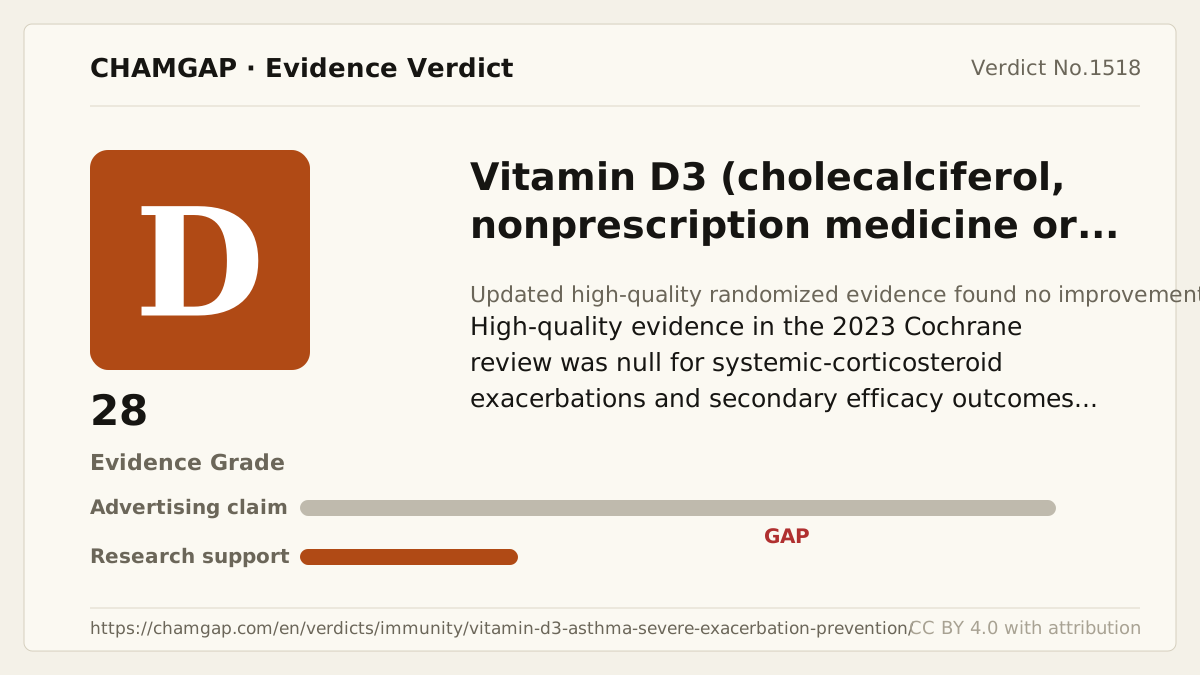
[Chamgap] Vitamin D3 x prevention of severe asthma exacerbations requiring systemic corticosteroids — Evidence Grade D·28. 2 cited sources checked. Source: https://chamgap.com/en/verdicts/immunity/vitamin-d3-asthma-severe-exacerbation-prevention/ · CC BY 4.0CC BY 4.0 — free to use with attribution; do not distort grades, numbers, or verdict meaning.
What this document does and does not do
Chamgap is an information source. It reports what research has and has not confirmed; it does not tell readers what to take or buy. That decision belongs to readers and, when needed, medical or legal professionals. This verdict reflects literature available up to the search date and may change as new research appears. Nothing here is medical advice.