
UV-C terminal-room disinfection added to standard cleaning,
does it really help with Reduced first target-organism clinical-culture or test positivity in the next room occupant?
research showsThe grade is C with 56 points. All-target-organism events were 115 during 22,426 exposure-days with reference cleaning, 51.3 per 10,000 days, versus 76 during 22,389 days with added UV-C, 33.9 per 10,000. The absolute rate difference was -17.4 per 10,000 exposure-days and RR 0.70 (95% CI 0.50 to 0.98). The co-primary C. difficile comparison was null: 30.4 versus 31.6, RR 1.0 (0.57 to 1.75).
ads claimUV disinfection robots are marketed and deployed in Korean infection-control programs. The absolute reduction was 17.4 per 10,000 exposure-days, or roughly 0.8 percentage points by patient proportions, 2.3% versus 1.5%. Reporting only a 30% relative reduction overstates the visual impression of a low-rate outcome.
Useful facts when choosing a product
- Median room-cleaning time increased by about four minutes, and emergency-department departure after an admit decision was about 10 to 20 minutes longer with enhanced strategies.
- One hospital reported one UV-C exposure event.
- The trial used Tru-D SmartUVC, and substantial in-kind contributions from device and disinfectant companies were disclosed.
Chamgap Semantic Classification Code
Candidate index · review held
UNK.uv-c-terminal-room-disinfection-added-to-standard-cleaning.UNK.first-target-organism-clinical-culture-or-test-positivity-in-the-next-room-occupant.reduce.addonUnknown > UV-C terminal-room disinfection added to standard cleaning > Unknown > first target-organism clinical-culture or test positivity in the next room occupant > Reduction claim > Added intervention on common background care
An automated migration candidate, not an issued permanent code; exact claim scope remains under review. This machine-generated migration candidate helps retrieval but is not a permanent assignment. The original verdict ID and URL remain authoritative.
What the research actually shows
Nine southeastern US hospitals used each of four strategies in successive seven-month periods in a cluster-randomized crossover trial. Of 31,226 exposed patients, 21,395 met prespecified qualification criteria and entered the ITT analysis. Limitation name: inadequate allocation concealment. Which listed item: inappropriate randomization or allocation concealment. Hospital-period sequences were generated with random numbers, but the report states, "Allocation was not masked." In a cluster trial, concealment concerns advance knowledge of the hospital's next period strategy, not concealment of an individual patient's treatment. Was it avoidable: yes - a central system could reveal each strategy only at period activation and separate bed-allocation and culture-data personnel. Individual patient masking was not separately counted because patients were not the allocation unit and the endpoint used cultures or PCR. Completer analysis was not applicable because ITT was primary. Substantial attrition (>=15%): the 9,831/31,226 exclusions applied prespecified 24-hour exposure and prior-positive case definitions rather than loss to follow-up. CDC and NIH grants were public, but TruD SmartUVC, Ecolab, and Clorox made significant material contributions, and two authors reported Clorox consulting fees.
Why this is classified as C (56)
A large cluster-randomized trial found fewer actual all-target culture events, but the C. difficile co-primary endpoint was null, allocation was unmasked, and companies supplied trial materials. Split co-primary results cap the grade at C with 56 points.
Counterpoint. Effect was not uniform across organisms. Baseline cleaning quality, bleach use, robot adherence, room-turnover pressures, and culture practice can change absolute benefit in Korean hospitals.
Rejudgment record. Article, registry, and acknowledgments cross-check — Two primary endpoints, ITT absolute and relative effects, unmasked cluster allocation, public grants, and company material contributions
| Endpoint | H | Hard endpoint - actual events such as death |
| Replication | R1 | Single confirmatory trial |
| Independence | I1 | Mixed funding sources |
| Effect size | E+ | Meets the clinically important threshold |
Stored derived and displayed grades match; this is not a current recalculation or validity check (C).
Sub-claim grades by effect
This ingredient is marketed for several effects. A single overall grade blends strong and weak claims together, so each effect is graded separately here. The overall grade reflects the strongest disconfirming or core claim.
| Effect (sub-claim) | Grade | Basis |
|---|---|---|
| Reduced acquisition or infection with all target organisms | C | RR was 0.70, with an absolute -17.4 per 10,000 exposure-days. |
| Reduced C. difficile | D | The result was null: 30.4 versus 31.6, RR 1.0. |
| Reduced MRSA and VRE individually | D | Individual-organism ITT intervals included 1. |
Cross-check — AI research and Codex final gate
Evidence Table
| Study | Design | Sample | Funding | Endpoint | Result | Weight |
|---|---|---|---|---|---|---|
| Anderson DJ et al. 2017 BETR Disinfection | Nine-hospital cluster-randomized crossover trial | 31,226 exposed; 21,395 meeting prespecified qualification criteria in the ITT population | CDC and NIH public grants plus material contributions from TruD SmartUVC, Ecolab, and Clorox | First qualifying same-target-organism clinical culture or test in the next room occupant | All targets 51.3 versus 33.9 per 10,000 exposure-days; absolute difference -17.4; RR 0.70 (95% CI 0.50 to 0.98). C. difficile 31.6 versus 30.4; absolute difference -1.2; RR 1.0 (0.57 to 1.75) | Pivotal large cluster trial with split co-primary results |
Receipt — 1 References
All 1 cited sources were verified for existence at the original page (as of 2026-08-18).
Final verification and publication gate: Codex · Evidence date: 2026-08-18 · Corrections: none
Cite this verdict
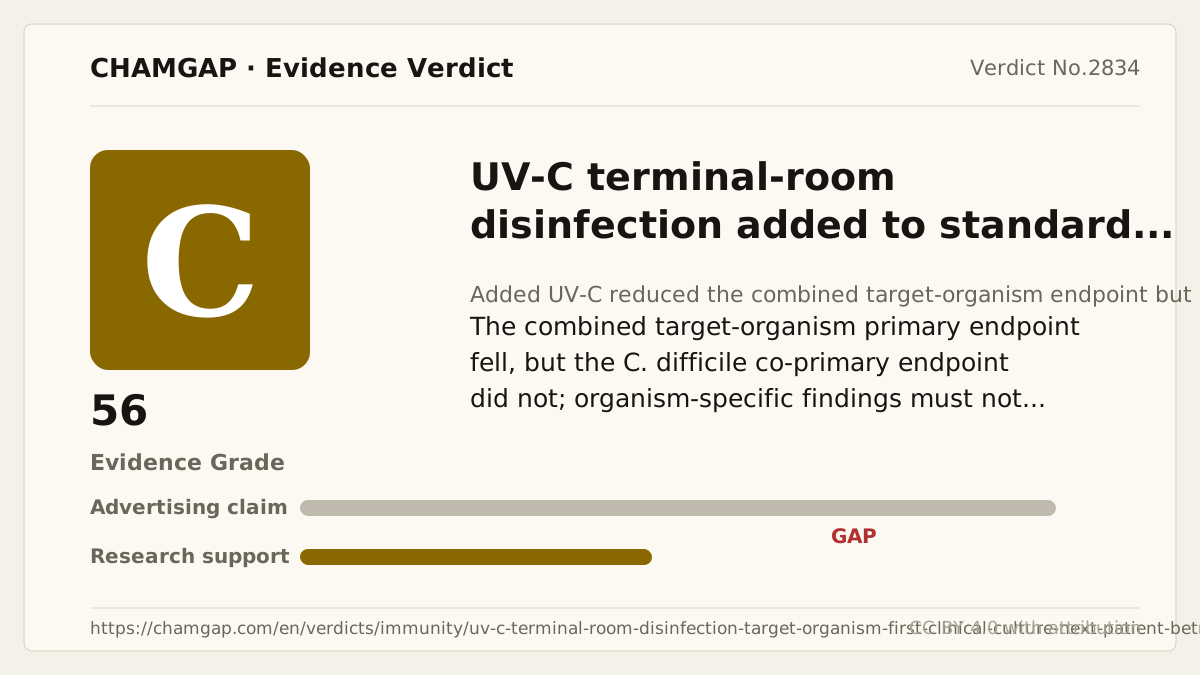
[Chamgap] Adding UV-C Terminal Room Disinfection for Target-Organism First Clinical-Culture Positivity in the Next Patient - Benefit — Evidence Grade C·56. 1 cited sources checked. Source: https://chamgap.com/en/verdicts/immunity/uv-c-terminal-room-disinfection-target-organism-first-clinical-culture-next-patient-betr/ · CC BY 4.0CC BY 4.0 — free to use with attribution; do not distort grades, numbers, or verdict meaning.
What this document does and does not do
Chamgap is an information source. It reports what research has and has not confirmed; it does not tell readers what to take or buy. That decision belongs to readers and, when needed, medical or legal professionals. This verdict reflects literature available up to the search date and may change as new research appears. Nothing here is medical advice.