
Updated mRNA COVID-19 vaccine,
does it really help with Prevention of COVID-19 hospitalization, severe disease, and death in high-risk people?
research showsUpdated mRNA COVID-19 vaccines are rated A because direct reductions in hospitalization, severe disease, and death among high-risk people are consistent across the large initial randomized trial and real-world studies from multiple periods and countries. The initial BNT162b2 trial showed about 95% efficacy against symptomatic COVID-19, while Israeli nationwide data estimated effectiveness of 97.2% against hospitalization, 97.5% against severe or critical disease, and 96.7% against death. Absolute and relative effects are lower in later variant eras and wane over time, but a Nordic study of adults aged 65 years or older still associated the 2023-2024 XBB.1.5-updated vaccine with 57.9% fewer hospitalizations and 75.2% fewer COVID-19-related deaths over 24 weeks. Rare myocarditis and common short-term reactogenicity are recorded separately under safety.
ads claimBoth extremes distort the evidence: vaccination does not guarantee that infection is impossible, and breakthrough infection does not mean protection against severe outcomes is absent. The central benefit, especially in high-risk people, is lower risk of hospitalization, severe disease, and death; protection against infection and against severe disease does not have the same magnitude or duration.
Useful facts when choosing a product
- The BNT162b2 and mRNA-1273 families are professionally administered vaccines whose antigen composition is updated for circulating variants; estimates from an older formulation do not transfer unchanged to every updated formulation.
- The benefit of another dose in a high-risk person depends on time since the last vaccination or infection, age, underlying conditions, and the circulating variant, so current national guidance and clinical assessment should be followed.
- Injection-site pain, fatigue, headache, and fever are common short-term reactions and usually improve within a few days.
- Myocarditis and pericarditis are rare but have been reported relatively more often in adolescent and young adult males, particularly after some second doses. Chest pain, shortness of breath, or palpitations warrants prompt assessment.
Chamgap Semantic Classification Code
Candidate index · review held
M.updated-mrna-covid-19-vaccine.UNK.covid-19-hospitalization-severe-disease-and-death.prevent.placeboMedicinal interventions > Updated mRNA COVID-19 vaccine > Unknown > COVID-19 hospitalization, severe disease, and death > Occurrence-prevention claim > Placebo
An automated migration candidate, not an issued permanent code; exact claim scope remains under review. This machine-generated migration candidate helps retrieval but is not a permanent assignment. The original verdict ID and URL remain authoritative.
What the research actually shows
Polack 2020 randomized 43,548 participants and found 95.0% efficacy of two BNT162b2 doses against symptomatic COVID-19. Haas 2021 analyzed Israeli national surveillance covering 232,268 infections, 7,694 hospitalizations, 4,481 severe or critical hospitalizations, and 1,113 deaths among people aged 16 years or older; estimated effectiveness after two doses was 97.2% against hospitalization, 97.5% against severe or critical disease, and 96.7% against death. Andersson 2024 matched 1,876,282 XBB.1.5-updated vaccine recipients aged 65 years or older to 1,876,282 nonrecipients and observed 1,085 versus 2,635 hospitalizations and 348 versus 1,458 deaths over 24 weeks. A European VEBIS study during JN.1 predominance estimated hospitalization effectiveness of 46% at days 14 to 59 and 34% at days 60 to 119, with no clear effect thereafter, demonstrating variant- and time-dependent waning.
Why this is classified as A (90)
The approximately 95% symptomatic efficacy in the initial 43,548-participant trial, national data on hospitalization, severe disease, and death, and reduced hospitalization and death among about 3.75 million adults aged 65 years or older receiving an XBB.1.5-updated vaccine converge on direct clinical endpoints, supporting A with 90 points. Residual confounding and waning across time and variants prevent a near-perfect score. Myocarditis and reactogenicity are safety issues independent of the efficacy grade.
Counterpoint. Individual benefit tends to be larger when baseline risk is higher. Age- and sex-specific harms, including rare myocarditis in younger males, should be weighed using the current recommendations for product choice and dosing interval.
Rejudgment record. New verdict — Consistent reductions in direct clinical endpoints of hospitalization, severe disease, and death across the large initial placebo-controlled trial, nationwide real-world studies, and a large target-trial emulation of the updated XBB.1.5 vaccine in older adults
Sub-claim grades by effect
This ingredient is marketed for several effects. A single overall grade blends strong and weak claims together, so each effect is graded separately here. The overall grade reflects the strongest disconfirming or core claim.
| Effect (sub-claim) | Grade | Basis |
|---|---|---|
| Prevention of COVID-19-related hospitalization in high-risk people | A | Early national data and a large registry study of the XBB.1.5-updated vaccine in adults aged 65 years or older consistently found fewer hospitalizations. |
| Prevention of severe or critical COVID-19 in high-risk people | A | The direction of severe cases in the large trial and multiple national real-world studies support fewer direct severe outcomes, with magnitude varying by variant and time. |
| Prevention of COVID-19-related death in high-risk people | A | Israeli national data and the Nordic updated-vaccine study in older adults directly found fewer deaths, although residual confounding remains possible. |
Cross-check — AI research and Codex final gate
Evidence Table
| Study | Design | Sample | Funding | Endpoint | Result | Weight |
|---|---|---|---|---|---|---|
| Polack FP et al.; C4591001 Clinical Trial Group. 2020 | Multinational randomized observer-blinded placebo-controlled phase 3 trial | 43,548 participants randomized | Sponsored and conducted with BioNTech and Pfizer | Laboratory-confirmed symptomatic and severe COVID-19 | Efficacy against symptomatic COVID-19 from seven days after dose two was 95.0%; severe cases numbered one with vaccine and nine with placebo. | Key large randomized direct evidence |
| Haas EJ et al. 2021 | Observational effectiveness study using national surveillance data | Israeli population of 6,538,911 people aged 16 years or older; 232,268 infections | Israeli Ministry of Health national data with several Pfizer employee coauthors | Infection, symptomatic disease, hospitalization, severe or critical disease, and death | From seven days after dose two, effectiveness was estimated at 97.2% against hospitalization, 97.5% against severe or critical disease, and 96.7% against death. | Large direct severe-outcome evidence |
| Andersson NW et al. 2024 | Target-trial emulation using Danish, Finnish, and Swedish registries | 1,876,282 vaccinated adults aged 65 years or older matched to 1,876,282 nonrecipients | Supported by the European Medicines Agency; no commercial relationship relevant to the submitted work | COVID-19-related hospitalization and death over 24 weeks | The XBB.1.5-updated mRNA vaccine was associated with 57.9% fewer hospitalizations and 75.2% fewer deaths. | Key updated-vaccine evidence in a high-risk population |
| Oster ME et al. 2022 | Adjudicated descriptive analysis of United States passive-surveillance reports | 192,405,448 people aged 12 years or older and 354,100,845 mRNA vaccine doses | United States CDC and public surveillance | Reporting rates and clinical features of postvaccination myocarditis | Myocarditis was rare, but reporting rates were highest in adolescent and young adult males after a second dose. | Key safety context kept separate from efficacy |
Receipt — 4 References
All 4 cited sources were verified for existence at the original page (as of 2026-07-21).
Final verification and publication gate: Codex · Evidence date: 2026-07-21 · Corrections: none
Cite this verdict
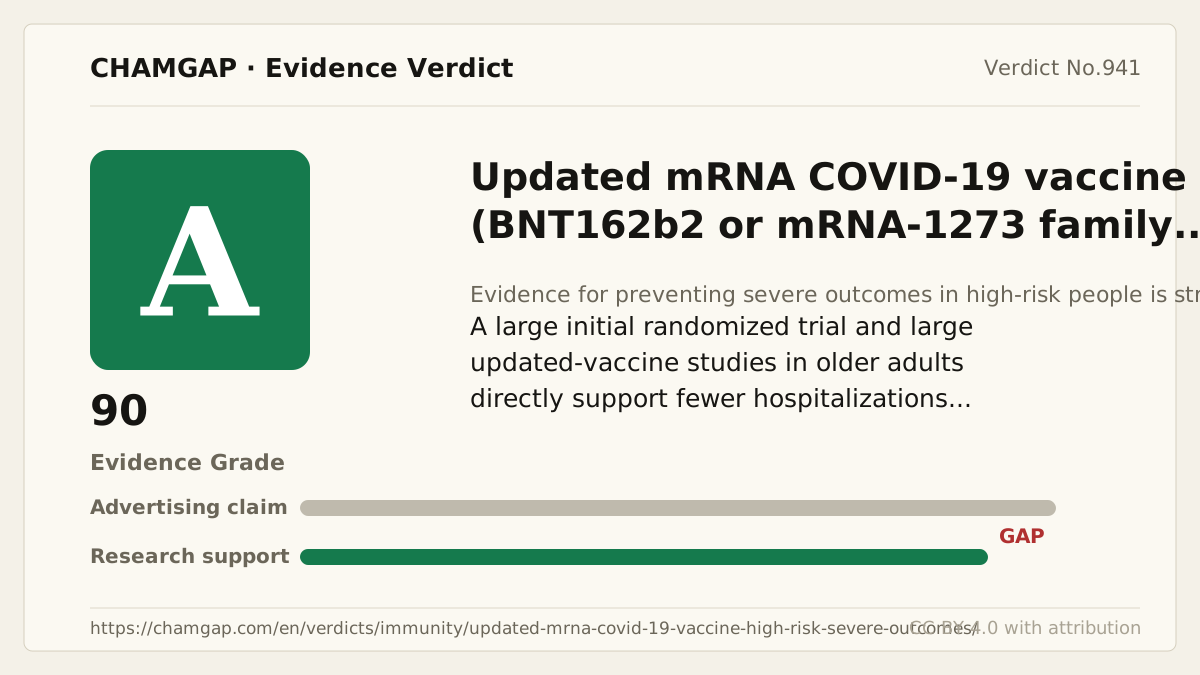
[Chamgap] Updated mRNA COVID-19 vaccine x prevention of hospitalization, severe disease, and death in high-risk people — Evidence Grade A·90. 4 cited sources checked. Source: https://chamgap.com/en/verdicts/immunity/updated-mrna-covid-19-vaccine-high-risk-severe-outcomes/ · CC BY 4.0CC BY 4.0 — free to use with attribution; do not distort grades, numbers, or verdict meaning.
What this document does and does not do
Chamgap is an information source. It reports what research has and has not confirmed; it does not tell readers what to take or buy. That decision belongs to readers and, when needed, medical or legal professionals. This verdict reflects literature available up to the search date and may change as new research appears. Nothing here is medical advice.