
Weekly tocilizumab plus a 26-week steroid taper,
does it really help with Glucocorticoid-free sustained remission at week 52 in giant-cell arteritis?
research showsThe grade is C with 50 points. In GiACTA, sustained remission at week 52 occurred in 56% with weekly tocilizumab versus 14% with placebo plus a 26-week taper and 18% with placebo plus a 52-week taper, both P<.001. Laboratory values alone could determine failure even without symptoms, making this a surrogate composite endpoint, and the pivotal evidence was entirely funded by Roche.
ads claimNormalization of inflammatory markers is real, but this was not a laboratory-only endpoint. Conversely, 56% is not a pure clinical-relapse-free rate, so marketing must disclose the composite definition.
Useful facts when choosing a product
- Tocilizumab is a prescription monoclonal antibody blocking the IL-6 receptor.
- GiACTA sustained remission required remission by week 12, no flare through week 52, normalized CRP, and adherence to the prednisone taper.
- NCT01791153 prespecified sustained remission at week 52.
Chamgap Semantic Classification Code
Candidate index · review held
M.subcutaneous-tocilizumab-with-a-prednisone-taper.subcutaneous.glucocorticoid-free-sustained-remission-at-week-52-in-giant-cell-arteritis.treat.placeboMedicinal interventions > subcutaneous tocilizumab with a prednisone taper > Subcutaneous > Glucocorticoid-free sustained remission at week 52 in giant-cell arteritis > Treatment or remission claim > Placebo
An automated migration candidate, not an issued permanent code; exact claim scope remains under review. This machine-generated migration candidate helps retrieval but is not a permanent assignment. The original verdict ID and URL remain authoritative.
What the research actually shows
This multinational double-blind phase 3 trial randomized 251 participants: 100 to weekly tocilizumab, 50 to every-other-week tocilizumab, 50 to placebo with a 26-week taper, and 51 to placebo with a 52-week taper. The article defined remission as "the absence of flare and the normalization of the CRP concentration to less than 1 mg per deciliter". Flare included recurrence of signs or symptoms as well as "an elevation of the ESR to 30 mm or more per hour", and two consecutive CRP elevations above 1 mg/dL meant nonresponse. It reported: "Only seven flares (all in the placebo groups) were associated with elevations in the ESR without signs or symptoms of giant-cell arteritis". Thus, seven flares were determined by asymptomatic ESR elevation alone. A sensitivity analysis excluding the CRP requirement broadly supported the main conclusion. CRP values were withheld from trial personnel, and both laboratory and efficacy assessors were unaware of assignments. Efficacy was described as intention to treat but excluded one randomized participant who received no drug, leaving 250, which was counted as one avoidable analysis limitation. The prespecified week-52 sustained-remission outcome in NCT01791153 matched the article. F. Hoffmann-La Roche funded the trial and participated in design, data collection, analysis, and manuscript preparation.
Why this is classified as C (50)
The large sustained-remission difference and supportive CRP-excluded sensitivity analysis are retained, but the surrogate composite endpoint (S) and exclusive Roche funding (I0) are two grade caps, giving C with 50 points.
Counterpoint. Prevention of rare major complications such as blindness and durability beyond one year require separate evidence.
Rejudgment record. Cross-check applied — Cross-checked GiACTA and NCT01791153 for the remission definition, 250-person efficacy set, CRP masking, Roche involvement, and prespecified primary outcome
| Endpoint | S | Surrogate marker - laboratory or imaging measures |
| Replication | R1 | Single confirmatory trial |
| Independence | I0 | Evidence comes only from manufacturer studies |
| Effect size | E+ | Meets the clinically important threshold |
Stored derived and displayed grades match; this is not a current recalculation or validity check (C).
Sub-claim grades by effect
This ingredient is marketed for several effects. A single overall grade blends strong and weak claims together, so each effect is graded separately here. The overall grade reflects the strongest disconfirming or core claim.
| Effect (sub-claim) | Grade | Basis |
|---|---|---|
| Increased sustained remission at week 52 | C | The result was 56% versus 14%, but it came from one manufacturer-funded trial using a mixed composite. |
| Reduced cumulative prednisone exposure | C | Median exposure was 1,862 mg versus 3,296 mg. |
Cross-check — AI research and Codex final gate
Evidence Table
| Study | Design | Sample | Funding | Endpoint | Result | Weight |
|---|---|---|---|---|---|---|
| Stone JH et al. 2017 GiACTA | Multinational double-blind placebo-controlled phase 3 randomized trial | 251 randomized and 250 analyzed for efficacy; 100 weekly and 50 in the 26-week placebo arm | Funded by F. Hoffmann-La Roche | Glucocorticoid-free sustained remission at week 52 | 56% versus 14% (P<.001); placebo with a 52-week taper was 18% (P<.001) | Single manufacturer-funded confirmatory trial with a large effect |
Receipt — 1 References
All 1 cited sources were verified for existence at the original page (as of 2026-08-18).
Final verification and publication gate: Codex · Evidence date: 2026-08-18 · Corrections: none
Cite this verdict
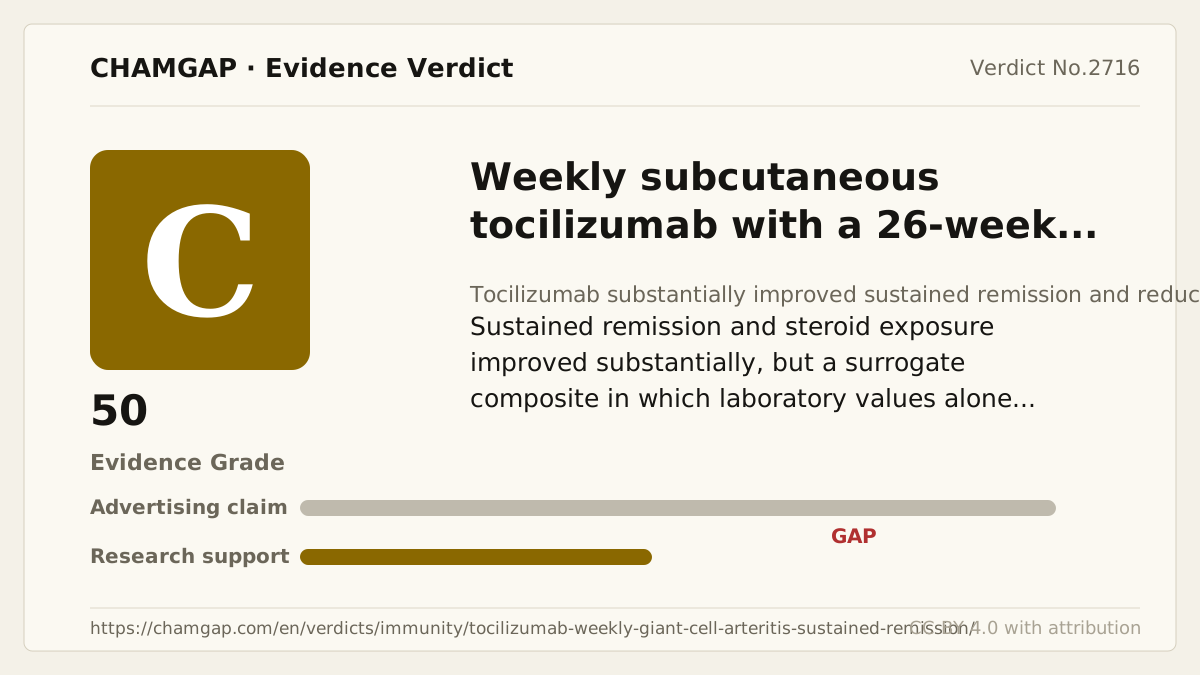
[Chamgap] Weekly tocilizumab plus a 26-week steroid taper x sustained remission in giant-cell arteritis — Evidence Grade C·50. 1 cited sources checked. Source: https://chamgap.com/en/verdicts/immunity/tocilizumab-weekly-giant-cell-arteritis-sustained-remission/ · CC BY 4.0CC BY 4.0 — free to use with attribution; do not distort grades, numbers, or verdict meaning.
What this document does and does not do
Chamgap is an information source. It reports what research has and has not confirmed; it does not tell readers what to take or buy. That decision belongs to readers and, when needed, medical or legal professionals. This verdict reflects literature available up to the search date and may change as new research appears. Nothing here is medical advice.