
Thickened liquids versus chin-down thin liquids,
does it really help with Reduction of three-month pneumonia compared with chin-down posture while drinking thin liquids?
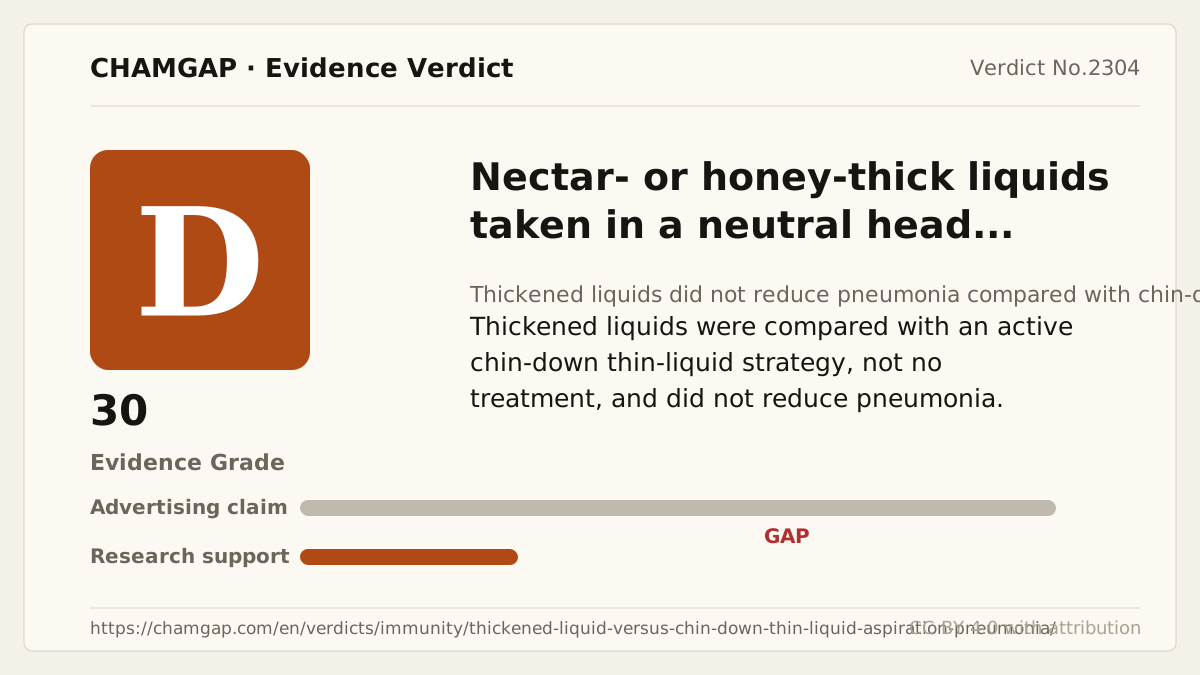
research showsThe grade is D. Among 515 people with dementia or Parkinson disease and videofluoroscopically confirmed aspiration, the raw pneumonia counts were 24/259 with chin-down thin liquids versus 28/256 with thickened liquids. The corresponding cumulative incidences were 9.8% versus 11.6%, HR 0.84 (95% CI 0.49 to 1.45). Within the thickened arm, rates were 8.4%, 10 events, for nectar and 15.0%, 18 events, for honey; HR 0.50 (0.23 to 1.09), also inconclusive.
ads claimA fluid can reduce aspiration during imaging without preventing pneumonia. This was not a no-treatment comparison, and nectar and honey cannot be assumed to have identical clinical outcomes.
Useful facts when choosing a product
- The comparator was active chin-down posture with thin liquids.
- Trial viscosities were approximately 300 mPa-s for nectar and 3,000 mPa-s for honey.
- Dehydration occurred in 6/259 (2%) with chin-down versus 15/256 (6%) with thickened liquids; weight loss was 4/259 (2%) versus 6/256 (2%).
Chamgap Semantic Classification Code
Candidate index · review held
UNK.nectar-or-honey-thick-liquids-taken-in-a-neutral-head-position.UNK.pneumonia.reduce.UNKUnknown > Nectar- or honey-thick liquids taken in a neutral head position > Unknown > pneumonia > Reduction claim > Unknown
An automated migration candidate, not an issued permanent code; exact claim scope remains under review. This machine-generated migration candidate helps retrieval but is not a permanent assignment. The original verdict ID and URL remain authoritative.
What the research actually shows
At 47 hospitals and 79 subacute facilities, 515 adults aged 50 to 95 were individually randomized. All had dementia or Parkinson disease and thin-liquid aspiration confirmed by videofluoroscopy. The chin-down group of 259 drank all thin liquids with chin lowered; 133 received nectar-thick and 123 honey-thick liquids in neutral posture. A total of 504 were followed to death or three months and 11 had incomplete follow-up. Definite pneumonia required radiographic evidence or at least three of fever, auscultatory findings, sputum leukocytes, and a respiratory pathogen culture. No formal nutritional-status endpoint was reported. A later Cochrane extraction reported 31 nutrition- or hydration-related admissions: 15 for dehydration, six for loss of appetite, and ten for reduced intake.
Why this is classified as D (30)
One mixed-funding trial was null for pneumonia and retained wide uncertainty, with unblinded assessment and an active-only comparator, giving D with 30 points.
Counterpoint. Dehydration, urinary infection, and fever were numerically higher with thickened liquids: 6%, 6%, and 4% versus 2%, 3%, and 2%. These burdens are considered separately from efficacy.
Rejudgment record. Cross-check applied — The active-comparator trial's primary definite-pneumonia endpoint and viscosity-specific results were separated, with unblinded assessment and comparator limitations retained
| Endpoint | H | Hard endpoint - actual events such as death |
| Replication | R1 | Single confirmatory trial |
| Independence | I1 | Mixed funding sources |
| Effect size | E0 | Null |
| Precision | C0 | The confidence interval leaves room for benefit |
Stored derived and displayed grades match; this is not a current recalculation or validity check (D).
Sub-claim grades by effect
This ingredient is marketed for several effects. A single overall grade blends strong and weak claims together, so each effect is graded separately here. The overall grade reflects the strongest disconfirming or core claim.
| Effect (sub-claim) | Grade | Basis |
|---|---|---|
| Reduced pneumonia with thickened liquids versus chin-down posture | D | The result was null at 11.6% versus 9.8%, HR 0.84. |
| Reduced pneumonia with honey versus nectar thickness | D | Rates were 15.0% versus 8.4%, without a conclusive difference. |
Cross-check — AI research and Codex final gate
Evidence Table
| Study | Design | Sample | Funding | Endpoint | Result | Weight |
|---|---|---|---|---|---|---|
| Robbins et al. 2008 | Multicenter individually randomized active-comparator trial | 515 randomized, 259/133/123; 504 followed to death or three months | US NIH public funding with support also reported from Novartis and E-Z-EM | Definite pneumonia within three months | Chin-down 9.8% (24 events) versus thickened liquids 11.6% (28 events), HR 0.84 (0.49 to 1.45); nectar 8.4%, honey 15.0% | Pivotal direct evidence |
Receipt — 1 References
All 1 cited sources were verified for existence at the original page (as of 2026-08-05).
Final verification and publication gate: Codex · Evidence date: 2026-08-05 · Corrections: none
Cite this verdict
[Chamgap] Thickened liquids versus chin-down thin liquids x aspiration pneumonia — Evidence Grade D·30. 1 cited sources checked. Source: https://chamgap.com/en/verdicts/immunity/thickened-liquid-versus-chin-down-thin-liquid-aspiration-pneumonia/ · CC BY 4.0CC BY 4.0 — free to use with attribution; do not distort grades, numbers, or verdict meaning.
What this document does and does not do
Chamgap is an information source. It reports what research has and has not confirmed; it does not tell readers what to take or buy. That decision belongs to readers and, when needed, medical or legal professionals. This verdict reflects literature available up to the search date and may change as new research appears. Nothing here is medical advice.