
S. salivarius K12,
does it really help with Prevention of recurrent pharyngotonsillitis and sore throat?
research showsK12 can colonize the mouth and produce bacteriocins, but that mechanism has not translated into clinical infection prevention. A systematic review of four RCTs and 1,846 participants rated every study as poor quality, and a 1,314-child school placebo trial did not significantly reduce culture-positive sore throat. A 60-adult acute pharyngotonsillitis trial was also null, resulting in D.
ads claimMarketing turns the in-vitro antimicrobial action of salivaricins A2 and B and oral colonization into 'sore-throat defense,' 'blocked tonsillitis recurrence,' and a 'natural antibiotic.' Bacteriocin production and higher salivary K12 abundance are not the same endpoint as fewer clinically diagnosed infections.
Useful facts when choosing a product
- BLIS K12 lozenges such as NOW OralBiotic are available to South Korean consumers mainly through cross-border online sellers, commonly labeled at around 1×10^9 CFU per serving.
- The large school trial used a 2.5×10^9 CFU lozenge on school days, while other trials used at least 1×10^9 CFU dissolved orally every day, so exposure was not identical.
- K12 is not equivalent to M18 or other S. salivarius strains, and viable counts can differ substantially among products over room-temperature shelf life.
- Short-term studies were generally well tolerated in healthy people, but as a live microorganism it should not be used without clinical judgment in severe immunocompromise, central-line patients, or critical illness.
Chamgap Semantic Classification Code
Candidate index · review held
UNK.streptococcus-salivarius-k12.UNK.recurrent-pharyngotonsillitis-and-sore-throat.prevent.placeboUnknown > Streptococcus salivarius K12 > Unknown > recurrent pharyngotonsillitis and sore throat > Occurrence-prevention claim > Placebo
An automated migration candidate, not an issued permanent code; exact claim scope remains under review. This machine-generated migration candidate helps retrieval but is not a permanent assignment. The original verdict ID and URL remain authoritative.
What the research actually shows
Doyle 2018 allocated 1,314 children aged 5 to 14 to K12 or placebo by odd or even birth date and followed them for a school year. GAS-positive swabs were 7.8% versus 8.8%, a nonsignificant difference that did not support routine prevention. Gilbey 2015 gave 60 hospitalized adults antibiotics plus K12 or placebo and found no benefit in pain, temperature, or laboratory measures. The 2019 systematic review by Wilcox evaluated four RCTs and 1,846 participants, rated all as poor quality, and concluded that further RCTs were required to establish prophylactic efficacy.
Why this is classified as D (28)
A large strain-specific placebo-controlled prevention trial and an adult acute trial were null, while positive studies were small, uncontrolled, and biased, resulting in D with 28 points. Short-term tolerability is separated into safety.
Counterpoint. A large independent placebo RCT using adequate daily dosing specifically in patients with frequent recurrent pharyngotonsillitis remains lacking, so the possibility in that narrow population is not entirely closed.
Rejudgment record. New verdict — The large placebo-controlled prevention trial and adult acute trial were null, and the systematic review found high risk of bias across four RCTs
Sub-claim grades by effect
This ingredient is marketed for several effects. A single overall grade blends strong and weak claims together, so each effect is graded separately here. The overall grade reflects the strongest disconfirming or core claim.
| Effect (sub-claim) | Grade | Basis |
|---|---|---|
| Prevention of recurrent pharyngotonsillitis and sore throat | D | The 1,314-participant placebo-controlled prevention trial found no significant reduction in culture-positive sore throat. |
| Adjunctive relief in acute pharyngotonsillitis | D | All major clinical and laboratory outcomes were null in a 60-adult adjunctive antibiotic RCT. |
Cross-check — AI research and Codex final gate
Evidence Table
| Study | Design | Sample | Funding | Endpoint | Result | Weight |
|---|---|---|---|---|---|---|
| Wilcox CR et al. 2019 | Systematic review | 1,846 | Varied across included trials | Prevention of pharyngotonsillitis and treatment of sore throat | All studies were poor quality; the large prevention and adult acute trials were null. | Key |
| Doyle H et al. 2018 | School-based quasi-randomized placebo-controlled pragmatic trial | 1,314 | Public program with product-related support | GAS culture-positive sore throat | K12 7.8% versus placebo 8.8%, p=0.34; not significant. | Key opposing |
| Gilbey P et al. 2015 | Randomized double-blind placebo-controlled antibiotic-adjunct trial | 60 | No financial support; product supplied | Pain, temperature, fluid intake, and laboratory measures | No significant added benefit from K12 in major clinical or laboratory outcomes. | Key opposing |
Receipt — 3 References
All 3 cited sources were verified for existence at the original page (as of 2026-07-18).
Final verification and publication gate: Codex · Evidence date: 2026-07-18 · Corrections: none
Cite this verdict
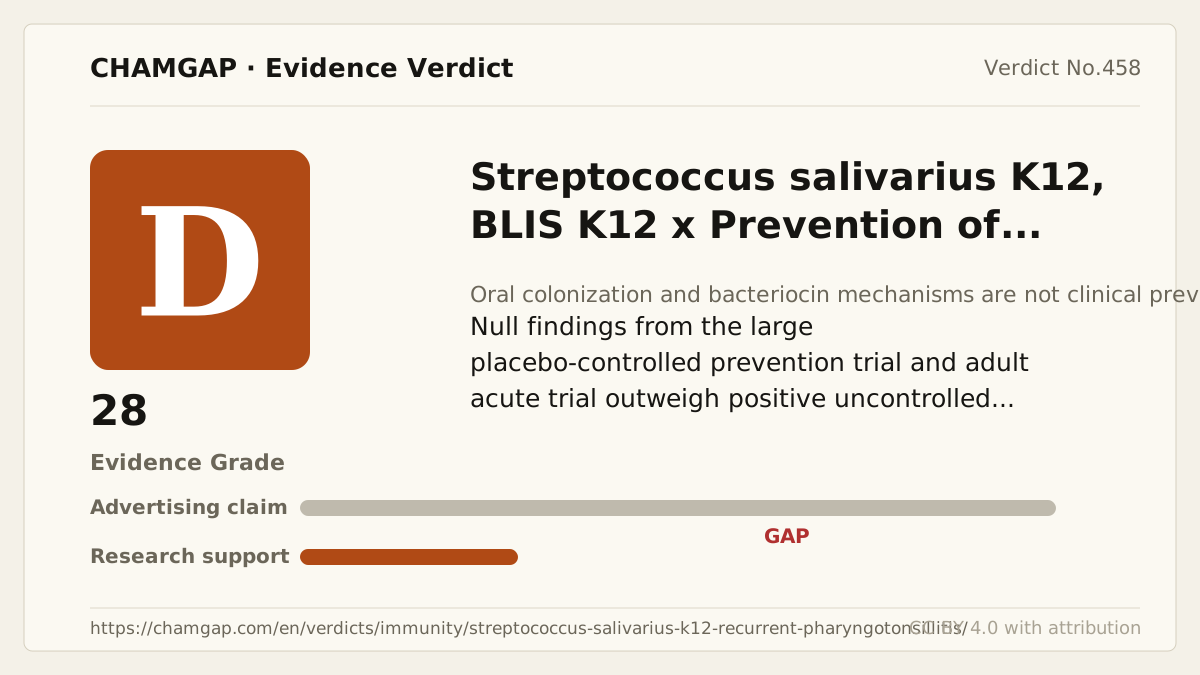
[Chamgap] S. salivarius K12 x prevention of recurrent pharyngotonsillitis and sore throat — Evidence Grade D·28. 3 cited sources checked. Source: https://chamgap.com/en/verdicts/immunity/streptococcus-salivarius-k12-recurrent-pharyngotonsillitis/ · CC BY 4.0CC BY 4.0 — free to use with attribution; do not distort grades, numbers, or verdict meaning.
What this document does and does not do
Chamgap is an information source. It reports what research has and has not confirmed; it does not tell readers what to take or buy. That decision belongs to readers and, when needed, medical or legal professionals. This verdict reflects literature available up to the search date and may change as new research appears. Nothing here is medical advice.