
Stepwise early heated egg,
does it really help with Prevention of egg allergy confirmed by oral food challenge at 12 months?
research showsThe grade is C. PETIT randomized 147 term infants with eczema to heated egg, 73, or rice-powder placebo, 74. In the primary population of 121 who received intervention, egg allergy confirmed by oral food challenge at 12 months occurred in 5/60 (8%) versus 23/61 (38%), RR 0.221 (95% CI 0.090 to 0.543). The absolute difference was large, but this was one small trial stopped after a planned interim analysis, with aggressive eczema treatment in both arms, giving C with 56 points.
ads claimMarketing must not turn this into early egg always prevents allergy. PETIT tested specialist eczema management plus stepwise heated egg. Infants with severe eczema or a prior reaction need an individualized introduction plan.
Useful facts when choosing a product
- PETIT used 50 mg daily of heated egg powder at six to nine months and 250 mg at nine to 12 months, with aggressive eczema treatment in both groups.
- Among 121 intervention recipients, challenge-confirmed egg allergy occurred in 5/60 versus 23/61.
- Acute ingestion reactions after powder occurred 19 times in nine egg participants and 14 times in 11 placebo participants. Overall hospital admission was 6/60 versus 0/61, but the reasons cannot be assumed to be egg-allergy reactions.
Chamgap Semantic Classification Code
Candidate index · review held
S.stepwise-heated-egg-powder.UNK.egg-allergy-confirmed-by-oral-food-challenge-at.prevent.placeboSupplements and nutraceuticals > Stepwise heated egg powder > Unknown > egg allergy confirmed by oral food challenge at > Occurrence-prevention claim > Placebo
An automated migration candidate, not an issued permanent code; exact claim scope remains under review. This machine-generated migration candidate helps retrieval but is not a permanent assignment. The original verdict ID and URL remain authoritative.
What the research actually shows
Natsume and colleagues randomized 147 term infants aged four to five months who had eczema and had never eaten egg. They received 50 mg daily of heated egg powder from six to nine months and 250 mg from nine to 12 months, or rice-powder placebo. Both arms received aggressive eczema treatment. At 12 months, an assessor unaware of allocation performed a standardized open challenge to 7 g egg powder. The trial stopped after its scheduled 100-participant interim analysis showed a difference. Japan's Ministry of Health, Labour and Welfare and National Center for Child Health and Development funded the study. UMIN000008673 and the registered endpoint were verified, but the initial registry posting date was not directly verified.
Why this is classified as C (56)
A blinded oral food challenge and large event difference are strengths, but the 121-infant trial was small and stopped after an interim analysis. Its high-risk eczema population and combined regimen give C with 56 points.
Counterpoint. General guidance for cooked egg introduction in all infants synthesizes a broader question. This verdict is limited to the PETIT strategy in high-risk infants with eczema.
Rejudgment record. Cross-check applied — Large oral-food-challenge effect in high-risk infants with eczema, limited by small sample and early stopping
| Endpoint | H | Hard endpoint - actual events such as death |
| Replication | R1 | Single confirmatory trial |
| Independence | I2 | Decisive evidence is publicly or non-profit funded |
| Effect size | E+ | Meets the clinically important threshold |
Stored derived and displayed grades match; this is not a current recalculation or validity check (C).
Sub-claim grades by effect
This ingredient is marketed for several effects. A single overall grade blends strong and weak claims together, so each effect is graded separately here. The overall grade reflects the strongest disconfirming or core claim.
| Effect (sub-claim) | Grade | Basis |
|---|---|---|
| Egg-allergy prevention with the PETIT regimen in infants with eczema | C | Challenge-confirmed events fell substantially, but this was one small early-stopped trial. |
| The same preventive effect in all general-population infants | D | General-population trials used different preparations and strategies and did not show clear intention-to-treat prevention. |
Cross-check — AI research and Codex final gate
Evidence Table
| Study | Design | Sample | Funding | Endpoint | Result | Weight |
|---|---|---|---|---|---|---|
| Natsume et al. 2017 PETIT | Double-blind placebo-controlled randomized trial stopped after a planned interim analysis | 147 randomized, 73 versus 74; primary intervention-recipient analysis 121, 60 versus 61 | Japanese Ministry of Health, Labour and Welfare and National Center for Child Health and Development | Egg allergy confirmed by open oral food challenge at 12 months | 5/60 (8%) versus 23/61 (38%), RR 0.221 (95% CI 0.090 to 0.543) | Decisive evidence in high-risk infants with eczema |
| Bellach et al. 2017 HEAP | Double-blind placebo-controlled randomized trial in general-population infants | 383 nonsensitized general-population infants randomized, 184 versus 199 | Nonprofit support from the Food Allergy & Anaphylaxis Network and pina e.V. | Primary egg sensitization and double-blind challenge-confirmed egg allergy at 12 months | Sensitization 5.6% versus 2.6%, RR 2.20 (0.68 to 7.14); egg allergy 2.1% versus 0.6%, RR 3.30 (0.35 to 31.32) | Indirect evidence using a different population and egg preparation |
Receipt — 3 References
All 3 cited sources were verified for existence at the original page (as of 2026-08-04).
Final verification and publication gate: Codex · Evidence date: 2026-08-04 · Corrections: none
Cite this verdict
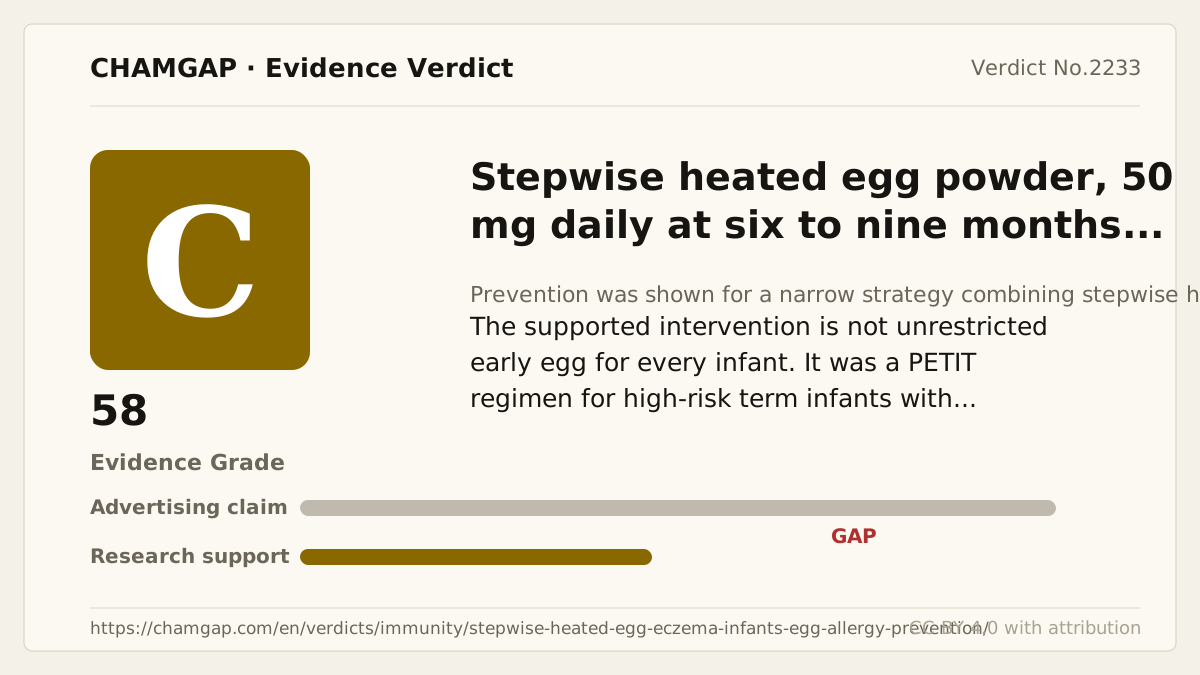
[Chamgap] Stepwise early heated egg x prevention of egg allergy in infants with eczema — Evidence Grade C·56. 3 cited sources checked. Source: https://chamgap.com/en/verdicts/immunity/stepwise-heated-egg-eczema-infants-egg-allergy-prevention/ · CC BY 4.0CC BY 4.0 — free to use with attribution; do not distort grades, numbers, or verdict meaning.
What this document does and does not do
Chamgap is an information source. It reports what research has and has not confirmed; it does not tell readers what to take or buy. That decision belongs to readers and, when needed, medical or legal professionals. This verdict reflects literature available up to the search date and may change as new research appears. Nothing here is medical advice.