
Sleeping in dentures,
does it really help with Increased incidence of serious pneumonia?
research showsThe grade is C. In a three-year prospective cohort of 453 community-dwelling denture wearers aged 85 years or older in Tokyo, serious pneumonia occurred in an estimated 25/186 (13.4%) overnight wearers versus 18/267 (6.7%) overnight removers; adjusted HR 2.38 (95% CI 1.25-4.56). This supports the harm claim, but it was not a randomized trial.
ads claimThe observational doubling should not be presented as an individual causal risk. Korean denture-care education generally supports night removal and cleaning, with individualized help for frail people or those with dysphagia.
Useful facts when choosing a product
- Exposure was reported in an interview, not directly observed.
- Pneumonia meant first hospitalization or death; central imaging adjudication was not confirmed.
- Verdict 1565 is B with 72 points and studies an inpatient toothbrushing intervention.
Chamgap Semantic Classification Code
Candidate index · review held
UNK.removable-dentures-worn-during-sleep.UNK.incidence-of-serious-pneumonia.increase.UNKUnknown > Removable dentures worn during sleep > Unknown > incidence of serious pneumonia > Increase claim > Unknown
An automated migration candidate, not an issued permanent code; exact claim scope remains under review. This machine-generated migration candidate helps retrieval but is not a permanent assignment. The original verdict ID and URL remain authoritative.
What the research actually shows
TOOTH followed 524 Tokyo community residents aged 85-102; 453 denture wearers entered this analysis. Exposure was self-reported in a face-to-face questionnaire. Serious pneumonia meant first hospitalization for or death from pneumonia, followed annually by telephone or mail; no central radiographic adjudication or diagnostic-code algorithm was reported. The model adjusted age, swallowing difficulty, overnight wear, cognitive impairment, ADL disability, stroke, respiratory disease, albumin, CRP, and IL-6. Sex, education, smoking, low BMI, diabetes, chronic kidney disease, ACE-inhibitor use, and statin use were screened but not retained. Oral-hygiene habits, broader frailty, income, and household or care context were not adequately controlled. Verdict 1565 is B with 72 points and concerns randomized daily toothbrushing in hospitalized patients, a different intervention and population.
Why this is classified as C (54)
Prospective follow-up, hard events, and a significant hazard ratio support the harm association, while major residual confounding and uncorrected multiple comparisons cap the evidence at C with 54 points.
Counterpoint. C grades the evidence for the harm claim, not the severity of the harm itself.
Rejudgment record. Cross-check applied — A prospective hard-outcome association tempered by nonrandom exposure, residual confounding, and uncorrected multiple comparisons
| Endpoint | H | Hard endpoint - actual events such as death |
| Replication | R1 | Single confirmatory trial |
| Independence | I1 | Mixed funding sources |
| Effect size | E+ | Meets the clinically important threshold |
Stored derived and displayed grades match; this is not a current recalculation or validity check (C).
Sub-claim grades by effect
This ingredient is marketed for several effects. A single overall grade blends strong and weak claims together, so each effect is graded separately here. The overall grade reflects the strongest disconfirming or core claim.
| Effect (sub-claim) | Grade | Basis |
|---|---|---|
| Increased serious pneumonia | C | The three-year adjusted HR was 2.38, but the study was observational. |
Cross-check — AI research and Codex final gate
Evidence Table
| Study | Design | Sample | Funding | Endpoint | Result | Weight |
|---|---|---|---|---|---|---|
| Iinuma T et al. 2015 TOOTH | Prospective cohort of community-dwelling very old adults | 524 analyzed; 453 denture wearers, 186 overnight wearers and 267 removers | The exact Funding and Acknowledgement wording could not be verified in the accessible record | First hospitalization for or death from pneumonia over three years | Calculated from table counts as 25/186 (13.4%) versus 18/267 (6.7%); adjusted HR 2.38 (95% CI 1.25-4.56) | Only direct prospective evidence |
Receipt — 1 References
All 1 cited sources were verified for existence at the original page (as of 2026-08-08).
Final verification and publication gate: Codex · Evidence date: 2026-08-08 · Corrections: none
Cite this verdict
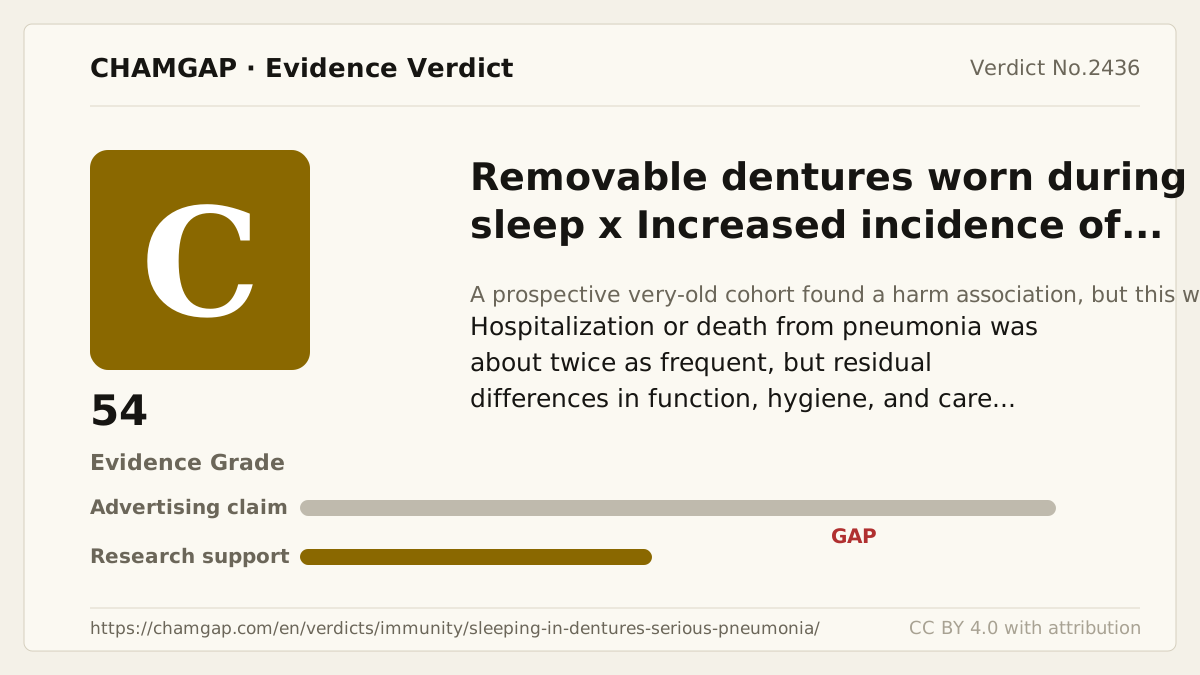
[Chamgap] Sleeping in dentures x increased serious pneumonia — Evidence Grade C·54. 1 cited sources checked. Source: https://chamgap.com/en/verdicts/immunity/sleeping-in-dentures-serious-pneumonia/ · CC BY 4.0CC BY 4.0 — free to use with attribution; do not distort grades, numbers, or verdict meaning.
What this document does and does not do
Chamgap is an information source. It reports what research has and has not confirmed; it does not tell readers what to take or buy. That decision belongs to readers and, when needed, medical or legal professionals. This verdict reflects literature available up to the search date and may change as new research appears. Nothing here is medical advice.