
Seven-day intravenous antibiotics,
does it really help with Noninferiority to 14 days for 21-day relapse after clinical remission of culture-proven neonatal sepsis?
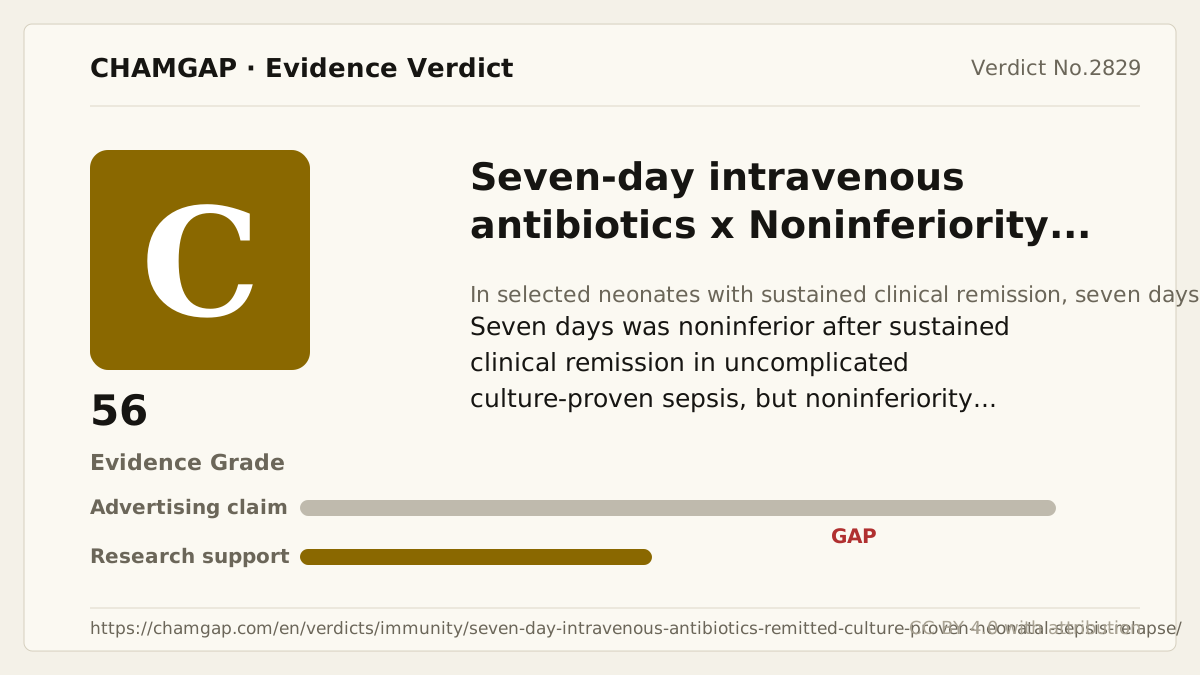
research showsThe grade is C with 56 points. Among selected neonates who remitted by day five on appropriate intravenous antibiotics and remained in remission through day seven, definite or probable relapse was 2/125 (1.6%) after seven days versus 6/130 (4.6%) after 14 days. The risk difference was -3.0 percentage points (99.5% CI -9.2 to 3.1), within the prespecified +7-point margin. This does not apply to all neonatal sepsis.
ads claimVerdict 2325 is B with 76 points for seven versus 14 days in general bloodstream infection, while verdict 2542 is B with 76 points for oral transition in bone and joint infection. This trial addresses a much narrower neonatal population with culture confirmation, remission by day five, sustained remission through day seven, and exclusions for specified pathogens and deep infection.
Useful facts when choosing a product
- By day 35, PP mortality was 1/125 (0.8%) versus 2/130 (1.5%); the death-relapse-secondary-sepsis composite was 5/125 (4.0%) versus 9/130 (6.9%).
- Hospitalization was a median four days shorter (95% CI -5 to -3), but this secondary process endpoint depends directly on assigned treatment duration and discharge decisions.
- Incident antibiotic resistance and readmission were not separately reported as between-group secondary results. The trial therefore cannot by itself establish reductions in either outcome.
Chamgap Semantic Classification Code
Candidate index · review held
M.intravenous-antibiotics.intravenous.noninferiority-to-for-relapse-after-clinical-remission-of-culture-proven-neonatal-sepsis.noninferior.MULTIMedicinal interventions > intravenous antibiotics > Intravenous > Noninferiority to for relapse after clinical remission of culture-proven neonatal sepsis > Noninferiority claim > Multiple: primary unresolved
An automated migration candidate, not an issued permanent code; exact claim scope remains under review. This machine-generated migration candidate helps retrieval but is not a permanent assignment. The original verdict ID and URL remain authoritative.
What the research actually shows
Eight Indian centers randomized 261 neonates to seven or 14 days of intravenous antibiotics. The primary PP analysis of 125 versus 130 and modified ITT analysis agreed. Limitation name: noninferiority design. Avoidability: possible - a tighter margin and adequately powered superiority or resource-saving analysis could have reduced residual uncertainty. Limitation name: early stopping at the prespecified O'Brien-Fleming noninferiority boundary. Avoidability: possible - enrollment could have continued to the planned 350 per arm for more precise efficacy and rare-harm estimates. Absence of placebo or no treatment was not counted. Avoidability: impossible - withholding standard antibiotics for culture-proven neonatal sepsis would be unethical. ICMR provided public funding; no commercial support or author conflict was reported.
Why this is classified as C (56)
The trial used an event endpoint, public funding, and a prespecified margin that was met, but it remains one noninferiority trial stopped at an interim boundary, imposing a C cap and 56 points.
Counterpoint. Clinical deterioration during days 8 to 14 and longer hospitalization in the 14-day group could influence secondary outcomes. Length of stay is weaker than relapse because treatment assignment directly influences it.
Rejudgment record. Cross-check applied — Cross-checked paper, protocol, and registry for remission criteria, relapse definition, +7-point margin, PP and mITT analyses, interim stopping, secondary outcomes, and ICMR funding
| Endpoint | H | Hard endpoint - actual events such as death |
| Replication | R1 | Single confirmatory trial |
| Independence | I2 | Decisive evidence is publicly or non-profit funded |
| Effect size | E+ | Meets the clinically important threshold |
Stored derived and displayed grades match; this is not a current recalculation or validity check (C).
Sub-claim grades by effect
This ingredient is marketed for several effects. A single overall grade blends strong and weak claims together, so each effect is graded separately here. The overall grade reflects the strongest disconfirming or core claim.
| Effect (sub-claim) | Grade | Basis |
|---|---|---|
| Noninferiority for definite or probable relapse at 21 days | C | The 99.5% upper bound of 3.1 points was within the +7-point margin. |
| Reduced antibiotic resistance or readmission | ? | Separate between-group results were not reported. |
Cross-check — AI research and Codex final gate
Evidence Table
| Study | Design | Sample | Funding | Endpoint | Result | Weight |
|---|---|---|---|---|---|---|
| Dutta S et al. 2025 multicenter noninferiority trial | Eight-center Indian randomized noninferiority trial of seven versus 14 days of intravenous antibiotics | 261 randomized; PP 125 versus 130 | Indian Council of Medical Research, 5/7/329/2009-RHN | Definite or probable relapse within 21 days after antibiotic completion | 2/125 (1.6%) versus 6/130 (4.6%); risk difference -3.0 points (99.5% CI -9.2 to 3.1); noninferiority margin +7 points | Pivotal single noninferiority trial |
Receipt — 2 References
All 2 cited sources were verified for existence at the original page (as of 2026-08-18).
Final verification and publication gate: Codex · Evidence date: 2026-08-18 · Corrections: none
Cite this verdict
[Chamgap] Seven-Day Intravenous Antibiotics Benefit Clinically Remitted Culture-Proven Neonatal Sepsis by Being Noninferior to Fourteen Days for 21-Day Relapse — Evidence Grade C·56. 2 cited sources checked. Source: https://chamgap.com/en/verdicts/immunity/seven-day-intravenous-antibiotics-remitted-culture-proven-neonatal-sepsis-relapse/ · CC BY 4.0CC BY 4.0 — free to use with attribution; do not distort grades, numbers, or verdict meaning.
What this document does and does not do
Chamgap is an information source. It reports what research has and has not confirmed; it does not tell readers what to take or buy. That decision belongs to readers and, when needed, medical or legal professionals. This verdict reflects literature available up to the search date and may change as new research appears. Nothing here is medical advice.