
School telemedicine plus observed controller therapy,
does it really help with More symptom-free days and fewer emergency visits or admissions in children with persistent asthma?
research showsThe grade is C with 50 points. In the modified intention-to-treat primary analysis of 395 from 400 randomized children, the primary endpoint of symptom-free days per two weeks was 11.6 (SD 2.7) with SB-TEAM versus 10.97 (SD 3.2) with enhanced usual care, adjusted difference 0.69 days (95% CI 0.15-1.22). Using the pooled SD of 2.96 gives d≈0.23, a small but real difference. The reduction in emergency visits or admissions (7.0% versus 14.8%, OR 0.52) was a secondary outcome. This was one bundled-intervention trial, and five randomized children were absent from primary analysis.
ads claimA tablet or video link did not itself treat asthma. The result belongs to an entire delivery system that connected assessment, prescribing, medication delivery, observed administration, feedback, and education.
Useful facts when choosing a product
- Among intervention children, 196/200 (98.0%) completed at least one telemedicine visit and 165/200 (82.5%) initiated school-based directly observed therapy.
- The control group also received symptom reports, guideline-based recommendations, education, and repeated feedback.
- The design did not factorially separate telemedicine from observed dosing.
Chamgap Semantic Classification Code
Candidate index · review held
UNK.sb-team-program-combining-school-based-telemedicine-with-directly-observed-controller-therapy.inhaled.more-symptom-free-days-and-fewer-emergency-visits-or-admissions-with-persistent-asthma.assess.usual-careUnknown > SB-TEAM program combining school-based telemedicine with directly observed controller therapy > Inhaled > More symptom-free days and fewer emergency visits or admissions with persistent asthma > Association or change assessment > Usual care
An automated migration candidate, not an issued permanent code; exact claim scope remains under review. This machine-generated migration candidate helps retrieval but is not a permanent assignment. The original verdict ID and URL remain authoritative.
What the research actually shows
The biostatistics center independently developed permuted blocks stratified by baseline controller use, and interviewers called the coordinator for assignment. Families and clinicians could not be blinded, but an independent masked team conducted bimonthly primary-outcome interviews. Four hundred children, 200 per arm, were randomized; the modified intention-to-treat primary analysis included 199 and 196, 395 total. Seven withdrew, and nearly all contributed at least one primary-outcome follow-up. NCT01650844 and the public protocol matched the symptom-free-day endpoint, comparator, and randomization. NHLBI grant R01HL079954 funded the trial, and no conflicts were reported.
Why this is classified as C (50)
In the publicly funded randomized trial, the primary-endpoint difference in symptom-free days was 0.69 day, d≈0.23: small but real. Because no validated between-group minimal clinically important difference was available, magnitude was classified by statistical convention as E~. Fewer emergency visits or admissions were a secondary outcome; this was one bundled trial with 395 of 400 children in primary analysis, giving C with 50 points.
Counterpoint. The study involved English-speaking families of children aged 3-10 in a high-poverty urban district; effects may differ with other school staffing and care systems.
Rejudgment record. Cross-check applied — The JAMA Pediatrics report, protocol, and NCT01650844 were checked for the primary endpoint, reported SDs of 2.7 and 3.2, allocation, masked interviews, 400 randomized and 395 analyzed, funding, and bundle components
| Endpoint | P | Symptom or function itself is the target - including patient reports and performance tests |
| Replication | R1 | Single confirmatory trial |
| Independence | I2 | Decisive evidence is publicly or non-profit funded |
| Effect size | E~ | Statistically positive but below the threshold |
Stored derived and displayed grades match; this is not a current recalculation or validity check (C).
Sub-claim grades by effect
This ingredient is marketed for several effects. A single overall grade blends strong and weak claims together, so each effect is graded separately here. The overall grade reflects the strongest disconfirming or core claim.
| Effect (sub-claim) | Grade | Basis |
|---|---|---|
| More symptom-free days per two weeks | C | The adjusted between-group difference was 0.69 day, d≈0.23: small but real. |
| Fewer asthma emergency visits or admissions | C | This secondary outcome was 7.0% versus 14.8%, OR 0.52. |
Cross-check — AI research and Codex final gate
Evidence Table
| Study | Design | Sample | Funding | Endpoint | Result | Weight |
|---|---|---|---|---|---|---|
| Halterman JS, Fagnano M, Tajon RS, Tremblay P, Wang H, Butz A, Perry TT, McConnochie KM. 2018 | Individually randomized bundled-intervention trial versus enhanced usual care | 400 randomized, 200 per arm; 395 in modified intention-to-treat primary analysis, 199 versus 196 | NHLBI R01HL079954; no conflicts reported | Primary symptom-free days per two weeks; secondary asthma emergency visit or admission | Adjusted symptom-free-day difference 0.69 day (95% CI 0.15-1.22); emergency visit or admission 14/199 versus 29/196, OR 0.52 (0.32-0.84). | Only direct publicly funded confirmatory trial |
Receipt — 1 References
All 1 cited sources were verified for existence at the original page (as of 2026-08-15).
Final verification and publication gate: Codex · Evidence date: 2026-08-15 · Corrections: none
Cite this verdict
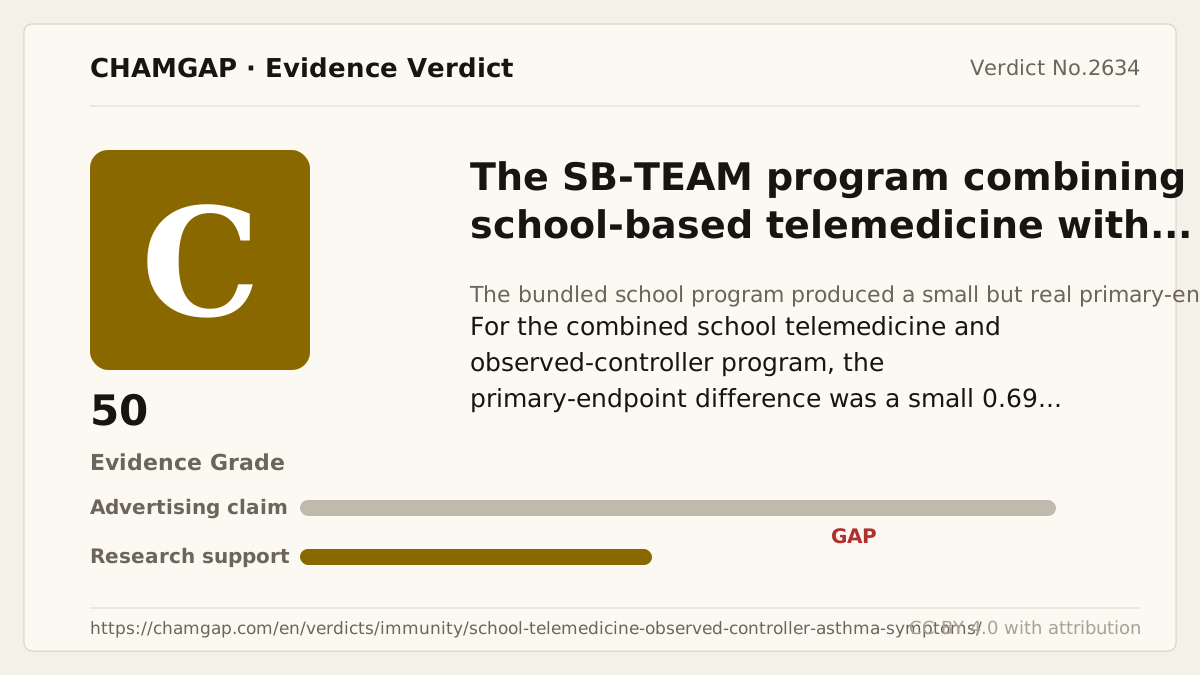
[Chamgap] School telemedicine plus observed controller therapy x lower childhood asthma morbidity — Evidence Grade C·50. 1 cited sources checked. Source: https://chamgap.com/en/verdicts/immunity/school-telemedicine-observed-controller-asthma-symptoms/ · CC BY 4.0CC BY 4.0 — free to use with attribution; do not distort grades, numbers, or verdict meaning.
What this document does and does not do
Chamgap is an information source. It reports what research has and has not confirmed; it does not tell readers what to take or buy. That decision belongs to readers and, when needed, medical or legal professionals. This verdict reflects literature available up to the search date and may change as new research appears. Nothing here is medical advice.