
Saline nasal irrigation,
does it really help with Relief of rhinorrhea, sneezing, itching, and obstruction in allergic rhinitis?
research showsSaline nasal irrigation earns C with 56 points because it may reduce allergic-rhinitis symptoms in the short term. Versus no treatment at four weeks or less, six trials and 407 participants had SMD -1.32 (95% CI -1.84 to -0.81), I-squared 75%, with low-certainty evidence.
ads claimEvidence does not show removal of the allergic cause or complete replacement of medication. It supports only adjunctive short-term symptom improvement.
Useful facts when choosing a product
- Marchisio confirms 220 completers, 80/80/60 by group, but the initial randomized number and attrition are unknown.
- The study evaluated many symptoms, signs, and medication-use outcomes without a single prespecified primary outcome.
- Verdict 1785, C with 54 points, addresses a different indication: high-volume irrigation for chronic nasal and sinus symptoms.
Chamgap Semantic Classification Code
Candidate index · review held
UNK.saline-nasal-irrigation.intranasal.rhinorrhea-sneezing-itching-and-obstruction-in-allergic-rhinitis.relieve.MULTIUnknown > Saline nasal irrigation > Intranasal > rhinorrhea, sneezing, itching, and obstruction in allergic rhinitis > Symptom-relief claim > Multiple: primary unresolved
An automated migration candidate, not an issued permanent code; exact claim scope remains under review. This machine-generated migration candidate helps retrieval but is not a permanent assignment. The original verdict ID and URL remain authoritative.
What the research actually shows
In Cochrane saline-versus-no-treatment analyses, six trials and 407 participants at four weeks or less had SMD -1.32 (95% CI -1.84 to -0.81), I-squared 75%, with low certainty; five trials and 167 participants at six to eight weeks had SMD -1.44 (-2.39 to -0.48), I-squared 86%. Added to drug treatment, two trials and 32 participants had SMD -0.60 (-1.34 to 0.15). There is no basis to claim the effect falls below a validated threshold.
Why this is classified as C (56)
A large short-term symptom signal is limited by low certainty, small trials, outcome-selection risk, unblinded symptom reports, and four-week follow-up, giving C with 56 points.
Counterpoint. It may be a practical low-cost adjunct, while persistent or severe disease still needs allergen management and standard treatment.
Rejudgment record. Cross-check applied — Accepted repeated short-term patient-reported symptom improvement while accounting for unclear primary-outcome specification, lack of masking, small samples, and intervention and scale heterogeneity
| Endpoint | P | Symptom or function itself is the target - including patient reports and performance tests |
| Replication | R2 | Independently replicated across trials |
| Independence | I2 | Decisive evidence is publicly or non-profit funded |
| Effect size | E+ | Meets the clinically important threshold |
Stored derived and displayed grades match; this is not a current recalculation or validity check (C).
Sub-claim grades by effect
This ingredient is marketed for several effects. A single overall grade blends strong and weak claims together, so each effect is graded separately here. The overall grade reflects the strongest disconfirming or core claim.
| Effect (sub-claim) | Grade | Basis |
|---|---|---|
| Relief of nasal symptoms at four weeks | C | Findings were repeatedly positive but unblinded and heterogeneous. |
| Improved disease severity through three months | C | The pooled evidence had low certainty. |
| Reduced duration of antihistamine use | C | A single pediatric trial was positive, with limited replication. |
Cross-check — AI research and Codex final gate
Evidence Table
| Study | Design | Sample | Funding | Endpoint | Result | Weight |
|---|---|---|---|---|---|---|
| Marchisio P et al. 2012 | Four-week assessor-blinded three-arm randomized trial | 220 completers (80/80/60); initial randomized number and attrition not established | Funding source not reported; all authors reported no relevant conflicts | Rhinorrhea, itching, sneezing, obstruction, and nasal signs; no single primary endpoint specified | Several symptom and sign outcomes were positive, but no single primary outcome was specified, creating selection risk | Direct positive pediatric trial |
| Head K et al. 2018 | Cochrane systematic review and meta-analysis of randomized trials | 14 trials and 747 participants | Public and nonprofit NIHR and Cochrane ENT infrastructure support; funding of many included trials was unclear | Patient-reported allergic-rhinitis severity through three months | Possible symptom improvement with low to very-low certainty | Replication with limited certainty |
Receipt — 2 References
All 2 cited sources were verified for existence at the original page (as of 2026-07-24).
Final verification and publication gate: Codex · Evidence date: 2026-07-24 · Corrections: none
Cite this verdict
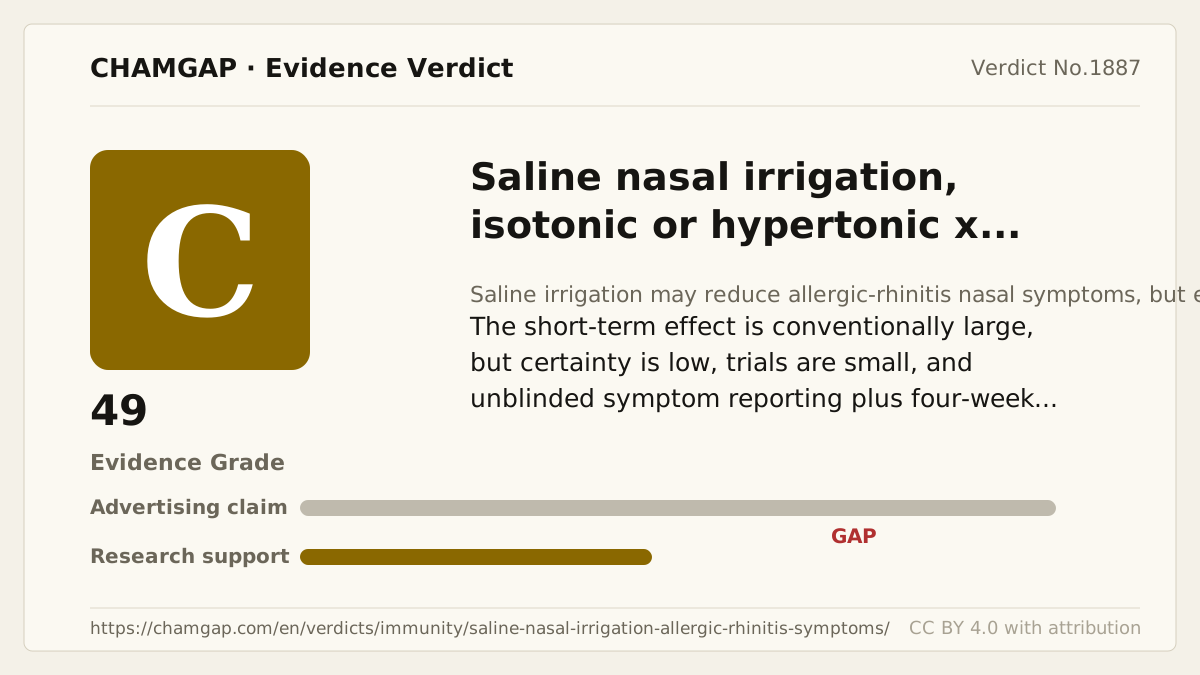
[Chamgap] Saline nasal irrigation x allergic-rhinitis nasal symptoms — Evidence Grade C·56. 2 cited sources checked. Source: https://chamgap.com/en/verdicts/immunity/saline-nasal-irrigation-allergic-rhinitis-symptoms/ · CC BY 4.0CC BY 4.0 — free to use with attribution; do not distort grades, numbers, or verdict meaning.
What this document does and does not do
Chamgap is an information source. It reports what research has and has not confirmed; it does not tell readers what to take or buy. That decision belongs to readers and, when needed, medical or legal professionals. This verdict reflects literature available up to the search date and may change as new research appears. Nothing here is medical advice.