
An onion kept in a room,
does it really help with Common-cold prevention?
research showsSearches through August 7, 2026 found no human study measuring whether an onion kept in a room reduces common-cold incidence. This does not prove no effect or prove that no such study exists.
ads claimKorean-language web results show that keeping an onion in a room or near the bed circulates as household cold advice. Circulation of the belief is not evidence that it prevents infection.
Useful facts when choosing a product
- PubMed, 2026-08-07: (onion[Title/Abstract] OR Allium cepa[Title/Abstract]) AND (common cold[Title/Abstract] OR upper respiratory infection[Title/Abstract]) AND (room[Title/Abstract] OR indoor[Title/Abstract] OR air[Title/Abstract]). No eligible human study was found; the total result count, screening count, and record-level exclusion reasons were not recorded.
- ClinicalTrials.gov, 2026-08-07: onion AND (common cold OR respiratory infection). No eligible room-onion trial was found. NCT04647071 was excluded because it tested an orally consumed garlic-onion concentrate; the total result and screening counts were not recorded.
- Google Scholar, general web, and RISS, 2026-08-07: onion cold prevention; onion air antimicrobial; allium volatile antibacterial; and Korean equivalents. No eligible human outcome was found. Separate exact queries, total result counts, screening counts, and individual exclusion reasons were not recorded for each source.
- Verdict 1963 is C with 54 points for raw onion juice and insomnia. Verdict 1968 is D with 28 points for quercetin-rich whole-onion powder and visceral fat. Both interventions and outcomes differ from this claim.
Chamgap Semantic Classification Code
Candidate index · review held
UNK.onion-kept-in-a-room.UNK.common-cold-prevention.prevent.UNKUnknown > onion kept in a room > Unknown > Common-cold prevention > Occurrence-prevention claim > Unknown
An automated migration candidate, not an issued permanent code; exact claim scope remains under review. This machine-generated migration candidate helps retrieval but is not a permanent assignment. The original verdict ID and URL remain authoritative.
What the research actually shows
A relevant study would randomize homes or dormitory rooms to onion exposure or control and compare laboratory-confirmed colds or a prospectively defined acute upper-respiratory-infection outcome.
Why this is classified as ?
No located human study measured the claimed endpoint of cold incidence under room-onion exposure, so the claim cannot yet be judged true or false.
Counterpoint. Laboratory antimicrobial activity uses concentrations, contact times, and organisms unlike room exposure and cannot substitute for human viral-cold incidence.
Rejudgment record. Cross-check applied — A bilingual literature search on August 7, 2026 found no human study measuring room-onion exposure and cold incidence; database-level screening-flow records were incomplete.
| Endpoint | H | Hard endpoint - actual events such as death |
Stored derived and displayed grades match; this is not a current recalculation or validity check (?).
Sub-claim grades by effect
This ingredient is marketed for several effects. A single overall grade blends strong and weak claims together, so each effect is graded separately here. The overall grade reflects the strongest disconfirming or core claim.
| Effect (sub-claim) | Grade | Basis |
|---|---|---|
| A room onion reduces common-cold incidence | ? | No human study measuring this exposure and endpoint was found in this search. |
Cross-check — AI research and Codex final gate
Evidence Table
| Study | Design | Sample | Funding | Endpoint | Result | Weight |
|---|---|---|---|---|---|---|
| Literature search, 2026-08-07 | Searches of PubMed, ClinicalTrials.gov, Google Scholar, RISS, and the general web; incomplete screening-flow records | 0 eligible human studies found in this search | Not applicable | Cold incidence after room-onion exposure | No directly measuring study found in this search | Direct basis for deferred judgment |
| Garcia-Garcia et al. 2023 | Randomized trial of an oral garlic-onion concentrate | 66 participants | DOMCA product study; NCT04647071 | Infectious respiratory disease in older adults | Excluded because it tested an oral combination, not room exposure | Reason for excluding the closest human trial |
Receipt — 2 References
All 2 cited sources were verified for existence at the original page (as of 2026-08-07).
Final verification and publication gate: Codex · Evidence date: 2026-08-07 · Corrections: none
Cite this verdict
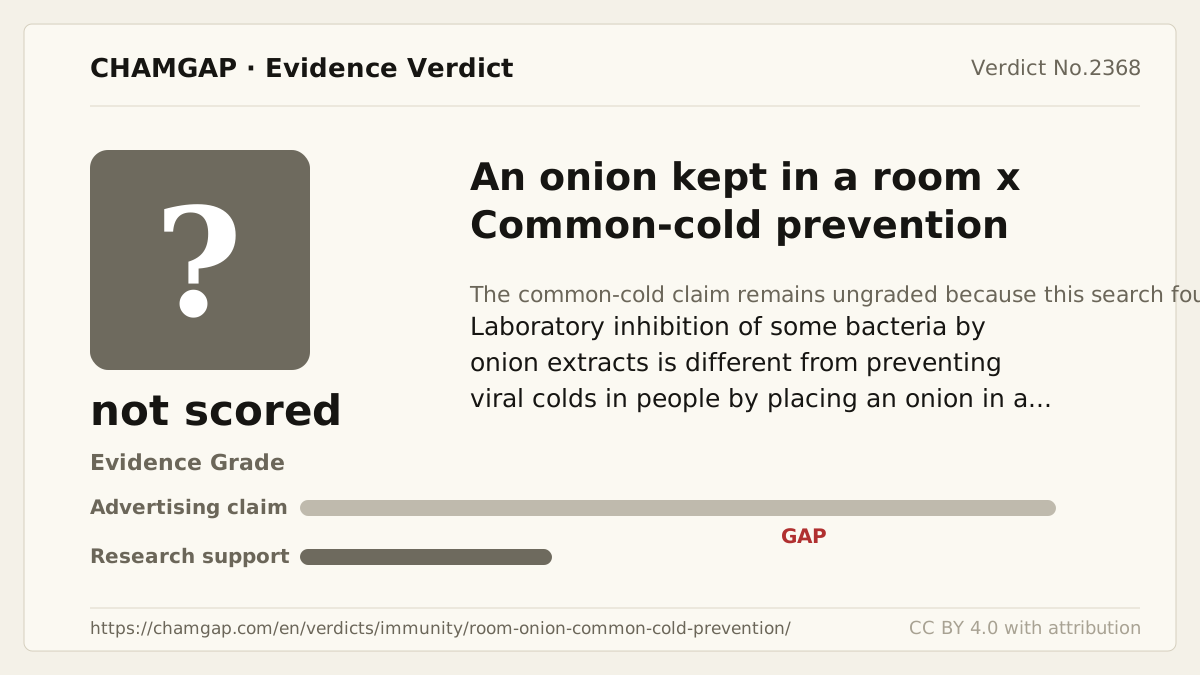
[Chamgap] Does keeping an onion in a room prevent colds? — Evidence Grade ?. 2 cited sources checked. Source: https://chamgap.com/en/verdicts/immunity/room-onion-common-cold-prevention/ · CC BY 4.0CC BY 4.0 — free to use with attribution; do not distort grades, numbers, or verdict meaning.
What this document does and does not do
Chamgap is an information source. It reports what research has and has not confirmed; it does not tell readers what to take or buy. That decision belongs to readers and, when needed, medical or legal professionals. This verdict reflects literature available up to the search date and may change as new research appears. Nothing here is medical advice.