
Prenatal and childhood PM2.5,
does it really help with Higher incidence of childhood asthma?
research showsThe grade is C with 56 points. A nationwide Danish birth cohort included 1,060,154 children, 9,353,431 person-years, and 65,143 new asthma events identified through hospital, emergency, and outpatient records. Prenatal PM2.5 gave HR 1.06 (95% CI 1.04 to 1.08) per 2.4-microgram/m3 interquartile increase. Postnatal exposure used a different unit and gave HR 1.17 (1.11 to 1.22) per 5 micrograms/m3.
ads claimAn observational environmental association does not establish that a child-targeted purifier or mask prevents asthma. Product-specific reduction in long-term personal exposure and new asthma events requires separate trials.
Useful facts when choosing a product
- The cohort included 1,060,154 children, 9,353,431 person-years, and 65,143 asthma cases.
- The prenatal PM2.5 interquartile range was 2.4 micrograms/m3 and its asthma HR was 1.06.
- Exposure followed residential addresses in a spatiotemporal model but did not directly measure personal or indoor PM2.5.
Chamgap Semantic Classification Code
Candidate index · review held
X.prenatal-and-childhood-pm2-5-exposure-assigned-to-birth-and-residential-addresses.environmental.higher-incidence-of-childhood-asthma.increase.UNKBehaviors, exposures and policies > Prenatal and childhood PM2.5 exposure assigned to birth and residential addresses > Environmental exposure > Higher incidence of childhood asthma > Increase claim > Unknown
An automated migration candidate, not an issued permanent code; exact claim scope remains under review. This machine-generated migration candidate helps retrieval but is not a permanent assignment. The original verdict ID and URL remain authoritative.
What the research actually shows
The study linked Danish registry records for singleton live births from 1998 through 2016. Prenatal exposure used the birth address, and postnatal exposure followed address changes using DEHM-UBM-AirGIS estimates. Thus moves were incorporated, but personal and indoor concentrations were not measured. The model adjusted for household income, maternal education, pregnancy smoking, and other factors, but smoking and some covariates relied on self-report; residual confounding from parental occupation, population density, dampness, mold, ventilation, and pets remained. Postnatal exposure gave HR 1.17 (1.11 to 1.22) per 5 micrograms/m3, a different unit from the prenatal estimate. Monotonicity was not verified. The work was conducted under a Health Effects Institute contract. This nonprofit's core support is jointly provided by the US EPA and the worldwide motor-vehicle industry, with other public and private support for some programs. HEI describes separate research and review committees, but its report on the same contracted work was not treated as independent replication. The authors declared nothing to disclose.
Why this is classified as C (56)
More than one million participants and direct asthma events are strong, but overlapping personal-exposure and confounding defects give C with 56 points.
Counterpoint. The small relative increase should not be expanded into certain causation for every child or a product-specific prevention claim.
Rejudgment record. Cross-check applied — Accepted new asthma identified through hospital, emergency, and outpatient records while accounting for absent personal and indoor exposure, self-reported covariates, and residual parental-occupation, density, and household confounding
| Endpoint | H | Hard endpoint - actual events such as death |
| Replication | R1 | Single confirmatory trial |
| Independence | I2 | Decisive evidence is publicly or non-profit funded |
| Effect size | E+ | Meets the clinically important threshold |
Stored derived and displayed grades match; this is not a current recalculation or validity check (C).
Sub-claim grades by effect
This ingredient is marketed for several effects. A single overall grade blends strong and weak claims together, so each effect is graded separately here. The overall grade reflects the strongest disconfirming or core claim.
| Effect (sub-claim) | Grade | Basis |
|---|---|---|
| Prenatal PM2.5 and higher childhood asthma incidence | B | The HR was 1.06 per 2.4-microgram/m3 interquartile increase. |
| PM2.5 association independent of NO2 | B | The PM2.5 estimate remained after adjustment for NO2. |
Cross-check — AI research and Codex final gate
Evidence Table
| Study | Design | Sample | Funding | Endpoint | Result | Weight |
|---|---|---|---|---|---|---|
| Pedersen M et al. 2023 Danish nationwide birth cohort | Nationwide prospective birth cohort with registry linkage | 1,060,154 children; 9,353,431 person-years; 65,143 asthma cases | Research conducted under contract to the Health Effects Institute | Incident asthma from hospital, emergency, and outpatient records | HR 1.06 (95% CI 1.04-1.08) per 2.4-microgram/m3 interquartile increase in prenatal PM2.5. | Key large direct-event observational evidence |
| Pedersen M et al. 2024 HEI Research Report 219 | Research report combining the nationwide cohort and two birth cohorts | Nationwide cohort 1,060,154 plus DNBC 22,084 and COPSAC 803 | Health Effects Institute, jointly supported at its core by the US EPA and worldwide motor-vehicle industry | Asthma incidence, prevalence, and lung function | Reported the nationwide result and uncertainty in smaller cohorts but was not treated as independent replication of the same contracted work. | Nonindependent supporting source for funding, methods, and limitations |
Receipt — 2 References
All 2 cited sources were verified for existence at the original page (as of 2026-08-04).
Final verification and publication gate: Codex · Evidence date: 2026-08-04 · Corrections: none
Cite this verdict
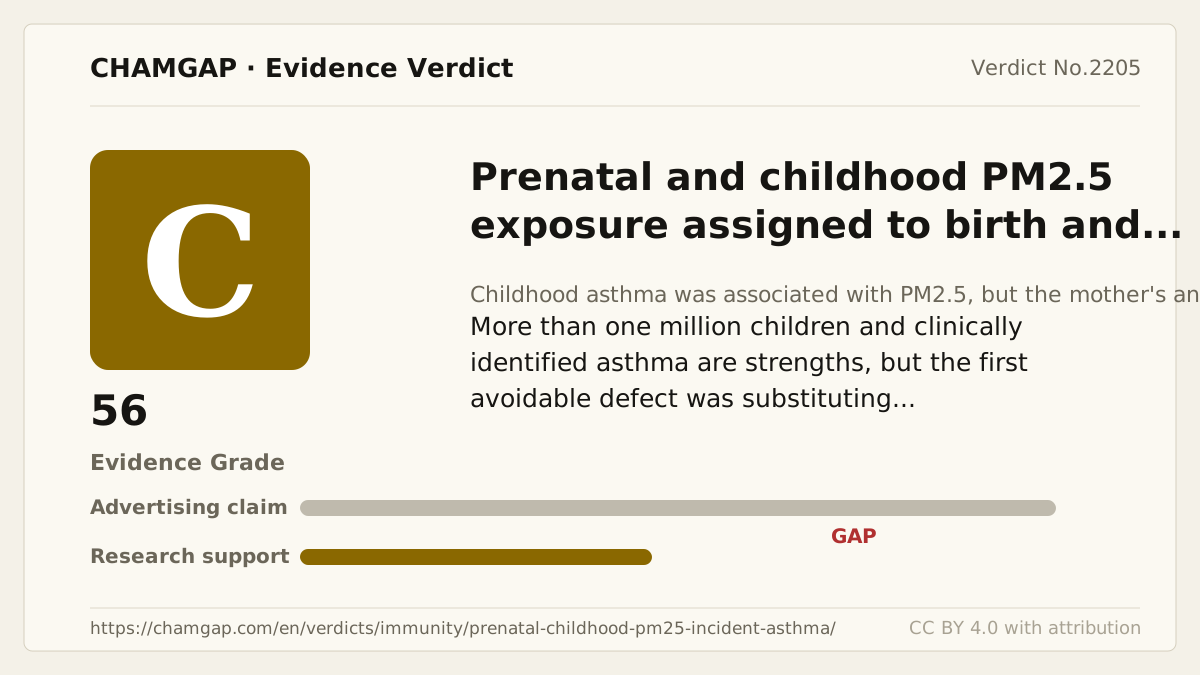
[Chamgap] Prenatal and childhood PM2.5 x incident childhood asthma — Evidence Grade C·56. 2 cited sources checked. Source: https://chamgap.com/en/verdicts/immunity/prenatal-childhood-pm25-incident-asthma/ · CC BY 4.0CC BY 4.0 — free to use with attribution; do not distort grades, numbers, or verdict meaning.
What this document does and does not do
Chamgap is an information source. It reports what research has and has not confirmed; it does not tell readers what to take or buy. That decision belongs to readers and, when needed, medical or legal professionals. This verdict reflects literature available up to the search date and may change as new research appears. Nothing here is medical advice.