
PPSV23,
does it really help with Reduced all-cause and pneumococcal pneumonia in nursing-home residents?
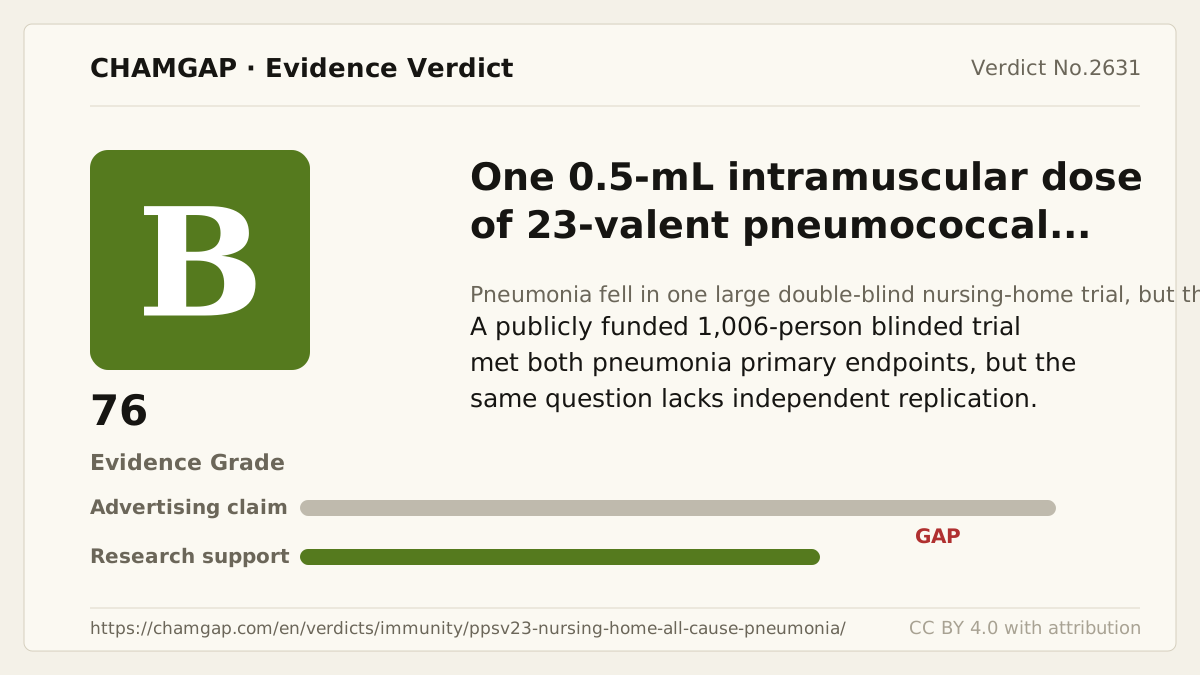
research showsThe grade is B. A double-blind placebo-controlled trial analyzed all 1,006 randomized Japanese nursing-home residents. All-cause pneumonia occurred in 63/502 (12.5%) with PPSV23 and 104/504 (20.6%) with placebo, a 44.8% incidence reduction (95% CI 22.4%-60.8%). Pneumococcal pneumonia occurred in 14/502 (2.8%) versus 37/504 (7.3%), a 63.8% reduction (32.1%-80.7%). These are large reductions in clinical disease events, but no second independent trial replicated the same nursing-home question, giving B with 76 points.
ads claimContaining pneumococcal antigens and eliciting antibodies is distinct from preventing clinical pneumonia. This trial directly counted disease, but its result should not automatically be extended to community-dwelling adults, immunocompromised people, or different vaccine schedules.
Useful facts when choosing a product
- The trial used Pneumovax 0.5 mL and an identical-appearing 0.5-mL saline placebo.
- All-cause and pneumococcal pneumonia were the two primary endpoints; mortality was secondary.
- Verdict 1911 is B with 76 points for PCV13 against vaccine-type pneumonia in community-dwelling adults aged 65 or older; this verdict concerns a different vaccine and nursing-home population.
Chamgap Semantic Classification Code
Candidate index · review held
M.one-intramuscular-dose-of-23-valent-pneumococcal-polysaccharide-vaccine.intramuscular.all-cause-and-pneumococcal-pneumonia-in-nursing-home-residents.reduce.placeboMedicinal interventions > One intramuscular dose of 23-valent pneumococcal polysaccharide vaccine > Intramuscular > all-cause and pneumococcal pneumonia in nursing-home residents > Reduction claim > Placebo
An automated migration candidate, not an issued permanent code; exact claim scope remains under review. This machine-generated migration candidate helps retrieval but is not a permanent assignment. The original verdict ID and URL remain authoritative.
What the research actually shows
The paper reports identical single-dose syringe-and-needle combinations labeled only with sequential study numbers. A statistician outside the study team generated the random-number-table sequence and numbered the containers; blinded nursing-home staff assigned participants, and the code remained closed until follow-up ended. All 1,006 randomized participants, 502 versus 504, formed the primary denominators. The paper names both primary endpoints and registration JMA-IIA00024; the current Japanese migration list maps it to jRCT1090220024. The original historical registration date and archived outcome fields could not be reconstructed from the accessible record. A Japanese education-ministry grant funded the trial, and the authors declared no conflicts.
Why this is classified as B (76)
Clinical pneumonia events, public funding, large effects, and strong masking and analysis support the claim, but absent independent replication limits it to B with 76 points.
Counterpoint. B does not mean every older adult receives the same absolute benefit; the high baseline risk and Japanese nursing-home setting matter.
Rejudgment record. Cross-check applied — The BMJ report, PubMed record, and Japanese registry migration list were checked for coprimary endpoints, randomized and analyzed denominators, masking, registration, funding, and event counts
| Endpoint | H | Hard endpoint - actual events such as death |
| Replication | R1 | Single confirmatory trial |
| Independence | I2 | Decisive evidence is publicly or non-profit funded |
| Effect size | E+ | Meets the clinically important threshold |
Stored derived and displayed grades match; this is not a current recalculation or validity check (B).
Sub-claim grades by effect
This ingredient is marketed for several effects. A single overall grade blends strong and weak claims together, so each effect is graded separately here. The overall grade reflects the strongest disconfirming or core claim.
| Effect (sub-claim) | Grade | Basis |
|---|---|---|
| Reduced all-cause pneumonia | B | Rates were 12.5% versus 20.6%, a 44.8% incidence reduction. |
| Reduced pneumococcal pneumonia | B | Rates were 2.8% versus 7.3%, a 63.8% incidence reduction. |
| Reduced all-cause mortality | D | Rates were 89/502 versus 80/504, without a significant difference. |
Cross-check — AI research and Codex final gate
Evidence Table
| Study | Design | Sample | Funding | Endpoint | Result | Weight |
|---|---|---|---|---|---|---|
| Maruyama T, Taguchi O, Niederman MS, Morser J, Kobayashi H, Kobayashi T, D'Alessandro-Gabazza C, Nakayama S, Nishikubo K, Noguchi T, Takei Y, Gabazza EC. 2010 | Multicenter double-blind randomized saline-placebo-controlled trial | 1,006 randomized and analyzed, 502 versus 504 | Japanese Ministry of Education, Culture, Sports, Science and Technology grant; no conflicts declared | Coprimary all-cause pneumonia and pneumococcal pneumonia | All-cause pneumonia 63/502 versus 104/504, reduction 44.8% (95% CI 22.4%-60.8%); pneumococcal pneumonia 14/502 versus 37/504, reduction 63.8% (32.1%-80.7%). | Only large publicly funded direct disease trial |
Receipt — 1 References
All 1 cited sources were verified for existence at the original page (as of 2026-08-15).
Final verification and publication gate: Codex · Evidence date: 2026-08-15 · Corrections: none
Cite this verdict
[Chamgap] PPSV23 x pneumonia prevention in nursing-home residents — Evidence Grade B·76. 1 cited sources checked. Source: https://chamgap.com/en/verdicts/immunity/ppsv23-nursing-home-all-cause-pneumonia/ · CC BY 4.0CC BY 4.0 — free to use with attribution; do not distort grades, numbers, or verdict meaning.
What this document does and does not do
Chamgap is an information source. It reports what research has and has not confirmed; it does not tell readers what to take or buy. That decision belongs to readers and, when needed, medical or legal professionals. This verdict reflects literature available up to the search date and may change as new research appears. Nothing here is medical advice.