
Chlorhexidine-mupirocin decolonization,
does it really help with Reduced one-year clinical MRSA infection among carriers after discharge?
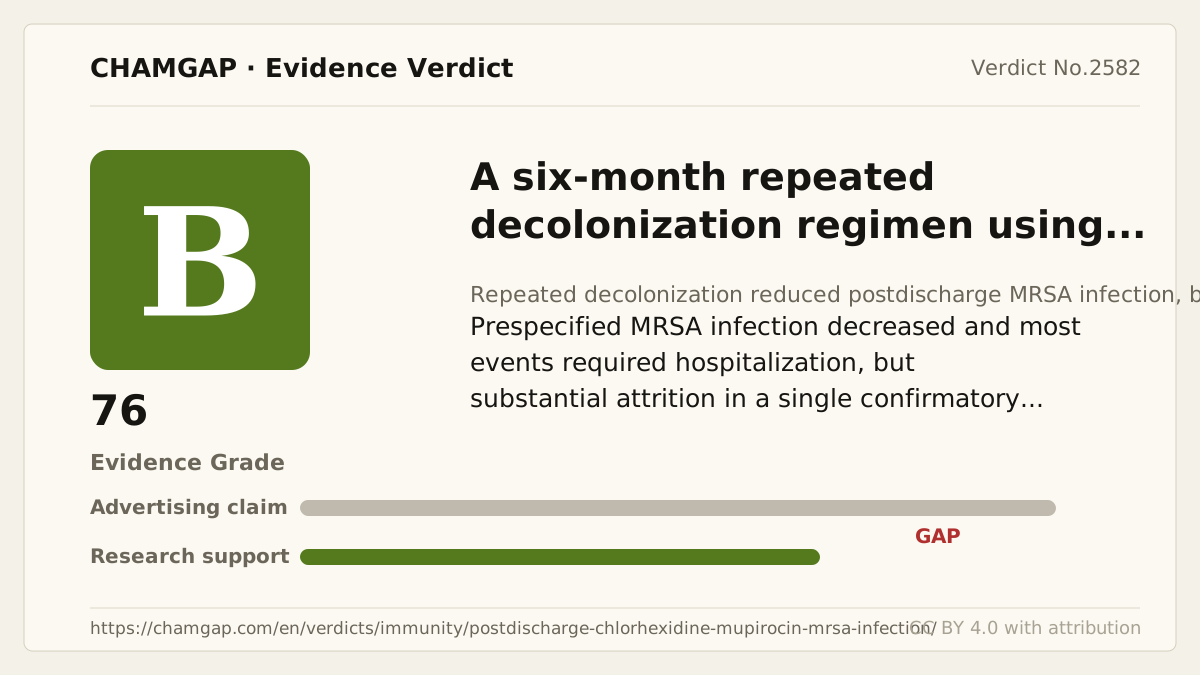
research showsThe grade is B. Among 2,121 analyzed CLEAR participants, one-year MRSA infection occurred in 67/1,058 (6.3%) with decolonization versus 98/1,063 (9.2%) with education, HR 0.70 (95% CI 0.52 to 0.96). The absolute difference was 2.9 percentage points, and the time-to-event number needed to treat was 30 (95% CI 18 to 230). This was a large publicly funded trial, but substantial one-year attrition and lack of independent replication give B with 76 points.
ads claimThe repeated combination regimen truly reduced one-year MRSA infection. The result cannot be shortened to one five-day course, chlorhexidine alone, or mupirocin alone, and the adherent-participant estimate should not be advertised as every patient's expected benefit.
Useful facts when choosing a product
- For six months, participants used 4% chlorhexidine bathing, 0.12% mouthwash, and 2% nasal mupirocin twice daily for five days, twice each month.
- Both groups received identical MRSA hygiene education, and all trial products were purchased with grant funds.
- Treatment-related adverse effects occurred in 44/1,058 (4.2%) and were all mild local irritation.
Chamgap Semantic Classification Code
Candidate index · review held
UNK.repeated-decolonization-regimen-using-4-percent-chlorhexidine-bathing.MULTI.clinical-mrsa-infection-among-carriers-after-discharge.reduce.UNKUnknown > repeated decolonization regimen using 4% chlorhexidine bathing > Multiple: primary unresolved > clinical MRSA infection among carriers after discharge > Reduction claim > Unknown
An automated migration candidate, not an issued permanent code; exact claim scope remains under review. This machine-generated migration candidate helps retrieval but is not a permanent assignment. The original verdict ID and URL remain authoritative.
What the research actually shows
Huang SS, Singh R, McKinnell JA, Park S, Gombosev A, Eells SJ, Gillen DL, Kim D, Rashid S, Macias-Gil R, Bolaris MA, Tjoa T, Cao C, Hong SS, Lequieu J, Cui E, Chang J, He J, Evans K, Peterson E, Simpson G, Robinson P, and the Project CLEAR Trial randomized MRSA carriers 1:1 across 17 hospitals and 7 nursing homes. Of 2,140 randomized, 19 who were ineligible or died during the enrollment hospitalization were excluded from the prespecified 2,121-person analysis population. Two infectious-disease physicians reviewed redacted records while blinded to group. Funding was AHRQ R01HS019388 and NIH UL1 TR000153, and products were purchased with grant funds.
Why this is classified as B (76)
A large publicly funded randomized trial reduced prespecified MRSA infection assessed by blinded reviewers. Substantial attrition and no independent replication give B with 76 points.
Counterpoint. Mupirocin and chlorhexidine resistance did not differ over one year, but later resistance cannot be excluded by this follow-up.
Rejudgment record. Cross-check applied — The article and NCT record were cross-checked for the primary endpoint, analysis population, blinded chart review, event counts, attrition, product purchase, and public funding.
| Endpoint | H | Hard endpoint - actual events such as death |
| Replication | R1 | Single confirmatory trial |
| Independence | I2 | Decisive evidence is publicly or non-profit funded |
| Effect size | E+ | Meets the clinically important threshold |
Stored derived and displayed grades match; this is not a current recalculation or validity check (B).
Sub-claim grades by effect
This ingredient is marketed for several effects. A single overall grade blends strong and weak claims together, so each effect is graded separately here. The overall grade reflects the strongest disconfirming or core claim.
| Effect (sub-claim) | Grade | Basis |
|---|---|---|
| Reduced one-year MRSA infection | B | Rates were 6.3% versus 9.2%, HR 0.70. |
| Reduced infection from any cause | C | Clinically judged infection decreased, but this was a secondary endpoint without multiplicity adjustment. |
Cross-check — AI research and Codex final gate
Evidence Table
| Study | Design | Sample | Funding | Endpoint | Result | Weight |
|---|---|---|---|---|---|---|
| Huang SS, Singh R, McKinnell JA, Park S, Gombosev A, Eells SJ, Gillen DL, Kim D, Rashid S, Macias-Gil R, Bolaris MA, Tjoa T, Cao C, Hong SS, Lequieu J, Cui E, Chang J, He J, Evans K, Peterson E, Simpson G, Robinson P, Project CLEAR Trial, 2019 CLEAR | Multicenter unblinded randomized superiority trial with blinded infection adjudication | 2,140 randomized; prespecified analysis population 2,121, with 1,058 and 1,063 | Public AHRQ R01HS019388 and NIH UL1 TR000153 funding; products purchased with grant funds | Time to CDC-defined MRSA infection during one year after discharge | 67/1,058 (6.3%) versus 98/1,063 (9.2%); HR 0.70 (95% CI 0.52 to 0.96), P=.03; NNT 30 (95% CI 18 to 230) | Single large publicly funded infection-event confirmatory trial |
Receipt — 2 References
All 2 cited sources were verified for existence at the original page (as of 2026-08-14).
Final verification and publication gate: Codex · Evidence date: 2026-08-14 · Corrections: none
Cite this verdict
[Chamgap] Chlorhexidine-mupirocin decolonization x postdischarge MRSA infection — Evidence Grade B·76. 2 cited sources checked. Source: https://chamgap.com/en/verdicts/immunity/postdischarge-chlorhexidine-mupirocin-mrsa-infection/ · CC BY 4.0CC BY 4.0 — free to use with attribution; do not distort grades, numbers, or verdict meaning.
What this document does and does not do
Chamgap is an information source. It reports what research has and has not confirmed; it does not tell readers what to take or buy. That decision belongs to readers and, when needed, medical or legal professionals. This verdict reflects literature available up to the search date and may change as new research appears. Nothing here is medical advice.