
Pacifier use,
does it really help with More acute and recurrent acute otitis media in young children?
research showsThe grade is C. In an Iowa prospective cohort with repeated questionnaires from six weeks to 12 months, pacifier use was associated with parent-reported otitis media, adjusted OR 1.20 (95% CI 1.03 to 1.39). Interval rates were 48% versus 42% at nine months and 48% versus 41% at 12 months. The association was small, diagnosis was parent-reported, follow-up loss was large, and residual confounding prevents a causal conclusion.
ads claimKorean parenting debate often merges ear-infection risk with soothing and sleep safety. Age, duration, sleep-only use, and continuous daytime use must be separated. Verdict 1757 is D with 28 points for tympanostomy tubes preventing recurrence, while verdict 1923 is B with 72 points for amoxicillin-clavulanate reducing treatment failure. Those concern treatment after disease, not this exposure association.
Useful facts when choosing a product
- The pivotal cohort measured interval-specific use as yes or no, without hours or sleep-only use.
- Otitis was parent-reported without standardized otoscopy or chart confirmation.
- Sleep-time pacifier use has a separate association with lower SIDS risk.
Chamgap Semantic Classification Code
Candidate index · review held
UNK.pacifier-use.UNK.more-acute-and-recurrent-acute-otitis-media-in-young-children.assess.UNKUnknown > Pacifier use > Unknown > More acute and recurrent acute otitis media in young children > Association or change assessment > Unknown
An automated migration candidate, not an issued permanent code; exact claim scope remains under review. This machine-generated migration candidate helps retrieval but is not a permanent assignment. The original verdict ID and URL remain authoritative.
What the research actually shows
A volunteer cohort of 1,375 infants from eight Iowa postpartum units completed parental questionnaires at six weeks and 3, 6, 9, and 12 months. Exposure was interval-specific yes/no pacifier use, without hours, sleep-only use, all-day use, or cumulative duration. Otitis meant a parent-reported treated episode for which antibiotics were prescribed; there was no standardized otoscopy or chart review. Interval rates were 48% versus 42% at nine months and 48% versus 41% at 12 months. Repeated-measures GEE gave adjusted OR 1.20 (95% CI 1.03 to 1.39). The overall unadjusted odds ratio and confidence interval were not reported in the source. Final model terms were age, age squared, sex, childcare days, income, childcare-by-income interaction, and pacifier use. Sibling count, breastfeeding duration, and secondhand smoke were not adjusted in the final model; all three can be linked to both otitis risk and pacifier use. Respondents declined from 1,236 to 792, a 42.4% loss from the analytic cohort by 12 months. Clinical-trial registration was not applicable to this observational cohort. The funding statement read: 'This study was supported by NIH grants R01-DE09551 and P30-DE10126.' A separate Dutch prospective cohort found recurrent AOM in 16% versus 11%, adjusted OR 1.9 (1.1 to 3.2), while any AOM was 35% versus 32%, OR 1.3 (0.9 to 1.9).
Why this is classified as C (56)
The association was statistically confirmed and reclassified as positive. Follow-up loss and residual confounding give C with 56 points.
Counterpoint. This does not mean every user develops otitis. Sleep-safety benefit and use after recurrent AOM are different decisions.
Rejudgment record. Cross-check applied — Small positive association in a repeated-questionnaire cohort with parent-reported outcomes, large follow-up loss, and residual confounding
| Endpoint | H | Hard endpoint - actual events such as death |
| Replication | R1 | Single confirmatory trial |
| Independence | I2 | Decisive evidence is publicly or non-profit funded |
| Effect size | E+ | Meets the clinically important threshold |
Stored derived and displayed grades match; this is not a current recalculation or validity check (C).
Sub-claim grades by effect
This ingredient is marketed for several effects. A single overall grade blends strong and weak claims together, so each effect is graded separately here. The overall grade reflects the strongest disconfirming or core claim.
| Effect (sub-claim) | Grade | Basis |
|---|---|---|
| Increased otitis media during the first year | C | Repeated-measures aOR was 1.20 (1.03 to 1.39), a small positive association. |
| Increased clinician-diagnosed recurrent AOM | C | A separate cohort found 16% versus 11%, aOR 1.9 (1.1 to 3.2). |
| Sleep-time use and lower SIDS risk | C | This is a separate known benefit, not part of the otitis grade. |
Cross-check — AI research and Codex final gate
Evidence Table
| Study | Design | Sample | Funding | Endpoint | Result | Weight |
|---|---|---|---|---|---|---|
| Warren et al. Iowa birth cohort 2001 | Prospective cohort with repeated parental questionnaires from six weeks to 12 months | 1,375 in analytic cohort; 792 responded at 12 months | NIH grants R01-DE09551 and P30-DE10126 | Parent-reported treated otitis with an antibiotic prescription | aOR 1.20 (1.03 to 1.39); 48% versus 42% at nine months and 48% versus 41% at 12 months | Pivotal prospective observational evidence |
| Rovers et al. dynamic prospective cohort 2008 | Prospective cohort linking parental baseline questionnaire with GP diagnostic codes | 495 followed; 476 in tables, 216 versus 260 | Funding and acknowledgement section not confirmed | GP-diagnosed any and recurrent AOM | Any AOM 35% versus 32%, aOR 1.3 (0.9 to 1.9); recurrent AOM 16% versus 11%, aOR 1.9 (1.1 to 3.2) | Supporting evidence with clinician diagnosis |
| Niemela et al. daycare prospective cohort 1995 | Prospective daycare cohort | 845 children over 15 months | Funding and acknowledgement section not confirmed | More than three AOM episodes and annual episode rate | Under age two 29.5% versus 20.6%, RR 1.6 (0.6 to 4.1); age two to three 30.6% versus 13.2%, RR 2.9 (1.2 to 7.3) | Supporting prospective observational evidence |
Receipt — 4 References
All 4 cited sources were verified for existence at the original page (as of 2026-08-08).
Final verification and publication gate: Codex · Evidence date: 2026-08-08 · Corrections: none
Cite this verdict
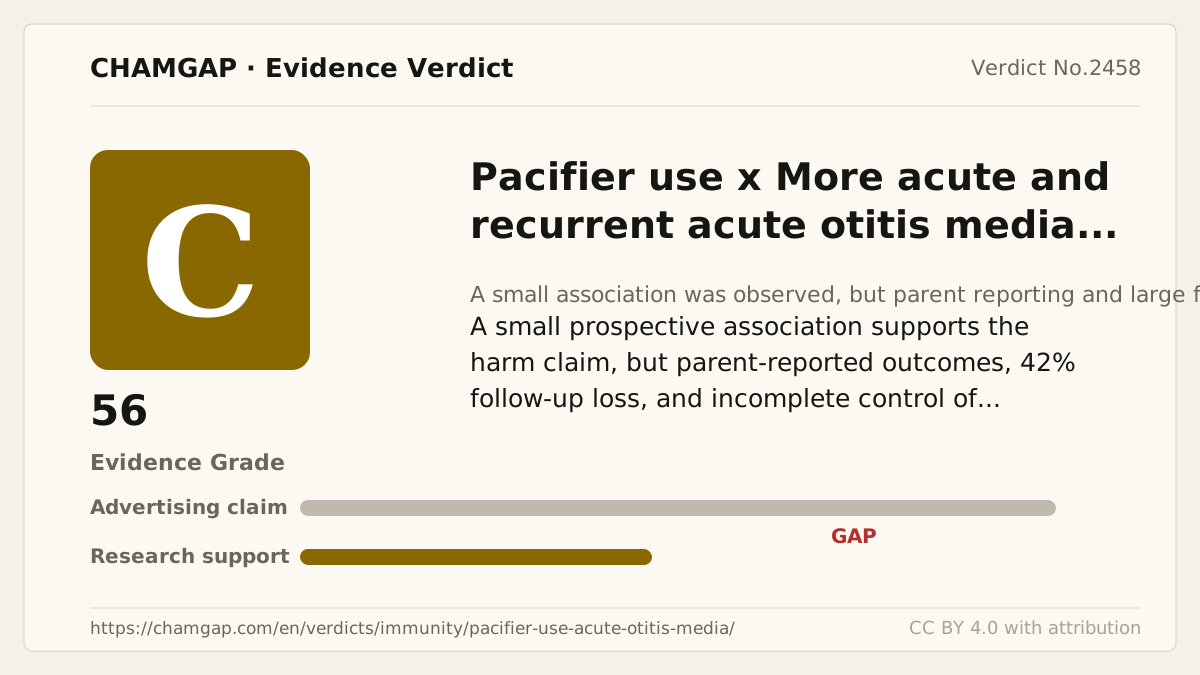
[Chamgap] Pacifier use x increased acute otitis media — Evidence Grade C·56. 4 cited sources checked. Source: https://chamgap.com/en/verdicts/immunity/pacifier-use-acute-otitis-media/ · CC BY 4.0CC BY 4.0 — free to use with attribution; do not distort grades, numbers, or verdict meaning.
What this document does and does not do
Chamgap is an information source. It reports what research has and has not confirmed; it does not tell readers what to take or buy. That decision belongs to readers and, when needed, medical or legal professionals. This verdict reflects literature available up to the search date and may change as new research appears. Nothing here is medical advice.