
Oscillococcinum 200C,
does it really help with Prevention of influenza-like illness and shortening of symptom duration?
research showsIn the Cochrane review, two prevention trials with 327 participants did not show a significant preventive effect and were poorly reported, supporting F for prevention. Four treatment trials with 1,196 participants produced a small extractable signal at 48 hours or about 0.28 day shorter illness, but this was low-quality, short-term evidence with unclear bias, supporting D for treatment. A 200C preparation undergoes two hundred successive hundredfold dilutions, leaving essentially no source-material molecules and conflicting with known pharmacologic plausibility.
ads claimMarketing presents influenza prevention, recovery within 48 hours, or shorter symptoms as established effects. Most trials involved influenza-like illness rather than laboratory-confirmed influenza, prevention was null, and treatment signals were short-term and low quality. The product is not a substitute for vaccination, antivirals, or medical assessment.
Useful facts when choosing a product
- The label lists Anas barbariae hepatis et cordis extractum 200CK; 200C or 200CK denotes two hundred successive 1:100 dilutions, theoretically 10^-400.
- One U.S. label directs users to dissolve the entire contents of a single-dose tube under the tongue and, at symptom onset, repeat every six hours up to three times daily. Label directions do not establish efficacy.
- Korean consumers may encounter six- or thirty-dose packages through online cross-border purchase or purchasing agents; formal import status, medicine authorization, and Korean labeling require product-specific verification.
- Pellets are principally sucrose and lactose, so people with relevant intolerance or metabolic concerns should check the label. The major risk is delay of influenza vaccination, antiviral therapy, or medical care.
Chamgap Semantic Classification Code
Candidate index · review held
S.oscillococcinum.UNK.influenza-like-illness-and-shortening-of-symptom-duration.prevent.placeboSupplements and nutraceuticals > Oscillococcinum > Unknown > influenza-like illness and shortening of symptom duration > Occurrence-prevention claim > Placebo
An automated migration candidate, not an issued permanent code; exact claim scope remains under review. This machine-generated migration candidate helps retrieval but is not a permanent assignment. The original verdict ID and URL remain authoritative.
What the research actually shows
The 2015 Mathie Cochrane review included six placebo-controlled Oscillococcinum trials. Two Russian prevention trials with 327 participants produced no statistically significant pooled prevention effect. Four French and German treatment trials included 1,196 participants; two trials with 796 participants supplied the 48-hour symptom-absence outcome and showed a small low-quality signal that was not significant on days three and four. An earlier Cochrane estimate put the mean illness-duration difference at about minus 0.28 day. Poor reporting and unclear bias prevented firm conclusions for either prevention or treatment.
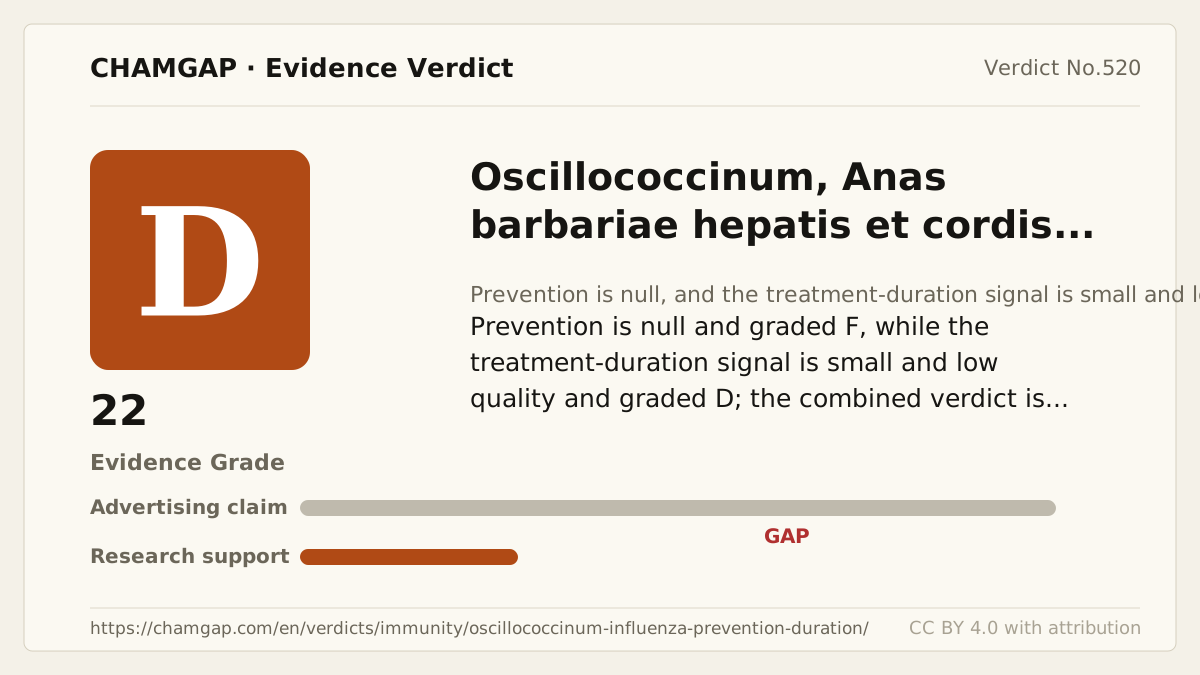
Why this is classified as D (22)
The null prevention trials are separated as an F subclaim. Treatment remains in the low D band rather than F because a small 48-hour and 0.28-day signal exists, but it is not clinically robust and mechanistic plausibility is absent; the overall score is D with 22 points.
Counterpoint. Natural recovery and expectancy may improve perceived experience after a dose, but this does not establish prevention of viral infection or a reproducible clinical reduction in duration.
Rejudgment record. New verdict — Pooled prevention trials were null and graded F; the 48-hour and 0.28-day treatment signals were low quality, short term, and at unclear risk of bias, while 200C lacks mechanistic plausibility, yielding overall D
Sub-claim grades by effect
This ingredient is marketed for several effects. A single overall grade blends strong and weak claims together, so each effect is graded separately here. The overall grade reflects the strongest disconfirming or core claim.
| Effect (sub-claim) | Grade | Basis |
|---|---|---|
| Prevention of influenza or influenza-like illness | D | Prevention (2 trials, 327 people) gave RR 0.48 (95% CI 0.17–1.34, p=.16), non-significant and low-quality, so this is D (absence of confirmatory evidence) rather than repeated refutation (F). |
| Shortening the duration of influenza-like illness | D | Signals for symptom absence at 48 hours or about 0.28 day shorter illness were low-quality and short term and were not sustained at later time points. |
Cross-check — AI research and Codex final gate
Evidence Table
| Study | Design | Sample | Funding | Endpoint | Result | Weight |
|---|---|---|---|---|---|---|
| Mathie RT et al. 2015 Cochrane review | Systematic review and meta-analysis of randomized placebo-controlled trials | 1,196 | Cochrane review; authors disclosed homeopathy-related interests | Prevention incidence, symptom absence at 48 hours, and symptom duration | The pooled prevention effect was not significant; the small 48-hour treatment signal was low quality and did not support a robust conclusion. | Key |
| Vickers AJ, Smith C. 2006 Cochrane review | Systematic review of randomized placebo-controlled trials | Cochrane review | Prevention and illness duration | Did not support prevention and estimated only about 0.28 day shorter illness. | Supportive | |
| NCCIH Homeopathy evidence summary | U.S. public-agency evidence summary | U.S. NIH and NCCIH | Ultradilution, clinical efficacy, and safety | Notes that many homeopathic products retain no source molecules and cites assessments finding no reliable evidence for any health condition. | Mechanism; context | |
| DailyMed Oscillococcinum label | Official product label | 200 | U.S. NLM label repository | Ingredients, directions, and sugar excipients | Confirms the 200CK labeling, single-dose tube directions, and sucrose or lactose ingredients. | Product facts |
Receipt — 4 References
All 4 cited sources were verified for existence at the original page (as of 2026-07-18).
Final verification and publication gate: Codex · Evidence date: 2026-07-18 · Corrections: none
Cite this verdict
[Chamgap] Oscillococcinum 200C x influenza prevention and symptom duration — Evidence Grade D·22. 4 cited sources checked. Source: https://chamgap.com/en/verdicts/immunity/oscillococcinum-influenza-prevention-duration/ · CC BY 4.0CC BY 4.0 — free to use with attribution; do not distort grades, numbers, or verdict meaning.
What this document does and does not do
Chamgap is an information source. It reports what research has and has not confirmed; it does not tell readers what to take or buy. That decision belongs to readers and, when needed, medical or legal professionals. This verdict reflects literature available up to the search date and may change as new research appears. Nothing here is medical advice.