
N95 respirators vs medical masks,
does it really help with Prevention of influenza among healthcare personnel?
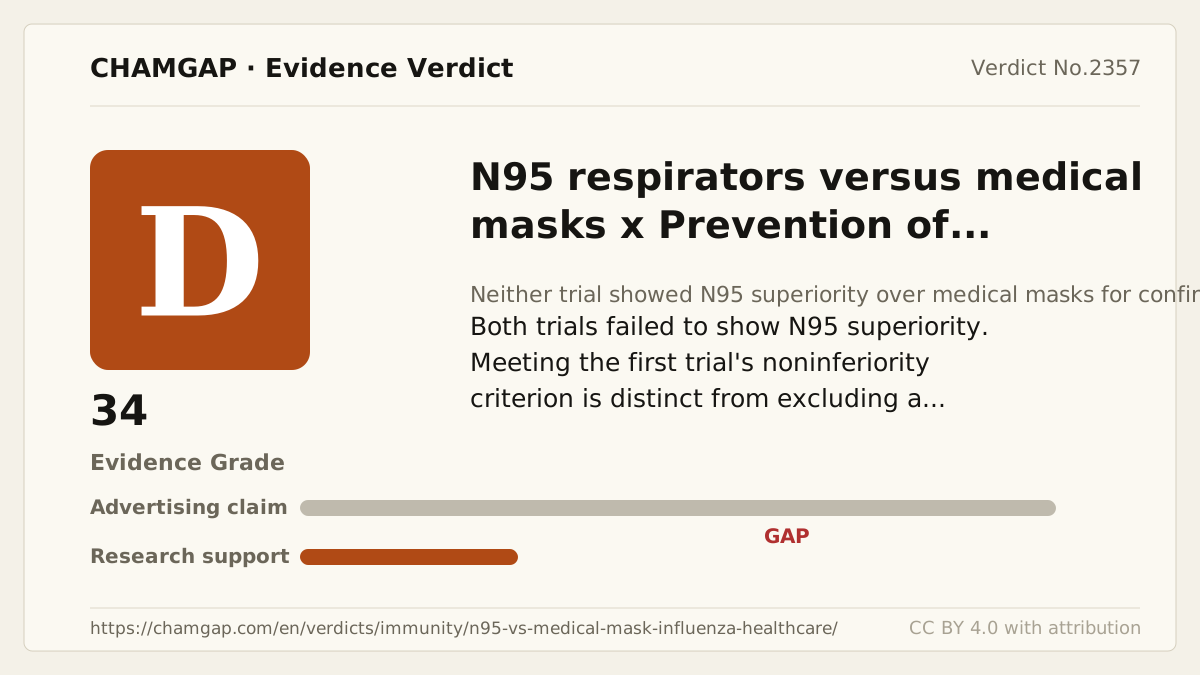
research showsThe grade is D with 34 points. In 2009, confirmed influenza was 50/212 (23.6%) with medical masks and 48/210 (22.9%) with N95; the difference was -0.73 points (95% CI -8.8 to 7.3). The prespecified noninferiority criterion was met, but the 9-point margin came from investigator clinical judgment and sample-size assumptions, not a validated clinical threshold. A 2019 trial also failed to show N95 superiority.
ads claimFailure to demonstrate superiority must not be rewritten as saying that N95 respirators are useless or have no effect.
Useful facts when choosing a product
- The Loeb margin was prespecified at 9 percentage points; no mid-trial change was identified.
- In Radonovich, always-use adherence was 65.2% with N95 and 65.1% with masks; always plus sometimes was 89.4% and 90.2%.
- Verdict 2201 is D with 28 points and concerns blood pressure and heart-rate variability during pollution exposure, a different indication and endpoint.
Chamgap Semantic Classification Code
Candidate index · review held
UNK.n95-respirators-versus-medical-masks.UNK.influenza-among-healthcare-personnel.prevent.UNKUnknown > N95 respirators versus medical masks > Unknown > influenza among healthcare personnel > Occurrence-prevention claim > Unknown
An automated migration candidate, not an issued permanent code; exact claim scope remains under review. This machine-generated migration candidate helps retrieval but is not a permanent assignment. The original verdict ID and URL remain authoritative.
What the research actually shows
Loeb randomized 446 nurses in emergency, medical, and pediatric units at eight Canadian tertiary hospitals. Assigned protection was used while caring for patients with febrile respiratory illness and continued during aerosol-generating procedures such as intubation or bronchoscopy unless tuberculosis was suspected. Confirmed influenza occurred in 50/212 and 48/210. Radonovich randomized 5,180 healthcare-person seasons from 2,862 workers across 137 mostly outpatient sites in seven US health systems. Influenza occurred in 207/2,512 N95 seasons and 193/2,668 medical-mask seasons; difference 1.0 points (95% CI -0.5 to 2.5), adjusted OR 1.18 (0.95 to 1.45). There were no overlapping author names between the papers.
Why this is classified as D (34)
Two independent trials failed to show superiority, but the 9-point margin was not a validated clinical threshold and cannot exclude meaningful benefit, yielding D with 34 points.
Counterpoint. Failure to show superiority does not establish equal absolute protection or ineffectiveness.
Rejudgment record. Editorial reassessment applied — Accepted two failures to show superiority but did not treat an investigator-selected sample-size margin as a validated benefit-exclusion threshold
| Endpoint | H | Hard endpoint - actual events such as death |
| Replication | RX | Repeatedly refuted in the same indication |
| Independence | I2 | Decisive evidence is publicly or non-profit funded |
| Effect size | E0 | Null |
| Precision | C0 | The confidence interval leaves room for benefit |
Stored derived and displayed grades match; this is not a current recalculation or validity check (D).
Sub-claim grades by effect
This ingredient is marketed for several effects. A single overall grade blends strong and weak claims together, so each effect is graded separately here. The overall grade reflects the strongest disconfirming or core claim.
| Effect (sub-claim) | Grade | Basis |
|---|---|---|
| Additional influenza prevention from N95 versus medical masks among healthcare personnel | D | Neither trial showed superiority, but no validated clinical threshold excluded benefit. |
Cross-check — AI research and Codex final gate
Evidence Table
| Study | Design | Sample | Funding | Endpoint | Result | Weight |
|---|---|---|---|---|---|---|
| Loeb M et al., 2009 | Open-label noninferiority randomized trial with blinded laboratory assessment | 446 randomized; 422 analyzed (212/210) | Original wording: This study was supported by the Public Health Agency of Canada. Mask-manufacturer funding was not reported in the paper. | Laboratory-confirmed influenza | Medical mask 50 (23.6%), N95 48 (22.9%); difference -0.73 points (95% CI -8.8 to 7.3), meeting the prespecified noninferiority criterion; the margin was not a validated clinical threshold. | Pivotal trial meeting noninferiority without establishing benefit exclusion |
| Radonovich LJ Jr et al., 2019 | Pragmatic cluster-randomized trial | 2,862 workers and 5,180 healthcare-person seasons | Original wording: This trial was funded by the US Centers for Disease Control and Prevention, Veterans Health Administration, and the Biodefense Advanced Research and Development Agency. No mask-manufacturer funding was reported. | Laboratory-confirmed influenza | N95 207/2,512 (8.2%), medical mask 193/2,668 (7.2%); adjusted OR 1.18 (0.95 to 1.45). | Independent repeated null trial |
Receipt — 2 References
All 2 cited sources were verified for existence at the original page (as of 2026-08-07).
Final verification and publication gate: Codex · Evidence date: 2026-08-07 · Corrections: none
Cite this verdict
[Chamgap] N95 respirators vs medical masks x influenza prevention — Evidence Grade D·34. 2 cited sources checked. Source: https://chamgap.com/en/verdicts/immunity/n95-vs-medical-mask-influenza-healthcare/ · CC BY 4.0CC BY 4.0 — free to use with attribution; do not distort grades, numbers, or verdict meaning.
What this document does and does not do
Chamgap is an information source. It reports what research has and has not confirmed; it does not tell readers what to take or buy. That decision belongs to readers and, when needed, medical or legal professionals. This verdict reflects literature available up to the search date and may change as new research appears. Nothing here is medical advice.