
MMR vaccine,
does it really help with Prevention of measles, mumps, and rubella infections in children?
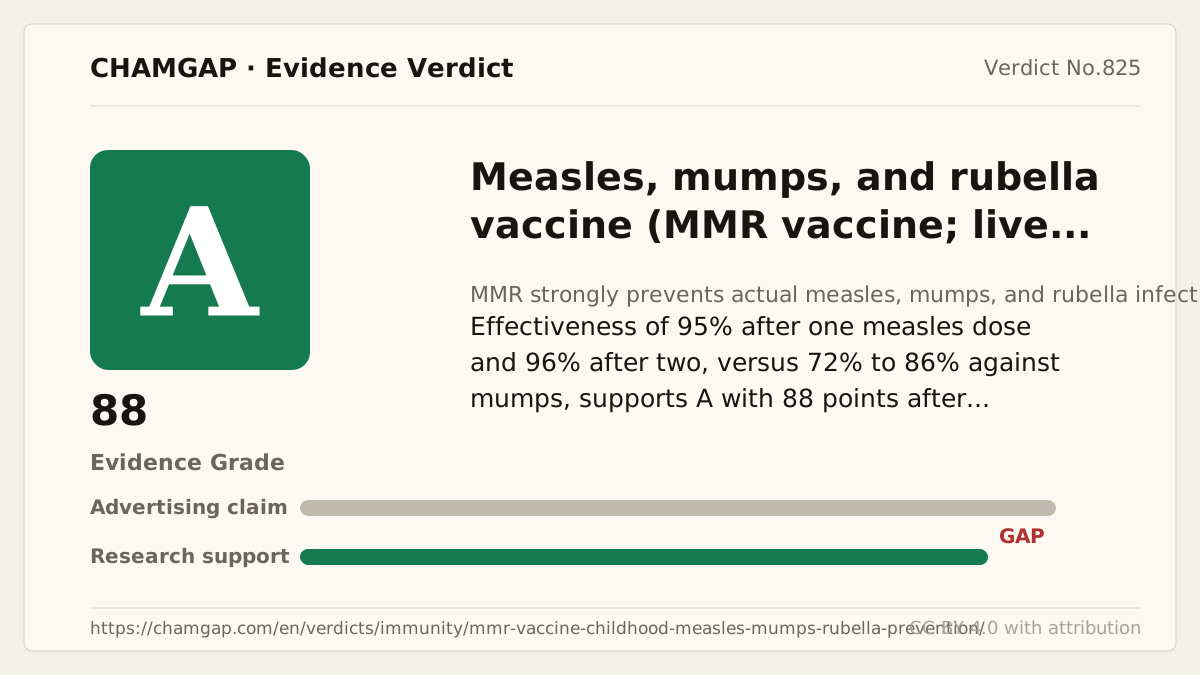
research showsMMR vaccine is rated A because it strongly and consistently prevents actual measles, mumps, and rubella infections in children. The 2021 Cochrane update synthesized 138 studies and about 23.48 million participants, estimating effectiveness of 95% after one dose and 96% after two doses against measles, 72% and 86% for one and two doses of Jeryl Lynn-containing vaccine against mumps, and 89% against rubella. Large direct disease data across countries, eras, and outbreaks and decades of surveillance point in the same direction, although the mumps component is relatively less effective and can wane. The claim that MMR causes autism is a repeatedly disproven myth in large cohorts and systematic reviews.
ads claimPublic-health messaging can sometimes sound like perfect 100% protection, although breakthrough infections occur. Conversely, the claim that MMR causes autism is a repeatedly disproven myth without credible supporting evidence and should not be presented as an equally valid efficacy or safety dispute.
Useful facts when choosing a product
- The routine national childhood schedule generally gives the first dose at 12 to 15 months and the second at 4 to 6 years; public-health guidance can modify timing for outbreaks, travel, or catch-up vaccination.
- MMR is a live attenuated vaccine. It is generally contraindicated in pregnancy and severe immunosuppression, and a previous severe allergic reaction to a dose or component requires evaluation before vaccination.
- Injection-site discomfort, fever, a mild rash, and transient joint symptoms can occur, and febrile seizure is uncommon. Anaphylaxis is very rare.
- Antibody response does not protect every person completely; mumps protection is lower than measles and rubella protection and may wane. Public-health authorities may recommend an additional dose during an outbreak.
Chamgap Semantic Classification Code
Candidate index · review held
M.measles.UNK.measles-mumps-and-rubella-infections.prevent.UNKMedicinal interventions > Measles > Unknown > measles, mumps, and rubella infections > Occurrence-prevention claim > Unknown
An automated migration candidate, not an issued permanent code; exact claim scope remains under review. This machine-generated migration candidate helps retrieval but is not a permanent assignment. The original verdict ID and URL remain authoritative.
What the research actually shows
The Di Pietrantonj Cochrane update synthesized 138 studies and about 23.48 million participants, estimating 95% and 96% effectiveness against measles after one and two doses, 72% and 86% for one and two doses of Jeryl Lynn-containing vaccine against mumps, and 89% against rubella. A Canadian mumps outbreak analysis found a wider and relatively lower range of 49.2% to 81.6% after one dose and 66.3% to 88.0% after two doses. In a nationwide Danish cohort of 657,461 children, MMR vaccination did not increase autism risk, with an adjusted hazard ratio of 0.93. Efficacy, component differences, and safety myths are treated as separate questions.
Why this is classified as A (88)
Independent studies, outbreak investigations, and long-term surveillance involving tens of millions repeatedly show prevention, but effectiveness differs by component: 95% to 96% against measles, 72% to 86% against mumps, and 89% against rubella. The evidence remains upper-range A but is placed below dexamethasone A94 at A with 88 points. The autism myth is repeatedly refuted, and vaccine reactions and contraindications remain under safety.
Counterpoint. When high coverage makes disease uncommon, individual benefit can be difficult to see, but importations can rapidly cause outbreaks in undervaccinated groups. Individual contraindications should be reviewed with a clinician, while routine childhood doses should generally be completed.
Rejudgment record. New verdict — Prioritized the independent Cochrane synthesis and direct infection outcomes across tens of millions while accounting for effectiveness differences of 95% to 96% against measles, 72% to 86% against mumps, and 89% against rubella, placing the verdict below dexamethasone A94 at A88
Sub-claim grades by effect
This ingredient is marketed for several effects. A single overall grade blends strong and weak claims together, so each effect is graded separately here. The overall grade reflects the strongest disconfirming or core claim.
| Effect (sub-claim) | Grade | Basis |
|---|---|---|
| Prevention of measles infection in children | A | Effectiveness of about 95% after one dose and 96% after two doses was consistent across direct disease studies. |
| Prevention of mumps infection in children | A | Effectiveness is about 72% after one dose and 86% after two doses, strong but lower and more prone to waning than measles or rubella protection. |
| Prevention of rubella infection in children | A | Synthesized direct infection data showed effectiveness of about 89%. |
| MMR vaccine causes autism | F | This is a repeatedly disproven myth in cohorts and systematic reviews involving hundreds of thousands to more than a million children. |
Cross-check — AI research and Codex final gate
Evidence Table
| Study | Design | Sample | Funding | Endpoint | Result | Weight |
|---|---|---|---|---|---|---|
| Di Pietrantonj C et al. Cochrane update 2021 | Systematic review and meta-analysis of effectiveness and safety of MMR and MMRV in children | 138 studies and about 23,480,668 participants | Independent Cochrane academic synthesis | Actual clinical or confirmed measles, mumps, and rubella infection and safety | Effectiveness was 95% and 96% after one and two doses against measles, 72% and 86% against mumps, and 89% against rubella, with no autism association. | Pivotal large independent synthesis |
| Deeks SL et al. Ontario mumps outbreak 2011 | Dose-specific vaccine-effectiveness analysis using confirmed outbreak data | 134 confirmed cases; vaccination information available for 114 | Canadian public-health institutions | Confirmed mumps infection | Effectiveness ranged from 49.2% to 81.6% after one dose and 66.3% to 88.0% after two doses, confirming protection with substantial variability. | Direct context for the relative weakness of mumps protection |
| Hviid A et al. Danish nationwide cohort 2019 | Nationwide population-registry linkage cohort | 657,461 children | Novo Nordisk Foundation and Danish Ministry of Health | Autism diagnosis | The adjusted hazard ratio for autism after MMR vaccination was 0.93 (95% CI 0.85 to 1.02), showing no increase. | Large independent refutation of the autism myth |
Receipt — 3 References
All 3 cited sources were verified for existence at the original page (as of 2026-07-20).
Final verification and publication gate: Codex · Evidence date: 2026-07-20 · Corrections: none
Cite this verdict
[Chamgap] MMR vaccine x prevention of measles, mumps, and rubella infections in children — Evidence Grade A·88. 3 cited sources checked. Source: https://chamgap.com/en/verdicts/immunity/mmr-vaccine-childhood-measles-mumps-rubella-prevention/ · CC BY 4.0CC BY 4.0 — free to use with attribution; do not distort grades, numbers, or verdict meaning.
What this document does and does not do
Chamgap is an information source. It reports what research has and has not confirmed; it does not tell readers what to take or buy. That decision belongs to readers and, when needed, medical or legal professionals. This verdict reflects literature available up to the search date and may change as new research appears. Nothing here is medical advice.