
Mite-impermeable bedding,
does it really help with Relief of house-dust-mite allergic rhinitis symptoms?
research showsMite-impermeable bedding is rated D because symptom benefit is unproven. Terreehorst 2003, NEJM 349(3):237-246, was a 279-person double-blind sham-cover trial and was null at P=.80. However, the nasal-symptom estimate in Arroyave 2014, Ann Allergy Asthma Immunol 112(3):237-248, was SMD -0.39 (95% CI -0.88 to 0.11), which does not exclude a large benefit. Seventeen trials and 1,671 participants describe the entire tertiary-prevention group, not the direct k/n for this nasal-symptom effect. F is reserved for repeated refutation in the same indication; this evidence is unproven rather than refuted, yielding D with 24 points.
ads claimMarketing implies that lower allergen concentration must reduce congestion and sneezing. The large trial shows that an exposure surrogate and actual symptoms can diverge.
Useful facts when choosing a product
- These products completely encase mattresses, pillows, and duvets in tightly woven material to reduce allergen movement.
- A cover alone has no established therapeutic effect on rhinitis and does not replace standard medication.
- Regular washing, humidity control, and other multicomponent measures constitute a different claim from a cover used alone.
Chamgap Semantic Classification Code
Candidate index · review held
X.mite-impermeable-bedding-covers.environmental.house-dust-mite-allergic-rhinitis-symptoms.relieve.shamBehaviors, exposures and policies > Mite-impermeable bedding covers > Environmental exposure > house-dust-mite allergic rhinitis symptoms > Symptom-relief claim > Sham procedure or device
An automated migration candidate, not an issued permanent code; exact claim scope remains under review. This machine-generated migration candidate helps retrieval but is not a permanent assignment. The original verdict ID and URL remain authoritative.
What the research actually shows
Terreehorst 2003, NEJM 349(3):237-246, randomized 279 participants to impermeable covers (139) or visually matched permeable sham covers (140) in a double-blind trial. The actual one-year primary analysis included 232 participants and was null at P=.80. Arroyave 2014, Ann Allergy Asthma Immunol 112(3):237-248, reported nasal symptoms at SMD -0.39 (95% CI -0.88 to 0.11), which does not exclude a large benefit. Seventeen trials and 1,671 participants are totals for the full tertiary-prevention group, not the direct k/n for the nasal-symptom effect, and must not be used as its denominator. This is lack of proof rather than repeated refutation.
Why this is classified as D (24)
Terreehorst 2003 was null at P=.80, but the Arroyave 2014 nasal-symptom estimate of SMD -0.39 (-0.88 to 0.11) does not exclude a large benefit. This is unproven rather than repeatedly refuted, yielding D with 24 points.
Counterpoint. A cover can remain one component of multicomponent exposure management, but should not be expected to treat symptoms by itself.
Rejudgment record. Cross-check applied — Terreehorst was null at P=.80, but the Arroyave nasal-symptom confidence interval did not exclude large benefit, so the evidence is unproven rather than repeatedly refuted in the same indication
Sub-claim grades by effect
This ingredient is marketed for several effects. A single overall grade blends strong and weak claims together, so each effect is graded separately here. The overall grade reflects the strongest disconfirming or core claim.
| Effect (sub-claim) | Grade | Basis |
|---|---|---|
| Relief of allergic rhinitis symptoms | D | The large sham-controlled trial was null, but the meta-analytic interval did not exclude large benefit. |
| Improvement in rhinitis-related quality of life | D | The pivotal trial found no significant comparative benefit. |
| Reduction in rhinitis medication use | D | A consistent reduction from bedding encasement alone was not established. |
Cross-check — AI research and Codex final gate
Evidence Table
| Study | Design | Sample | Funding | Endpoint | Result | Weight |
|---|---|---|---|---|---|---|
| Terreehorst I et al. 2003 | Multicenter randomized double-blind sham-cover-controlled trial | 279 randomized (139/140); 232 included in the actual one-year primary analysis | Public and nonprofit support from the Netherlands Organization for Health Research and Development and the Netherlands Asthma Foundation; insurers covered encasement costs | Primary improvement in rhinitis visual-analogue symptoms at one year | The primary endpoint failed at 9.8 versus 10.9 points, P=.80; only allergen concentration decreased. | Large pivotal trial with a direct symptom endpoint |
| Arroyave WD et al. 2014 | Systematic review and meta-analysis | Full tertiary-prevention group: 17 trials and 1,671 participants, not the direct k/n for the nasal-symptom estimate; seven primary-prevention trials with 3,461 participants | No specific commercial funding reported in the article; academic research | Nasal symptoms and incidence of allergic disease | Nasal symptoms were null at SMD -0.39 (95% CI -0.88 to 0.11), as was allergic rhinitis at RR 1.03 (0.90 to 1.19). | Imprecise synthesis that does not exclude large benefit |
Receipt — 2 References
All 2 cited sources were verified for existence at the original page (as of 2026-07-24).
Final verification and publication gate: Codex · Evidence date: 2026-07-24 · Corrections: none
Cite this verdict
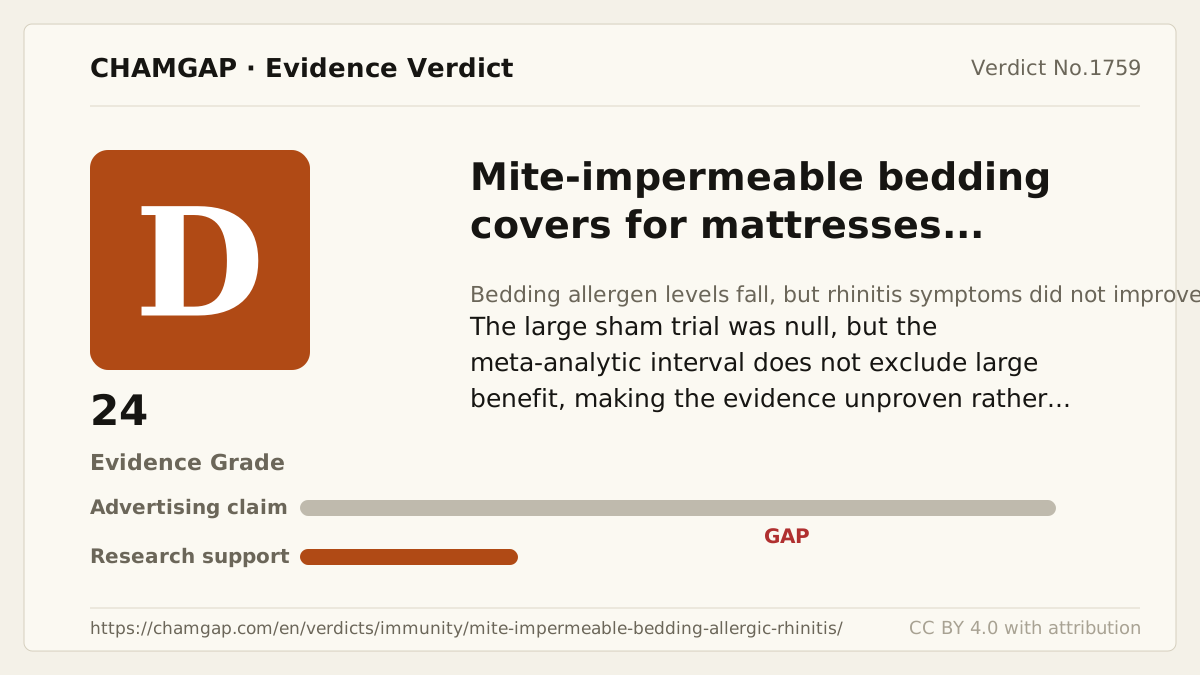
[Chamgap] Mite-impermeable bedding x relief of house-dust-mite allergic rhinitis symptoms — Evidence Grade D·24. 2 cited sources checked. Source: https://chamgap.com/en/verdicts/immunity/mite-impermeable-bedding-allergic-rhinitis/ · CC BY 4.0CC BY 4.0 — free to use with attribution; do not distort grades, numbers, or verdict meaning.
What this document does and does not do
Chamgap is an information source. It reports what research has and has not confirmed; it does not tell readers what to take or buy. That decision belongs to readers and, when needed, medical or legal professionals. This verdict reflects literature available up to the search date and may change as new research appears. Nothing here is medical advice.