
Inactivated influenza vaccination during pregnancy,
does it really help with Prevention of laboratory-confirmed influenza in infants through six months?
research showsA. In saline-placebo trials, laboratory-confirmed infant influenza was 19/1,026 versus 37/1,023 in South Africa and 74/1,820 versus 105/1,793 in Nepal. The publication author lists did not overlap.
ads claimThe evidence should not be expanded to prevention of every cold or respiratory symptom.
Useful facts when choosing a product
- Madhi and Steinhoff both used saline placebo and had zero overlapping authors.
- Zaman used pneumococcal vaccine and Tapia used meningococcal conjugate vaccine, so neither forms the direct placebo-controlled replication pair.
- Zaman listed Gates Foundation, USAID, US HHS, National Vaccine Program Office, Wyeth, Thrasher Research Fund, Aventis Pasteur, ICDDR,B, and Johns Hopkins Bloomberg School of Public Health support.
- Madhi listed Gates Foundation, NIH/NCATS Colorado CTSI, South African Research Chairs Initiative, and a Medical Research Council unit, and the study team purchased vaccine.
- Sanofi Pasteur supplied vaccine for Tapia; vaccine-supply status could not be confirmed for Zaman or Steinhoff.
- Verdict 1571 is B with 77 points for a manufacturer-sponsored single pivotal trial of maternal RSV vaccine and severe infant RSV lower respiratory illness; this verdict has independent placebo-controlled influenza trials.
Chamgap Semantic Classification Code
Candidate index · review held
M.inactivated-influenza-vaccination-during-pregnancy.UNK.laboratory-confirmed-influenza-through.prevent.MULTIMedicinal interventions > Inactivated influenza vaccination during pregnancy > Unknown > laboratory-confirmed influenza through > Occurrence-prevention claim > Multiple: primary unresolved
An automated migration candidate, not an issued permanent code; exact claim scope remains under review. This machine-generated migration candidate helps retrieval but is not a permanent assignment. The original verdict ID and URL remain authoritative.
What the research actually shows
Madhi randomized 2,116 HIV-uninfected pregnant women in South Africa, and Steinhoff randomized 3,693 pregnant women in Nepal; both used saline placebo and followed infant laboratory-confirmed influenza through about six months. Their complete publication author lists had zero overlap. Active-control trials reported 6/159 versus 16/157 in Bangladesh and 52/2,064 versus 77/2,041 in Mali. The South African team purchased vaccine; Sanofi Pasteur supplied vaccine in Mali; supply status could not be confirmed for Bangladesh or Nepal.
Why this is classified as A (86)
Repeated randomized hard-endpoint protection with nonoverlapping teams supports A with 86 points; mixed funding is not manufacturer-only evidence.
Counterpoint. Protection was not demonstrated in HIV-exposed infants in the South African trial.
Rejudgment record. New verdict — Multiple randomized trials by nonoverlapping teams reproduced protection against laboratory-confirmed infant influenza through 24 weeks
| Endpoint | H | Hard endpoint - actual events such as death |
| Replication | R2 | Independently replicated across trials |
| Independence | I1 | Mixed funding sources |
| Effect size | E+ | Meets the clinically important threshold |
Stored derived and displayed grades match; this is not a current recalculation or validity check (A).
Sub-claim grades by effect
This ingredient is marketed for several effects. A single overall grade blends strong and weak claims together, so each effect is graded separately here. The overall grade reflects the strongest disconfirming or core claim.
| Effect (sub-claim) | Grade | Basis |
|---|---|---|
| Prevention of confirmed infant influenza | A | Positive in multiple RCTs through 24 weeks |
Cross-check — AI research and Codex final gate
Evidence Table
| Study | Design | Sample | Funding | Endpoint | Result | Weight |
|---|---|---|---|---|---|---|
| Zaman et al., 2008 | Blinded randomized active-controlled trial | 340 randomized; 159 versus 157 infants analyzed | Gates Foundation, USAID, US HHS, National Vaccine Program Office, Wyeth, Thrasher, Aventis Pasteur, ICDDR,B, and Johns Hopkins | First laboratory-confirmed influenza through 24 weeks | 6/159 versus 16/157; efficacy 63% (95% CI 5–85) | Pivotal RCT |
| Madhi et al., 2014 | Double-blind saline-placebo RCT | 2,116 HIV-uninfected pregnant women | Gates Foundation and public research grants; vaccine purchased by the study team | Infant RT-PCR-confirmed influenza through 24 weeks | 1.9% versus 3.6%; efficacy 48.8% (11.6–70.4) | South African RCT in the direct replication pair |
| Tapia et al., 2016 | Observer-blind active-controlled randomized trial | 4,193 pregnant women; 4,105 liveborn infants | Bill & Melinda Gates Foundation; vaccines supplied by Sanofi Pasteur | First laboratory-confirmed influenza through six months | 52/2,064 versus 77/2,041; efficacy 33.1% (95% CI 3.7–53.9) | Supporting RCT with a different vaccine control |
| Steinhoff et al., 2017 | Saline-placebo randomized trial | 3,693 pregnant women | Bill & Melinda Gates Foundation; manufacturer vaccine-supply status could not be confirmed | Laboratory-confirmed infant influenza through six months | 74/1,820 versus 105/1,793; efficacy 30% (95% CI 5–48) | Direct replication of the South African trial with zero overlapping authors |
Receipt — 4 References
All 4 cited sources were verified for existence at the original page (as of 2026-08-07).
Final verification and publication gate: Codex · Evidence date: 2026-08-07 · Corrections: none
Cite this verdict
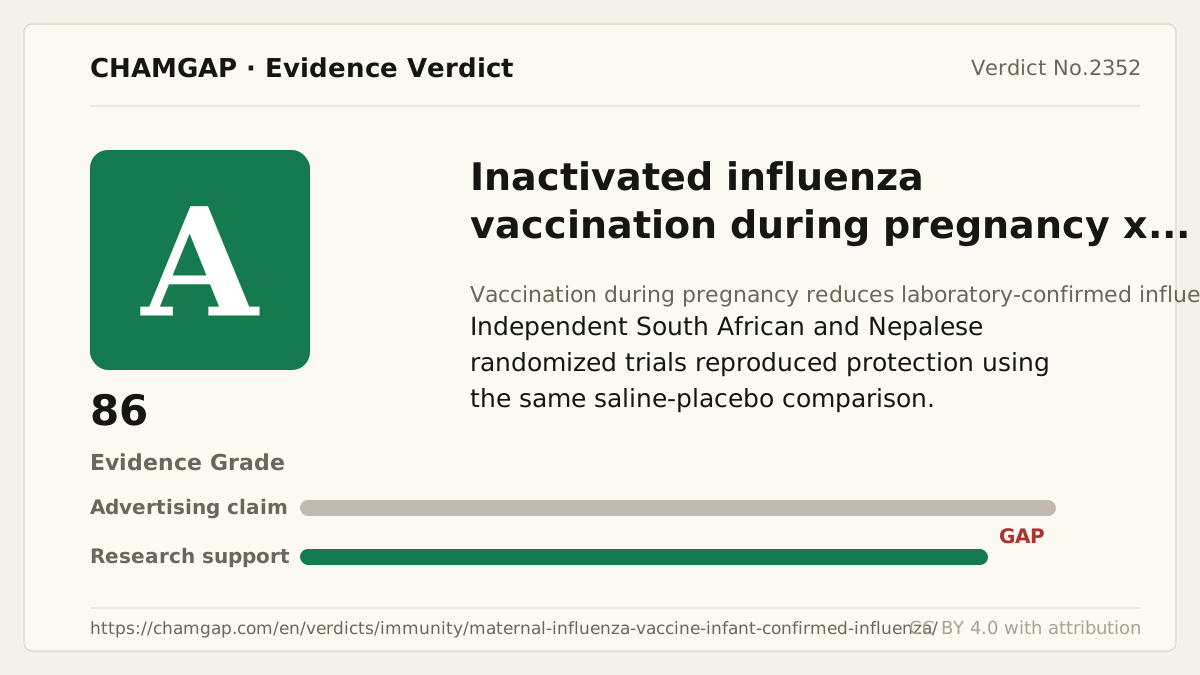
[Chamgap] Maternal influenza vaccination × laboratory-confirmed infant influenza — Evidence Grade A·86. 4 cited sources checked. Source: https://chamgap.com/en/verdicts/immunity/maternal-influenza-vaccine-infant-confirmed-influenza/ · CC BY 4.0CC BY 4.0 — free to use with attribution; do not distort grades, numbers, or verdict meaning.
What this document does and does not do
Chamgap is an information source. It reports what research has and has not confirmed; it does not tell readers what to take or buy. That decision belongs to readers and, when needed, medical or legal professionals. This verdict reflects literature available up to the search date and may change as new research appears. Nothing here is medical advice.