
Luspatercept,
does it really help with Transfusion independence with concurrent hemoglobin response in transfusion-dependent lower-risk MDS?
research showsThe grade is C. The prespecified COMMANDS primary endpoint required at least 12 weeks of red-cell transfusion independence together with a mean hemoglobin increase of at least 1.5 g/dL during weeks 1 to 24. It occurred in 110/182 (60%) versus 63/181 (35%), adjusted absolute difference 25.4 points (95% CI 15.8 to 35.0). The effect was large, but evidence comes from one developer-funded trial.
ads claimThe drug is the same but the indication differs. Verdict 2765 is C with 54 points for transfusion-dependent beta-thalassemia, whereas this verdict concerns myelodysplastic syndromes. Verdict 2775 is C with 50 points for mitapivat in non-transfusion-dependent thalassemia, and verdict 2769 is C with 54 points for deferiprone in transfusional iron overload.
Useful facts when choosing a product
- Luspatercept was injected every three weeks and epoetin alfa weekly.
- COMMANDS enrolled ESA-naive, transfusion-dependent lower-risk MDS with serum erythropoietin below 500 U/L.
- Grade 3-4 hypertension occurred in 10% versus 4%.
Chamgap Semantic Classification Code
Candidate index · review held
UNK.luspatercept.UNK.transfusion-independence-with-concurrent-hemoglobin-response-in-transfusion-dependent-lower-risk-mds.reduce.MULTIUnknown > Luspatercept > Unknown > Transfusion independence with concurrent hemoglobin response in transfusion-dependent lower-risk MDS > Reduction claim > Multiple: primary unresolved
An automated migration candidate, not an issued permanent code; exact claim scope remains under review. This machine-generated migration candidate helps retrieval but is not a permanent assignment. The original verdict ID and URL remain authoritative.
What the research actually shows
COMMANDS randomized 363 patients across 142 sites in 26 countries, 182 versus 181, and evaluated all randomized patients in the primary ITT analysis. There was one avoidable design limitation. Limitation name: open-label conduct. Avoidability: possible - blinded transfusion-decision procedures could have been used. The primary endpoint included clinician-mediated transfusion decisions. Epoetin alfa was an appropriate active standard for ESA-naive lower-risk MDS, so omission of a placebo-only arm was not counted as a defect. Funding came from Celgene and Acceleron Pharma. Jiahui Li, Jennie Zhang, Richard Pilot, Veronika Pozharskaya, Karen Keeperman, Shelonitda Rose, Thomas Prebet, and Yinzhi Lai were affiliated with Bristol Myers Squibb; Sandra Kreitz was affiliated with Celgene.
Why this is classified as C (54)
The composite primary endpoint included clinically direct transfusion independence and improved by 25.4 absolute points, but one developer-funded open-label trial with many company-employed authors gives C with 54 points.
Counterpoint. A large response does not substitute for independent replication in the same indication.
Rejudgment record. Article, registry, and affiliation cross-check — ITT composite primary endpoint, 25.4-point absolute difference, developer funding, company-employed authors, and open-label conduct
| Endpoint | H | Hard endpoint - actual events such as death |
| Replication | R1 | Single confirmatory trial |
| Independence | I0 | Evidence comes only from manufacturer studies |
| Effect size | E+ | Meets the clinically important threshold |
Stored derived and displayed grades match; this is not a current recalculation or validity check (C).
Sub-claim grades by effect
This ingredient is marketed for several effects. A single overall grade blends strong and weak claims together, so each effect is graded separately here. The overall grade reflects the strongest disconfirming or core claim.
| Effect (sub-claim) | Grade | Basis |
|---|---|---|
| At least 12 weeks of transfusion independence with concurrent hemoglobin response | C | Rates were 60% versus 35%, adjusted absolute difference 25.4 points. |
Cross-check — AI research and Codex final gate
Evidence Table
| Study | Design | Sample | Funding | Endpoint | Result | Weight |
|---|---|---|---|---|---|---|
| Della Porta MG et al. 2024 COMMANDS | Phase 3 open-label multinational randomized active-controlled trial | 363 randomized (182/181), all 363 in ITT | Funded by Celgene and Acceleron Pharma; multiple Bristol Myers Squibb and Celgene employee coauthors | At least 12 weeks of red-cell transfusion independence with concurrent mean hemoglobin increase of at least 1.5 g/dL during weeks 1-24 | 110/182 (60%) versus 63/181 (35%), adjusted absolute difference 25.4 points (95% CI 15.8 to 35.0), P<0.0001 | Single developer-funded evidence on a composite including transfusion independence |
Receipt — 1 References
All 1 cited sources were verified for existence at the original page (as of 2026-08-18).
Final verification and publication gate: Codex · Evidence date: 2026-08-18 · Corrections: none
Cite this verdict
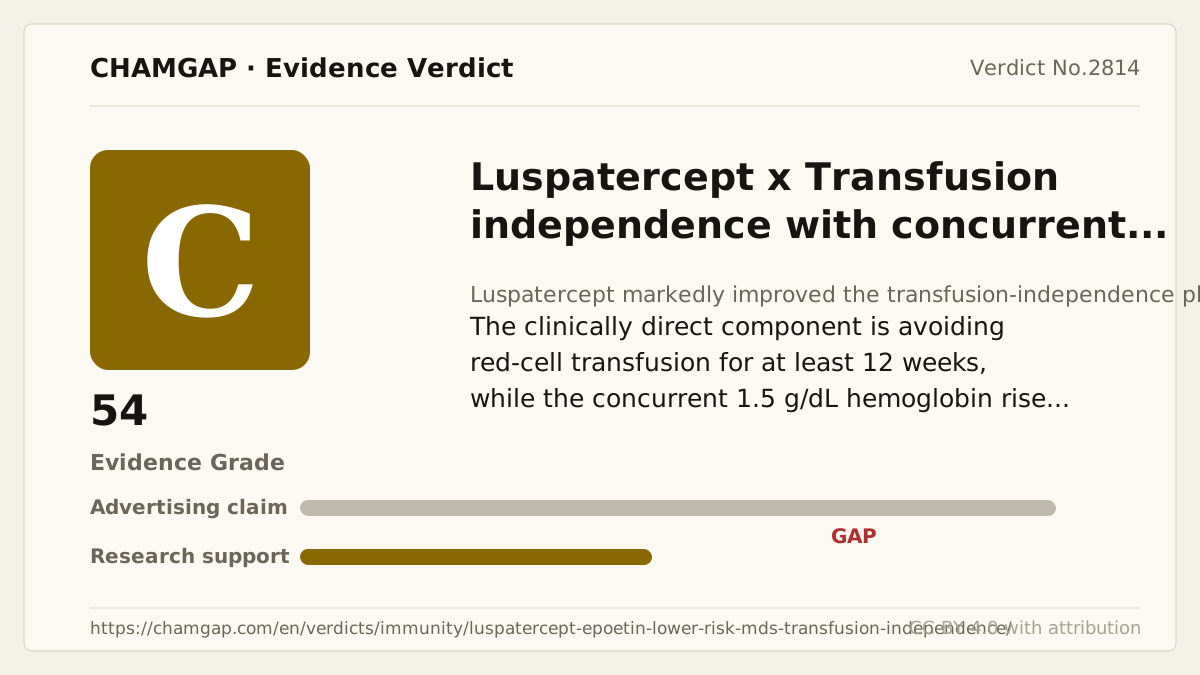
[Chamgap] Luspatercept versus Epoetin Alfa in Lower-Risk MDS - Benefit — Evidence Grade C·54. 1 cited sources checked. Source: https://chamgap.com/en/verdicts/immunity/luspatercept-epoetin-lower-risk-mds-transfusion-independence/ · CC BY 4.0CC BY 4.0 — free to use with attribution; do not distort grades, numbers, or verdict meaning.
What this document does and does not do
Chamgap is an information source. It reports what research has and has not confirmed; it does not tell readers what to take or buy. That decision belongs to readers and, when needed, medical or legal professionals. This verdict reflects literature available up to the search date and may change as new research appears. Nothing here is medical advice.