
Long-term supplemental oxygen,
does it really help with Delay of death or first hospitalization in stable COPD with moderate desaturation?
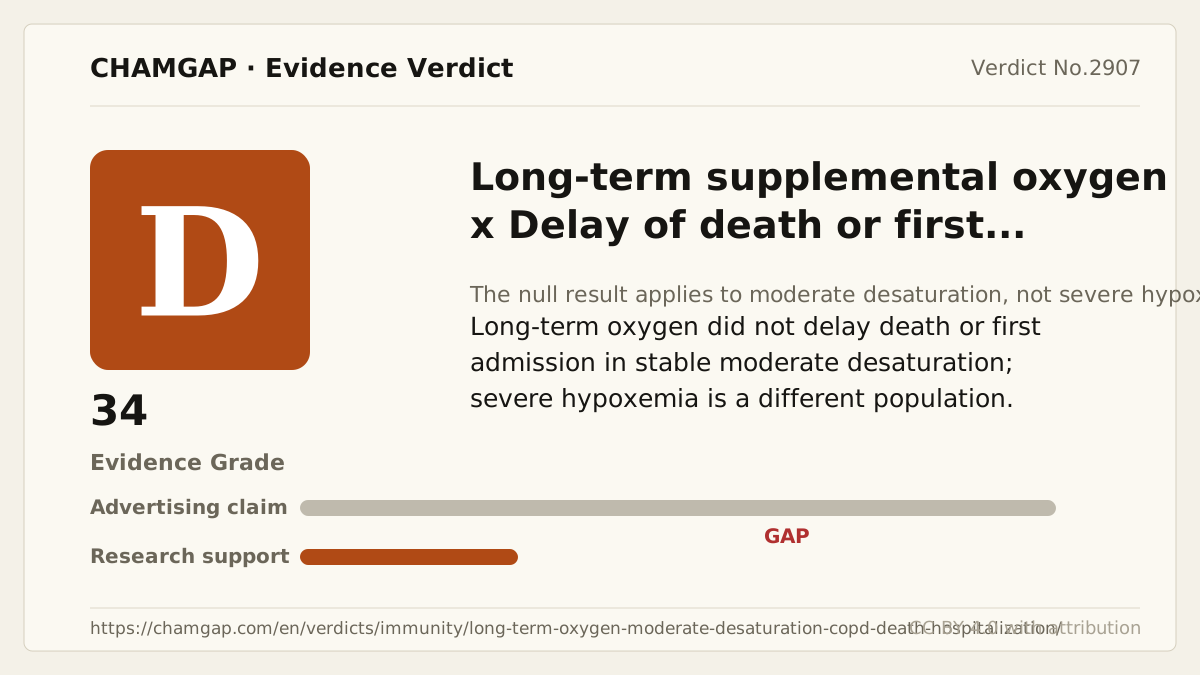
research showsGrade D, 34 points. In 738 LOTT participants, time to death or first hospitalization gave HR 0.94 (95% CI 0.79 to 1.12). The lower tail still permits up to a 21% lower hazard, so this is null evidence, not definitive exclusion of benefit.
ads claimNull results in moderate desaturation must not be used to stop survival-prolonging oxygen in severe hypoxemia.
Useful facts when choosing a product
- Eligibility was stable COPD with resting SpO2 89% to 93% or moderate exertional desaturation.
- The 51 oxygen-attributed events included 23 equipment trips and 6 fires or burns.
Chamgap Semantic Classification Code
Candidate index · review held
UNK.long-term-supplemental-oxygen.UNK.delay-of-death-or-first-hospitalization-in-stable-copd-with-moderate-desaturation.reduce.UNKUnknown > Long-term supplemental oxygen > Unknown > Delay of death or first hospitalization in stable COPD with moderate desaturation > Reduction claim > Unknown
An automated migration candidate, not an issued permanent code; exact claim scope remains under review. This machine-generated migration candidate helps retrieval but is not a permanent assignment. The original verdict ID and URL remain authoritative.
What the research actually shows
This verdict asks whether to prescribe oxygen in stable COPD with moderate desaturation. Verdict 2908 asks whether adding a statin reduces exacerbations in high-risk COPD, while verdict 2909 asks whether a statin saves critically ill patients with acute respiratory distress syndrome. Thus, 2907 concerns oxygen prescribing and hypoxemia severity; the other two test a statin in distinct respiratory settings. Four-gate review: ① Unmasked subjective endpoint ② listed item ③ allocation was open but death and hospitalization were objective events ④ masking oxygen equipment was infeasible and the endpoint was not subjective, so not counted. ① At least 15% attrition ② listed item ③ administrative survival censoring is not attrition and all 738 were in ITT ④ criterion not met. Axis 6 B0 evidence ① Allocation concealment: "The LOTT used a web-based data system to randomly assign participants" ② Masking: "The LOTT did not mask study personnel or participants"; "objective primary endpoint components of hospitalization and death" ③ Analysis population and missingness: "in the intention-to-treat population"; survival censoring was used ④ Prespecified primary endpoint: "PRIMARY OUTCOME: Time to the composite event, all-cause mortality or all-cause hospitalization" - consistent with NCT00692198
Why this is classified as D (34)
One large public hard-outcome null trial without repeated refutation or threshold-based exclusion gives D, 34.
Counterpoint. The interval ranges from a possible 21% lower to 12% higher hazard.
Rejudgment record. Source checked — Large LOTT hard-outcome null result contrasted with severe-hypoxemia evidence
| Endpoint | H | Hard endpoint - actual events such as death |
| Replication | R1 | Single confirmatory trial |
| Independence | I2 | Decisive evidence is publicly or non-profit funded |
| Effect size | E- | Harm increased in the trials |
| Precision | C0 | The confidence interval leaves room for benefit |
Stored derived and displayed grades match; this is not a current recalculation or validity check (D).
Sub-claim grades by effect
This ingredient is marketed for several effects. A single overall grade blends strong and weak claims together, so each effect is graded separately here. The overall grade reflects the strongest disconfirming or core claim.
| Effect (sub-claim) | Grade | Basis |
|---|---|---|
| Delay of death or first hospitalization | D | HR was 0.94. |
Cross-check — AI research and Codex final gate
Evidence Table
| Study | Design | Sample | Funding | Endpoint | Result | Weight |
|---|---|---|---|---|---|---|
| LOTT | Multicenter randomized open-label controlled trial | 738 participants (368/370) | Public funding from NHLBI and CMS | Time to death or first hospitalization | HR 0.94 (95% CI 0.79 to 1.12), P=0.52 | Large hard-outcome RCT |
Receipt — 2 References
All 2 cited sources were verified for existence at the original page (as of 2026-08-26).
Final verification and publication gate: Codex · Evidence date: 2026-08-26 · Corrections: none
Cite this verdict
[Chamgap] No Benefit of Long-Term Supplemental Oxygen × Death or First Hospitalization in Stable COPD with Moderate Desaturation — Evidence Grade D·34. 2 cited sources checked. Source: https://chamgap.com/en/verdicts/immunity/long-term-oxygen-moderate-desaturation-copd-death-hospitalization/ · CC BY 4.0CC BY 4.0 — free to use with attribution; do not distort grades, numbers, or verdict meaning.
What this document does and does not do
Chamgap is an information source. It reports what research has and has not confirmed; it does not tell readers what to take or buy. That decision belongs to readers and, when needed, medical or legal professionals. This verdict reflects literature available up to the search date and may change as new research appears. Nothing here is medical advice.