
Long-term add-on azithromycin,
does it really help with Reduced moderate and severe asthma exacerbations over 48 weeks?
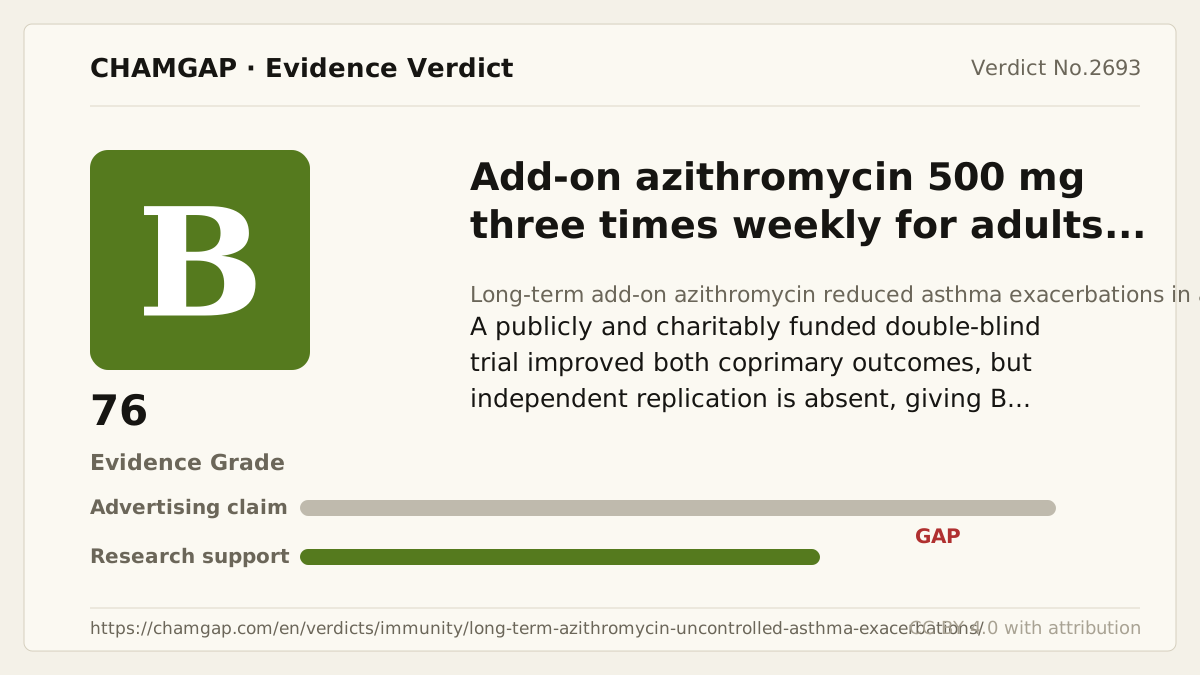
research showsThe grade is B with 76 points. In 420 AMAZES participants, exacerbation rates were 1.07 versus 1.86 per person-year, IRR 0.59 (95% CI 0.47 to 0.74).
ads claimBenefit was shown under specialist conditions after QT and hearing screening while background inhaled therapy continued for 48 weeks.
Useful facts when choosing a product
- The tested regimen was azithromycin 500 mg three times weekly for 48 weeks.
- People with hearing impairment or abnormal QTc prolongation were excluded.
- The registration is ACTRN12609000197235.
Chamgap Semantic Classification Code
Candidate index · review held
M.add-on-azithromycin-three-times.inhaled.moderate-and-severe-asthma-exacerbations-over.reduce.MULTIMedicinal interventions > Add-on azithromycin three times > Inhaled > moderate and severe asthma exacerbations over > Reduction claim > Multiple: primary unresolved
An automated migration candidate, not an issued permanent code; exact claim scope remains under review. This machine-generated migration candidate helps retrieval but is not a permanent assignment. The original verdict ID and URL remain authoritative.
What the research actually shows
The paper reports central concealed allocation from a computer-generated table with permuted blocks of 4 or 6, placebo masking of participants and investigators, and agreement between registered and published coprimary outcomes. The exacerbation-rate primary outcome included all 420 participants in their assigned groups, but the paper did not report how missing 48-week AQLQ data for the coprimary quality-of-life outcome were handled. Follow-up lasted 48 weeks and both coprimary outcomes succeeded. The Australian NHMRC and John Hunter Hospital Charitable Trust funded the trial. Author pharmaceutical relationships were disclosed separately from trial funding.
Why this is classified as B (76)
A large publicly funded double-blind trial succeeded on both coprimary outcomes, but handling of missing 48-week AQLQ data was not reported and one confirmatory trial gives B with 76 points.
Counterpoint. Resistance, QT prolongation, hearing effects, gastrointestinal adverse events, and interactions require specialist selection and monitoring.
Rejudgment record. Cross-check applied — The Lancet paper and ACTRN12609000197235 establish both coprimary outcomes, central concealed allocation, participant and investigator masking, assigned-group analysis for exacerbations, unreported AQLQ missing-data handling, 48-week follow-up, and public-charitable funding
| Endpoint | H | Hard endpoint - actual events such as death |
| Replication | R1 | Single confirmatory trial |
| Independence | I2 | Decisive evidence is publicly or non-profit funded |
| Effect size | E+ | Meets the clinically important threshold |
Stored derived and displayed grades match; this is not a current recalculation or validity check (B).
Sub-claim grades by effect
This ingredient is marketed for several effects. A single overall grade blends strong and weak claims together, so each effect is graded separately here. The overall grade reflects the strongest disconfirming or core claim.
| Effect (sub-claim) | Grade | Basis |
|---|---|---|
| Reduced moderate and severe asthma exacerbations | B | The IRR was 0.59 (0.47 to 0.74). |
Cross-check — AI research and Codex final gate
Evidence Table
| Study | Design | Sample | Funding | Endpoint | Result | Weight |
|---|---|---|---|---|---|---|
| Gibson PG, Yang IA, Upham JW, Reynolds PN, Hodge S, James AL, Jenkins C, Peters MJ, Marks GB, Baraket M, Powell H, Taylor SL, Leong LEX, Rogers GB, Simpson JL. 2017 | Multicenter double-blind placebo-controlled randomized trial | 420 randomized and analyzed by intention to treat (213/207) | Australian NHMRC and John Hunter Hospital Charitable Trust | Coprimary 48-week moderate/severe exacerbation rate and AQLQ | Exacerbation rates 1.07 versus 1.86 per person-year; IRR 0.59 (95% CI 0.47 to 0.74), P<.0001; AQLQ difference 0.36 (0.21 to 0.52) | Pivotal single independently funded confirmatory trial |
Receipt — 1 References
All 1 cited sources were verified for existence at the original page (as of 2026-08-15).
Final verification and publication gate: Codex · Evidence date: 2026-08-15 · Corrections: none
Cite this verdict
[Chamgap] Long-term add-on azithromycin x fewer exacerbations in uncontrolled asthma — Evidence Grade B·76. 1 cited sources checked. Source: https://chamgap.com/en/verdicts/immunity/long-term-azithromycin-uncontrolled-asthma-exacerbations/ · CC BY 4.0CC BY 4.0 — free to use with attribution; do not distort grades, numbers, or verdict meaning.
What this document does and does not do
Chamgap is an information source. It reports what research has and has not confirmed; it does not tell readers what to take or buy. That decision belongs to readers and, when needed, medical or legal professionals. This verdict reflects literature available up to the search date and may change as new research appears. Nothing here is medical advice.