
Long-lasting insecticidal nets,
does it really help with Prevention of clinical malaria and all-cause mortality in children in malaria-endemic areas?
research showsInsecticide-treated nets are graded A because multiple randomized and quasi-randomized trials provide high-certainty evidence of reduced clinical malaria and all-cause child mortality in endemic areas. The 2018 Cochrane review included 23 trials and more than 275,793 participants, comparing treated nets with no nets or untreated nets. In five trials versus no nets, all-cause mortality in children younger than five fell by about 17%, corresponding to 5.6 fewer deaths per 1,000 protected children per year, while clinical Plasmodium falciparum episodes fell by about 45%. Modern LLINs are the durable implementation of this treated-net class, although spreading pyrethroid resistance can reduce field effectiveness.
ads claimMarketing can turn long-lasting into permanent insecticidal action or identical protection in every environment. Clinical effectiveness varies with actual use, net integrity, residual insecticide, and vector resistance.
Useful facts when choosing a product
- An LLIN binds or coats insecticide onto fibers so that insecticidal activity persists for a defined period despite repeated washing.
- The Cochrane class evidence includes both modern LLINs and pyrethroid-treated nets that required periodic retreatment.
- A treated net combines a physical barrier between people and mosquitoes with pyrethroid effects that reduce landing, blood feeding, and mosquito survival.
- Transient skin or eye irritation and odor discomfort can occur, while trials did not show a prominent serious systemic-harm signal.
Chamgap Semantic Classification Code
Candidate index · review held
UNK.long-lasting-insecticidal-net.UNK.clinical-malaria-and-all-cause-mortality-in-malaria-endemic-areas.prevent.noneUnknown > Long-lasting insecticidal net > Unknown > clinical malaria and all-cause mortality in malaria-endemic areas > Occurrence-prevention claim > No intervention
An automated migration candidate, not an issued permanent code; exact claim scope remains under review. This machine-generated migration candidate helps retrieval but is not a permanent assignment. The original verdict ID and URL remain authoritative.
What the research actually shows
The 2018 Cochrane review by Pryce, Richardson, and Lengeler included 23 randomized or quasi-randomized trials and more than 275,793 adults and children. Across five trials versus no nets, all-cause child mortality had a rate ratio of 0.83 (95% CI 0.77 to 0.89), a 17% protective effect corresponding to 5.6 fewer deaths per 1,000 protected children each year. Clinical falciparum malaria in stable-transmission areas had a rate ratio of 0.55 (95% CI 0.48 to 0.64), about a 45% reduction. Comparisons with untreated nets also supported reduced infection and illness, while the mortality estimate was less precise because fewer trials contributed.
Why this is classified as A (92)
Across 23 randomized or quasi-randomized trials and more than 275,793 participants, treated nets versus no nets reduced all-cause mortality in children younger than five, rate ratio 0.83 (95% CI 0.77 to 0.89), and clinical falciparum malaria, rate ratio 0.55 (95% CI 0.48 to 0.64), providing high-certainty direct hard-endpoint evidence and giving A with 92 points.
Counterpoint. Pyrethroid resistance and physical damage can lower the present-day absolute effect relative to older trials, but they do not erase the multiple randomized hard-endpoint findings.
Rejudgment record. New verdict — Applied the multiple-independent-trial criterion because a high-certainty synthesis of 23 randomized or quasi-randomized trials directly reduced all-cause mortality in children younger than five and clinical falciparum malaria
Sub-claim grades by effect
This ingredient is marketed for several effects. A single overall grade blends strong and weak claims together, so each effect is graded separately here. The overall grade reflects the strongest disconfirming or core claim.
| Effect (sub-claim) | Grade | Basis |
|---|---|---|
| Reduction in all-cause mortality among children younger than five | A | Five trials versus no nets gave a rate ratio of 0.83 (95% CI 0.77 to 0.89), with high-certainty evidence. |
| Prevention of clinical Plasmodium falciparum malaria | A | The rate ratio in stable-transmission settings was 0.55 (95% CI 0.48 to 0.64). |
| Reduction in severe malaria episodes | A | Multiple trials found reductions, although events were fewer and definitions varied more than for all-cause mortality. |
Cross-check — AI research and Codex final gate
Evidence Table
| Study | Design | Sample | Funding | Endpoint | Result | Weight |
|---|---|---|---|---|---|---|
| Pryce J, Richardson M, and Lengeler C. 2018 Cochrane review | Systematic review and meta-analysis of randomized and quasi-randomized trials | 23 trials and more than 275,793 participants | Public support for the Cochrane Infectious Diseases Group through UK aid | All-cause child mortality and clinical malaria episodes | Versus no nets, all-cause child mortality rate ratio 0.83 (95% CI 0.77 to 0.89) and clinical falciparum malaria rate ratio 0.55 (95% CI 0.48 to 0.64). | Key high-certainty multiple-trial hard-endpoint synthesis |
| Lengeler C. 2004 Cochrane review | Systematic review of randomized insecticide-treated-net trials | Five trials contributing child mortality | Academic Cochrane review | All-cause child mortality and malaria illness | Protective efficacy against child mortality versus no nets was 17% (rate ratio 0.83, 95% CI 0.76 to 0.90). | Earlier synthesis of the mortality effect |
| Nevill CG et al. 1996 Kilifi, Kenya trial | Community randomized controlled trial across 56 communities of permethrin-treated bednets retreated every six months | More than 11,000 children younger than five on the rural Kenyan coast | Wellcome Trust (listed in the EuropePMC grants record) | All-cause child mortality and severe malaria admissions | All-cause mortality in children aged 1 to 59 months fell 33% (PE 33%, CI 7 to 51) and severe life-threatening malaria fell 44% (CI 19 to 62). | Independent replication of the original Gambian finding by a different team with different funding in a different epidemiological setting |
| Binka FN et al. 1996 Navrongo, Ghana trial | Cluster randomized controlled trial across 96 geographical areas of permethrin-impregnated bednets retreated every six months | Children aged 6 months to 4 years in the Kassena-Nankana district of northern Ghana, with nets provided in 48 areas | Not confirmed (no funder listed in the EuropePMC record) | All-cause child mortality | All-cause mortality in children aged 6 months to 4 years fell 17% (RR 0.83, 95% CI 0.69 to 1.00, P=0.05), with the effect concentrated in children two years or younger and in and just after the wet season. | Independent replication confirming the same direction in an intense-transmission area with no bednet tradition |
Receipt — 4 References
All 4 cited sources were verified for existence at the original page (as of 2026-08-11).
Final verification and publication gate: Codex · Evidence date: 2026-08-11 · Corrections: none
Cite this verdict
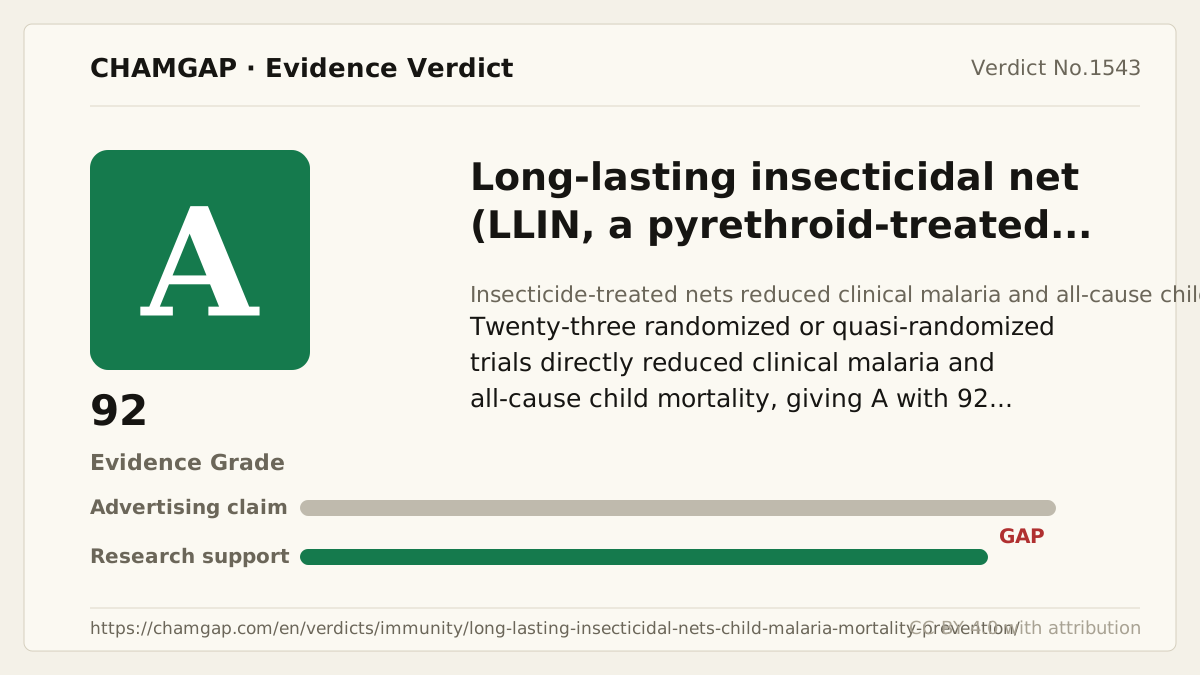
[Chamgap] Long-lasting insecticidal nets x prevention of clinical malaria and child mortality — Evidence Grade A·92. 4 cited sources checked. Source: https://chamgap.com/en/verdicts/immunity/long-lasting-insecticidal-nets-child-malaria-mortality-prevention/ · CC BY 4.0CC BY 4.0 — free to use with attribution; do not distort grades, numbers, or verdict meaning.
What this document does and does not do
Chamgap is an information source. It reports what research has and has not confirmed; it does not tell readers what to take or buy. That decision belongs to readers and, when needed, medical or legal professionals. This verdict reflects literature available up to the search date and may change as new research appears. Nothing here is medical advice.