
Lenacapavir,
does it really help with Prevention of sexually acquired HIV-1 infection with twice-yearly injectable PrEP?
research showsTwice-yearly subcutaneous lenacapavir PrEP is rated A. In PURPOSE 1, no incident HIV infection occurred among 2,134 cisgender women in Africa. In PURPOSE 2, which mainly enrolled cisgender men and gender-diverse participants, two infections occurred and incidence was 96% lower than estimated background incidence. Two separately recruited and conducted large randomized phase 3 trials demonstrated superiority on confirmed incident HIV infection, a hard outcome, both against background incidence and effective oral F/TDF. Because both belong to the same Gilead development program and the main confirmatory evidence is concentrated at 52 weeks, the verdict is A with 91 points.
ads claimTwice a year does not mean that scheduled redosing and HIV testing can be skipped. Lenacapavir prevents HIV, not other sexually transmitted infections or pregnancy, and protection is not assured beyond six months if dosing stops.
Useful facts when choosing a product
- The PrEP regimen uses oral loading doses and two abdominal subcutaneous injections at initiation, followed by subcutaneous dosing every 26 weeks. The locally authorized product and regimen must be checked.
- Sunlenca is a treatment brand containing the same ingredient. The United States PrEP brand is Yeztugo; products authorized for treatment and prevention should not be assumed interchangeable.
- HIV antigen-antibody and HIV-1 RNA testing is required before initiation and at each injection to exclude unrecognized acute infection. Functional monotherapy during infection can select capsid-inhibitor resistance.
- Injection-site pain, nodules, erythema, and swelling are common, and the pharmacologic tail is prolonged. Strong CYP3A inducers and other interacting drugs require review, and lenacapavir does not prevent other sexually transmitted infections.
Chamgap Semantic Classification Code
Candidate index · review held
M.lenacapavir.UNK.sexually-acquired-hiv-1-infection-with-twice-yearly-injectable-prep.prevent.activeMedicinal interventions > Lenacapavir > Unknown > sexually acquired HIV-1 infection with twice-yearly injectable PrEP > Occurrence-prevention claim > Active comparator
An automated migration candidate, not an issued permanent code; exact claim scope remains under review. This machine-generated migration candidate helps retrieval but is not a permanent assignment. The original verdict ID and URL remain authoritative.
What the research actually shows
PURPOSE 1 double-masked 5,338 adolescent girls and young cisgender women in South Africa and Uganda to lenacapavir every 26 weeks, daily F/TAF, or daily F/TDF. There were zero infections among 2,134 lenacapavir recipients, amounting to 100% prevention in women, 39 with F/TAF, and 16 with F/TDF. PURPOSE 2 randomized 3,271 cisgender men, transgender women and men, and gender-nonbinary participants 2:1 to lenacapavir or F/TDF, with 3,265 included in the modified intention-to-treat analysis. Infections numbered two versus nine; incidence with lenacapavir was about 96% lower than background incidence and about 89% lower than with F/TDF. The studies were separately recruited and conducted trials within the same Gilead development program. CDC judged the two trials high-certainty evidence and strongly recommended twice-yearly lenacapavir for people weighing at least 35 kg who would benefit from PrEP. The grade rests on the infection outcomes in the trials, not regulatory approval or the recommendation itself.
Why this is classified as A (91)
PURPOSE 1 and PURPOSE 2 were separately recruited randomized phase 3 trials involving about 8,600 participants and reduced confirmed incident HIV infection to zero among women and two cases among mainly men and gender-diverse participants. Both trials showed superiority to background incidence and effective oral F/TDF, satisfying large effect, hard endpoint, replication, and molecule-specific attribution. Their common Gilead development program and concentration of the main confirmatory evidence at 52 weeks are reflected in A with 91 points.
Counterpoint. Oral PrEP remains highly effective for people who can take it consistently. Lenacapavir primarily addresses daily adherence and persistence barriers through 26-week dosing rather than replacing an ineffective oral option.
Rejudgment record. Cross-check applied — Applied A because separately recruited and conducted randomized phase 3 PURPOSE 1 and PURPOSE 2 trials showed 100% prevention in women and reductions of about 96% versus background and 89% versus F/TDF in PURPOSE 2, satisfying hard-endpoint, replication, and molecule-specific criteria; deducted for the same Gilead development program and 52-week-centered confirmation
Sub-claim grades by effect
This ingredient is marketed for several effects. A single overall grade blends strong and weak claims together, so each effect is graded separately here. The overall grade reflects the strongest disconfirming or core claim.
| Effect (sub-claim) | Grade | Basis |
|---|---|---|
| Prevention of sexually acquired HIV-1 infection | A | Two large phase 3 trials in different sex populations recorded zero or two confirmed incident infections. |
| Reduction in HIV infection versus daily oral F/TDF PrEP | A | Both PURPOSE 1 and PURPOSE 2 showed superiority; the incidence rate ratio in PURPOSE 2 was 0.11. |
| Maintenance of preventive efficacy with 26-week dosing | A | Both trials directly tested infection prevention with the subcutaneous 26-week dosing formulation. |
Cross-check — AI research and Codex final gate
Evidence Table
| Study | Design | Sample | Funding | Endpoint | Result | Weight |
|---|---|---|---|---|---|---|
| Bekker LG et al.; PURPOSE 1 Study Team. 2024 | Multicenter randomized double-blind active-controlled phase 3 trial | 5,338 initially HIV-negative women; 2,134 assigned to lenacapavir | Gilead Sciences | Incident HIV infection versus background incidence and F/TDF | Zero infections with lenacapavir, 39 with F/TAF, and 16 with F/TDF; P<0.001 versus both background incidence and F/TDF. | Key hard-infection-endpoint trial in women |
| Kelley CF et al.; PURPOSE 2 Study Team. 2025 | Multicenter randomized double-blind active-controlled phase 3 trial | 3,271 randomized and 3,265 in the modified intention-to-treat analysis; 2,183 assigned to lenacapavir and 1,088 to F/TDF | Gilead Sciences | Incident HIV infection versus background incidence and F/TDF | Two infections versus nine; incidence rate ratio 0.04 versus background incidence and 0.11 versus F/TDF. | Separately recruited replication within the same Gilead development program |
| Patel RR et al. CDC recommendation. 2025 | GRADE-based systematic evidence assessment and clinical recommendation | Two randomized trials, PURPOSE 1 and PURPOSE 2 | United States Centers for Disease Control and Prevention | HIV incidence, serious adverse events, and injection-site reactions | Rated certainty in efficacy and safety as high and issued a strong recommendation for twice-yearly lenacapavir PrEP. | Independent guideline cross-check |
Receipt — 3 References
All 3 cited sources were verified for existence at the original page (as of 2026-07-24).
Final verification and publication gate: Codex · Evidence date: 2026-07-24 · Corrections: none
Cite this verdict
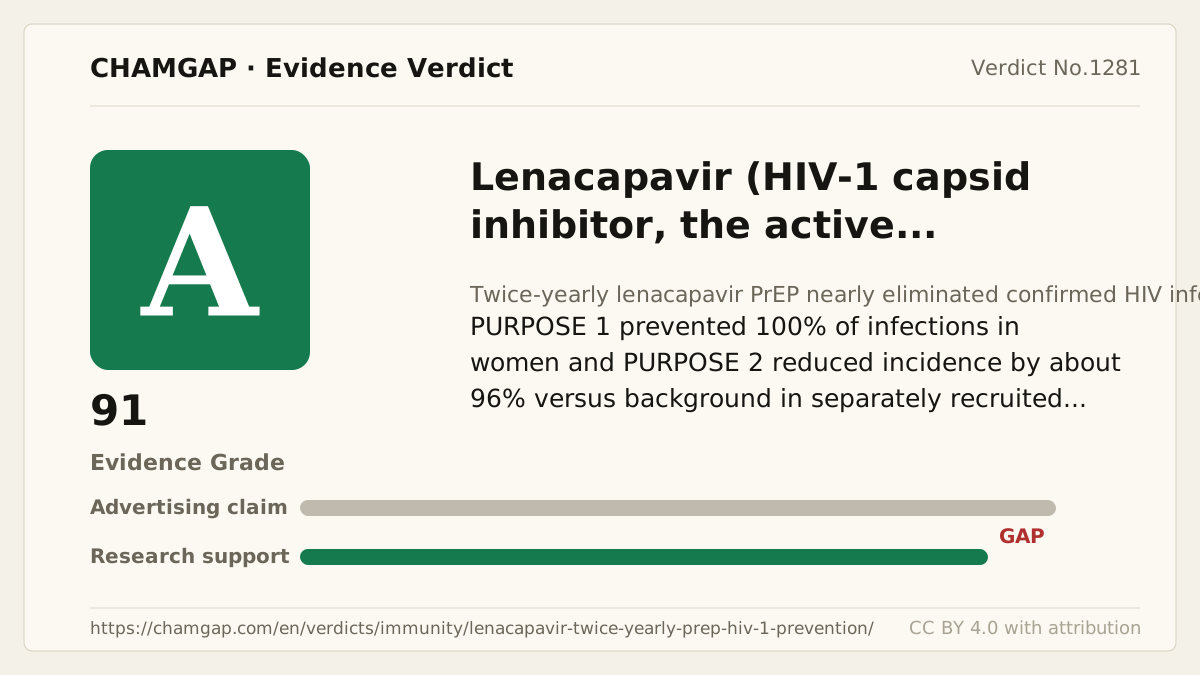
[Chamgap] Lenacapavir x prevention of HIV-1 infection with twice-yearly injectable PrEP — Evidence Grade A·91. 3 cited sources checked. Source: https://chamgap.com/en/verdicts/immunity/lenacapavir-twice-yearly-prep-hiv-1-prevention/ · CC BY 4.0CC BY 4.0 — free to use with attribution; do not distort grades, numbers, or verdict meaning.
What this document does and does not do
Chamgap is an information source. It reports what research has and has not confirmed; it does not tell readers what to take or buy. That decision belongs to readers and, when needed, medical or legal professionals. This verdict reflects literature available up to the search date and may change as new research appears. Nothing here is medical advice.