
Large-volume saline nasal irrigation,
does it really help with Improved chronic nasal and sinus symptoms and disease-specific quality of life?
research showsThe grade is C. Pynnonen 2007 randomized 127 community adults with chronic nasal and sinus symptoms and analyzed 121 who had at least one follow-up. SNOT-20, one of several main outcomes, improved 6.4 points more at eight weeks with P=.002. The comparator was active saline spray rather than placebo or no treatment, and the population was not restricted to allergic rhinitis. An eight-week unblinded NeilMed-funded trial with limited independent supportive evidence supports C with 50 points.
ads claimPromotion can claim that irrigation cures allergic rhinitis or every chronic sinus condition. The pivotal evidence shows better eight-week quality of life than saline spray in a diagnostically mixed symptom population, not cure of the underlying disease or replacement of indicated medication.
Useful facts when choosing a product
- The pivotal trial used large-volume low-positive-pressure isotonic saline twice daily for eight weeks.
- Use sterile or distilled water, or water that has been boiled and cooled, and clean and dry the device after use.
- Irritation, discomfort, nosebleed, or ear pressure can occur; clinical instructions take priority after surgery or in immunocompromised patients.
Chamgap Semantic Classification Code
Candidate index · review held
UNK.large-volume-low-pressure-isotonic-saline-nasal-irrigation.intranasal.chronic-nasal-and-sinus-symptoms-and-disease-specific-quality-of-life.improve.activeUnknown > Large-volume low-pressure isotonic saline nasal irrigation > Intranasal > chronic nasal and sinus symptoms and disease-specific quality of life > Improvement claim > Active comparator
An automated migration candidate, not an issued permanent code; exact claim scope remains under review. This machine-generated migration candidate helps retrieval but is not a permanent assignment. The original verdict ID and URL remain authoritative.
What the research actually shows
Pynnonen et al. assigned 64 participants to large-volume low-pressure irrigation and 63 to saline spray. Six withdrew before the first follow-up, leaving 121 in the actual analysis and 113 with complete eight-week data. Among several main outcomes, SNOT-20 favored irrigation at two, four, and eight weeks, with 6.4 points of additional improvement at week eight; medication use did not differ. NeilMed funded the study but reported no role in design, analysis, or publication. Rabago was an independently supportive trial with 76 randomized and 69 completing, but different solution, comparator, and follow-up preclude calling it an exact replication. Chong 2016 included only two randomized trials with 116 adults and rated possible benefit as low or very low certainty.
Why this is classified as C (50)
SNOT-20, one of several main outcomes, succeeded against active spray, placing the evidence above D. One short unblinded 121-patient analysis, manufacturer funding, mixed diagnoses, and low-certainty independent support invoke the limited-evidence and manufacturer ceilings, yielding C with 50 points.
Counterpoint. The 6.4-point difference is meaningful as an active-spray contrast, but it is not an untreated absolute effect or an allergic-rhinitis-specific effect.
Rejudgment record. Cross-check applied — Accepted successful SNOT-20 among several main outcomes in 121 analyzed participants, did not reinterpret the active-spray contrast as an untreated effect, and applied a C ceiling for short unblinded NeilMed-funded evidence with low-certainty independent support
| Endpoint | P | Symptom or function itself is the target - including patient reports and performance tests |
| Replication | R1 | Single confirmatory trial |
| Independence | I0 | Evidence comes only from manufacturer studies |
| Effect size | E+ | Meets the clinically important threshold |
Stored derived and displayed grades match; this is not a current recalculation or validity check (C).
Sub-claim grades by effect
This ingredient is marketed for several effects. A single overall grade blends strong and weak claims together, so each effect is graded separately here. The overall grade reflects the strongest disconfirming or core claim.
| Effect (sub-claim) | Grade | Basis |
|---|---|---|
| Improved disease-specific quality of life | C | SNOT-20, one of several main outcomes, succeeded, but evidence centers on a short manufacturer-funded trial. |
| Reduced frequent nasal and sinus symptoms | C | Frequent symptoms at eight weeks were 40% versus 61%, in an unblinded active-control comparison. |
| Reduced use of nasal and sinus medications | D | The pivotal trial found no between-group difference in medication use. |
Cross-check — AI research and Codex final gate
Evidence Table
| Study | Design | Sample | Funding | Endpoint | Result | Weight |
|---|---|---|---|---|---|---|
| Pynnonen MA et al. 2007 | Randomized active-controlled unblinded trial | 127 randomized; 121 in the actual analysis with follow-up; 113 with complete eight-week data | Financial support from NeilMed Pharmaceuticals, manufacturer of Sinus Rinse; reported no role in design, analysis, or publication | Multiple main outcomes: SNOT-20, symptom frequency, and medication use | SNOT-20 improved 6.4 points more than spray at eight weeks, P=.002; medication use did not differ. | Pivotal direct-efficacy randomized trial |
| Chong LY et al. 2016 Cochrane review | Systematic review of randomized trials in chronic rhinosinusitis | Two randomized trials and 116 adults | United Kingdom NIHR and Cochrane ENT infrastructure and program support | Disease-specific quality of life, symptoms, and adverse events | Possible large-volume benefit was supported by low to very low certainty evidence with substantial trial heterogeneity. | Independent synthesis defining uncertainty |
Receipt — 2 References
All 2 cited sources were verified for existence at the original page (as of 2026-07-24).
Final verification and publication gate: Codex · Evidence date: 2026-07-24 · Corrections: none
Cite this verdict
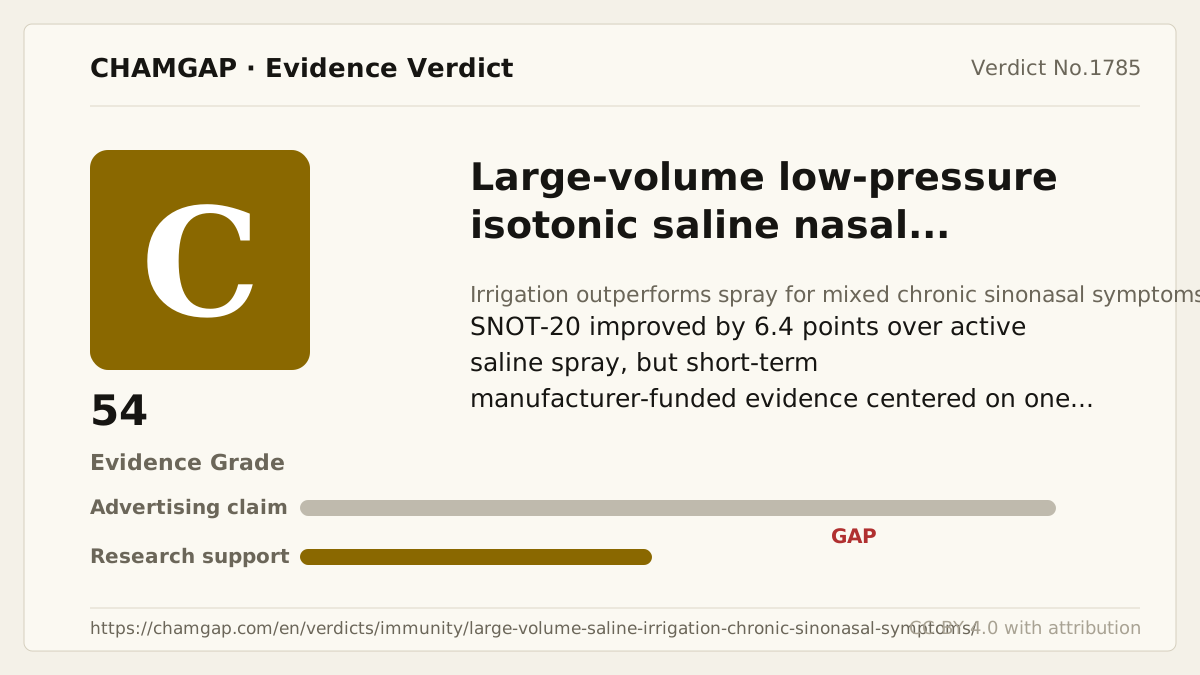
[Chamgap] Large-volume saline nasal irrigation x chronic sinonasal symptoms — Evidence Grade C·50. 2 cited sources checked. Source: https://chamgap.com/en/verdicts/immunity/large-volume-saline-irrigation-chronic-sinonasal-symptoms/ · CC BY 4.0CC BY 4.0 — free to use with attribution; do not distort grades, numbers, or verdict meaning.
What this document does and does not do
Chamgap is an information source. It reports what research has and has not confirmed; it does not tell readers what to take or buy. That decision belongs to readers and, when needed, medical or legal professionals. This verdict reflects literature available up to the search date and may change as new research appears. Nothing here is medical advice.