
L-lysine,
does it really help with Prevention of recurrent herpes labialis and acceleration of lesion healing?
research showsEvidence for preventing cold-sore recurrence comes only from small trials conducted largely in the 1980s. Doses around 1 g/day were generally ineffective, while some studies using approximately 1.2 to 3 g/day reported conflicting positive findings. Cochrane did not confirm preventive efficacy and rated certainty very low. Lower-dose healing trials were null, while one industry-linked 3 g/day trial was positive, so faster healing is also unconfirmed. The compound claim is graded C.
ads claimClaims of starving the virus, eliminating HSV by blocking arginine, preventing recurrence with 3 g/day, or instantly healing blisters exaggerate an in vitro mechanism and isolated small trials. Lysine does not eradicate latent HSV and should not replace established antiviral treatment.
Useful facts when choosing a product
- Imported and cross-border L-lysine supplements, including 1,000 mg tablets, are available to consumers in South Korea, but this is separate from authorization as a cold-sore medicine.
- Trial doses ranged from about 0.6 to 3 g/day, and the positive 3 g/day trial was old and product-specific, so it cannot be transferred directly to one 1 g retail tablet.
- Short-term tolerance at supplement doses is generally good, but high doses may cause abdominal pain, diarrhea, or nausea, and data are limited for kidney or liver disease, pregnancy, and lactation.
- Lesions near the eye, extensive disease, immunocompromise, severe pain, or frequent recurrence warrant clinical evaluation and consideration of antiviral therapy rather than supplement self-treatment.
Chamgap Semantic Classification Code
Candidate index · review held
UNK.l-lysine.UNK.recurrent-herpes-labialis-and-acceleration-of-lesion-healing.prevent.placeboUnknown > L-lysine > Unknown > recurrent herpes labialis and acceleration of lesion healing > Occurrence-prevention claim > Placebo
An automated migration candidate, not an issued permanent code; exact claim scope remains under review. This machine-generated migration candidate helps retrieval but is not a permanent assignment. The original verdict ID and URL remain authoritative.
What the research actually shows
In the 1980 Milman crossover trial of 65 participants, 1 g/day did not reduce the overall recurrence rate or improve lesion healing. McCune 1984 studied 41 participants: 624 mg/day was ineffective and 1,248 mg/day showed a recurrence signal, but neither dose shortened healing. A 21-person DiGiovanna 1984 trial also found no therapeutic or preventive benefit at 1.2 g/day. In contrast, the GNC research department-linked Griffith 1987 trial reported fewer recurrences, lower severity, and shorter healing among 52 completers receiving 3 g/day. The 2015 Cochrane review analyzed first-period data from 26 participants in Thein 1984 and found a monthly recurrence difference of -0.04 with a 95% confidence interval from -0.37 to 0.29, concluding that preventive efficacy was not established.
Why this is classified as C (42)
Human trials exist, but all are old and small, and prevention and healing results conflict by dose and funding source. The null very-low-certainty Cochrane prevention analysis and lower-dose null healing results are balanced against one industry-linked higher-dose positive trial, supporting C rather than D with 42 points.
Counterpoint. A hypothesis of higher-dose prevention and healing remains, but it needs a modern preregistered large randomized trial independent of industry.
Rejudgment record. New verdict — Old small dose-dependent conflicting prevention results, a null Cochrane analysis, and repeated null acute-healing results, with isolated higher-dose positive signals retaining C
Sub-claim grades by effect
This ingredient is marketed for several effects. A single overall grade blends strong and weak claims together, so each effect is graded separately here. The overall grade reflects the strongest disconfirming or core claim.
| Effect (sub-claim) | Grade | Basis |
|---|---|---|
| Prevention of recurrent herpes labialis | C | One gram per day was ineffective, while some trials at approximately 1.2 to 3 g/day were positive; the old small evidence remains conflicting. |
| Acceleration of healing of acute herpes labialis lesions | C | Lower-dose trials were null, while one industry-linked 3 g/day trial was positive, leaving conflicting and limited evidence. |
Cross-check — AI research and Codex final gate
Evidence Table
| Study | Design | Sample | Funding | Endpoint | Result | Weight |
|---|---|---|---|---|---|---|
| Chi CC et al. 2015 | Cochrane systematic review | 1 | Cochrane | Monthly recurrence of herpes labialis | The difference between 1 g/day and placebo was null at -0.04 recurrences per month, with a 95% confidence interval from -0.37 to 0.29, and certainty was very low. | Key |
| Milman N et al. 1980 | Double-blind placebo-controlled crossover trial | 65 | Unknown | Recurrence rate, lesion appearance, and healing rate | One gram per day had no effect on overall recurrence or lesion healing rate. | Key |
| McCune MA et al. 1984 | Randomized double-blind placebo-controlled crossover trial | 41 | Unknown | Recurrence, symptoms, and healing time | Six hundred twenty-four milligrams per day was ineffective and 1,248 mg/day showed a recurrence signal, but neither dose shortened healing. | Supportive |
| DiGiovanna JJ, Blank H 1984 | Double-blind placebo-controlled trial | 21 | Unknown | Recurrence frequency, duration, and severity | At 1.2 g/day, no substantial benefit was found for either treatment of active episodes or prevention of recurrence. | Supportive |
| Griffith RS et al. 1987 | Multicenter double-blind placebo-controlled trial | 52 | General Nutrition Corporation research department involvement | Recurrence, severity, and healing time | Three grams per day was reported to improve recurrence, severity, and healing time. | Supportive |
Receipt — 5 References
All 5 cited sources were verified for existence at the original page (as of 2026-07-18).
Final verification and publication gate: Codex · Evidence date: 2026-07-18 · Corrections: none
Cite this verdict
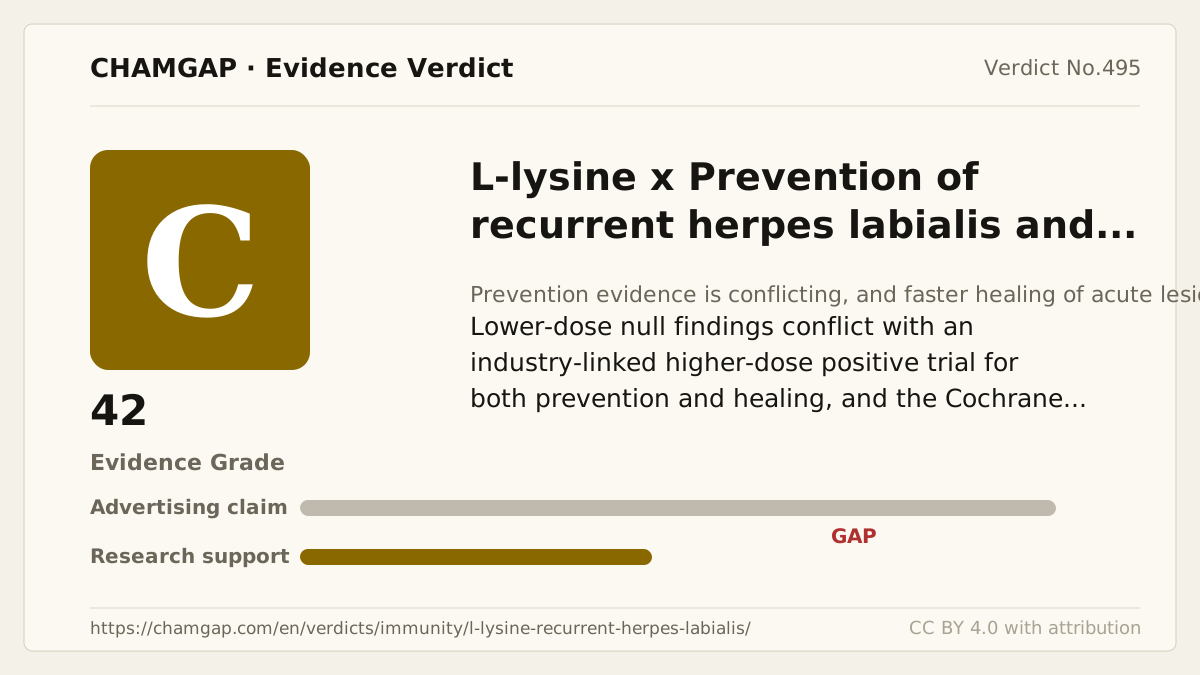
[Chamgap] L-lysine x prevention and healing of recurrent herpes labialis — Evidence Grade C·42. 5 cited sources checked. Source: https://chamgap.com/en/verdicts/immunity/l-lysine-recurrent-herpes-labialis/ · CC BY 4.0CC BY 4.0 — free to use with attribution; do not distort grades, numbers, or verdict meaning.
What this document does and does not do
Chamgap is an information source. It reports what research has and has not confirmed; it does not tell readers what to take or buy. That decision belongs to readers and, when needed, medical or legal professionals. This verdict reflects literature available up to the search date and may change as new research appears. Nothing here is medical advice.