
Ivermectin,
does it really help with Prevention of severe progression or hospitalization in early COVID-19?
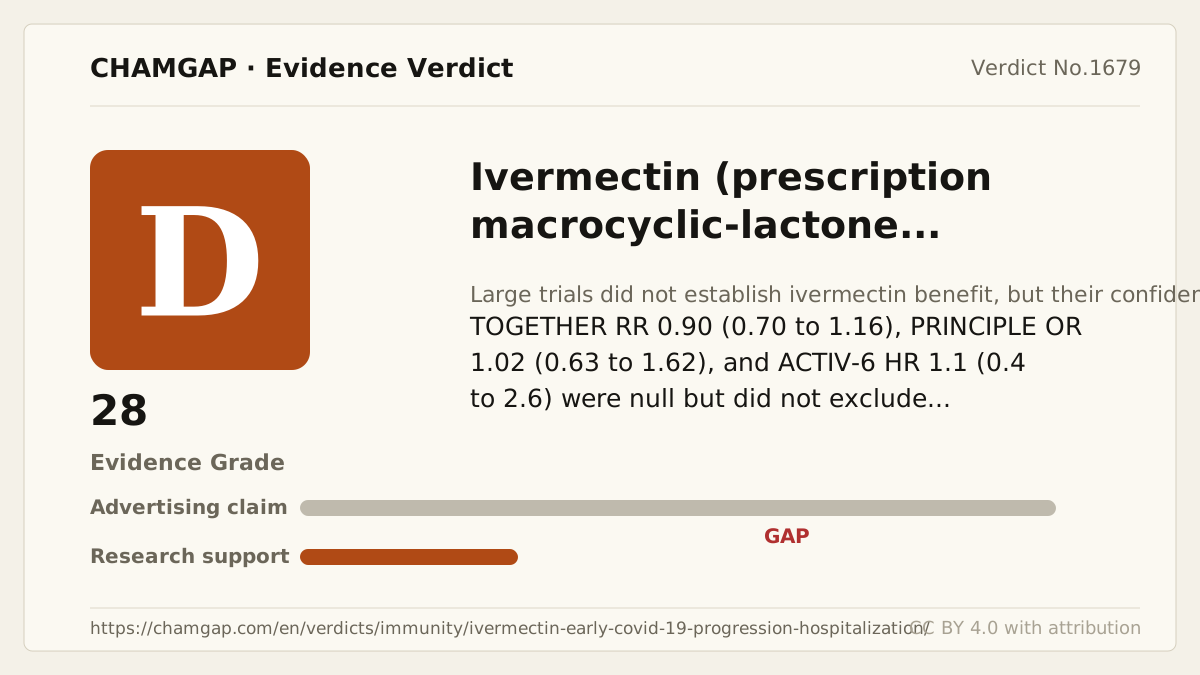
research showsLarge trials did not establish benefit, but their confidence intervals did not exclude meaningful benefit; this is unproven efficacy rather than refutation, supporting D with 28 points.
ads claimMarketing and online claims convert an in-vitro antiviral mechanism of an antiparasitic into clinical prevention of progression and hospitalization. Large trials at human treatment doses did not reduce either outcome.
Useful facts when choosing a product
- I-TECH used 0.4 mg/kg/day for 5 days and TOGETHER used 400 micrograms/kg/day for 3 days; both primary endpoints failed.
- Ivermectin treats specified parasitic infections and is not an authorized COVID-19 preventive or treatment.
- People at high risk from COVID-19 should promptly review eligibility and timing for authorized antivirals with a clinician, accounting for the circulating variant and individual risk.
Chamgap Semantic Classification Code
Candidate index · review held
M.ivermectin.UNK.severe-progression-or-hospitalization-in-early-covid-19.prevent.MULTIMedicinal interventions > Ivermectin > Unknown > severe progression or hospitalization in early COVID-19 > Occurrence-prevention claim > Multiple: primary unresolved
An automated migration candidate, not an issued permanent code; exact claim scope remains under review. This machine-generated migration candidate helps retrieval but is not a permanent assignment. The original verdict ID and URL remain authoritative.
What the research actually shows
I-TECH randomized 500 participants and analyzed 490 by modified intention to treat. TOGETHER randomized 1,358 and included all 1,358 in its primary intention-to-treat analysis, failing with RR 0.90 (95% Bayesian credible interval, 0.70 to 1.16). PRINCIPLE randomized 9,577 across the platform, but its concurrent ivermectin-versus-usual-care direct comparison included 1,806 and failed with OR 1.02 (95% CI, 0.63 to 1.62). ACTIV-6 included 1,591 in the modified intention-to-treat analysis, 817 ivermectin and 774 placebo. Its prespecified time-to-recovery primary endpoint failed. The HR 1.1 (95% CI, 0.4 to 2.6) belongs to the secondary or safety hospitalization-or-death result, not the recovery primary endpoint.
Why this is classified as D (28)
The large trials were null, but TOGETHER RR 0.90 (0.70 to 1.16), PRINCIPLE OR 1.02 (0.63 to 1.62), and the ACTIV-6 hospitalization-or-death HR 1.1 (0.4 to 2.6) did not exclude meaningful benefit. This is unproven efficacy rather than the repeated refutation required for F, yielding D with 28 points.
Counterpoint. Some older small studies and secondary signals are cited, but integrity and bias concerns prevent them from overturning prespecified primary endpoints in large independent trials. Regulatory warnings were not used as efficacy-grade evidence.
Rejudgment record. Cross-check applied — Reserved F for repeated refutation in the same indication; TOGETHER RR 0.90 (0.70 to 1.16), PRINCIPLE OR 1.02 (0.63 to 1.62), and the ACTIV-6 hospitalization-or-death HR 1.1 (0.4 to 2.6) do not exclude meaningful benefit, so the evidence is unproven and supports D
Sub-claim grades by effect
This ingredient is marketed for several effects. A single overall grade blends strong and weak claims together, so each effect is graded separately here. The overall grade reflects the strongest disconfirming or core claim.
| Effect (sub-claim) | Grade | Basis |
|---|---|---|
| Prevention of severe progression in early COVID-19 | D | The I-TECH primary endpoint failed with RR 1.25 and P=0.25. |
| Prevention of hospitalization in early COVID-19 | D | The TOGETHER hospitalization or prolonged emergency-observation primary endpoint was null. |
| Faster clinical recovery in early COVID-19 | D | Large trials did not establish consistent efficacy on prespecified clinical recovery or progression outcomes. |
Cross-check — AI research and Codex final gate
Evidence Table
| Study | Design | Sample | Funding | Endpoint | Result | Weight |
|---|---|---|---|---|---|---|
| Lim SCL et al. 2022 I-TECH | Multicenter open-label randomized standard-care-controlled trial | 500 randomized; actual primary modified intention-to-treat analysis included 490 | No specific funding source reported; the study was conducted in Malaysian Ministry of Health public institutions, with no manufacturer-led role or commercial funding reported and only the drug manufacturer identified | Primary proportion progressing to severe COVID-19 requiring oxygen | 21.6% versus 17.3%, RR 1.25 (95% CI, 0.87 to 1.80; P=0.25); the primary endpoint failed. | Direct null progression trial |
| Reis G et al. 2022 TOGETHER | Double-blind randomized placebo-controlled adaptive platform trial | 1,358 randomized and included in the intention-to-treat primary analysis | Nonprofit funding from FastGrants and the Rainwater Charitable Foundation; not manufacturer-led | Primary composite of hospitalization or emergency observation for at least 6 hours | 14.7% versus 16.3%, RR 0.90 (95% Bayesian credible interval, 0.70 to 1.16); the primary endpoint failed. | Large null trial that did not exclude meaningful benefit |
| Butler CC et al. PRINCIPLE | Community-based open-label adaptive platform randomized trial | 9,577 randomized across the platform; 1,806 in the concurrent direct comparison of ivermectin with usual care | Primarily publicly funded United Kingdom platform trial | Time to recovery and hospitalization or death | The concurrent direct comparison failed with OR 1.02 (95% CI, 0.63 to 1.62), and the interval did not exclude meaningful benefit. | Large null trial insufficient for refutation |
| Naggie S et al. ACTIV-6 | Decentralized double-blind randomized placebo-controlled platform trial | 1,591 in the modified intention-to-treat analysis; 817 ivermectin and 774 placebo | Publicly funded United States NIH platform trial | The prespecified primary endpoint was time to recovery; hospitalization or death was a secondary or safety result | The time-to-recovery primary endpoint failed. HR 1.1 (95% CI, 0.4 to 2.6) was the hospitalization-or-death secondary or safety result, not recovery, and did not exclude meaningful benefit. | Large null trial requiring correct outcome attribution |
Receipt — 2 References
All 2 cited sources were verified for existence at the original page (as of 2026-07-24).
Final verification and publication gate: Codex · Evidence date: 2026-07-24 · Corrections: none
Cite this verdict
[Chamgap] Ivermectin x prevention of severe progression or hospitalization in early covid-19 — Evidence Grade D·28. 2 cited sources checked. Source: https://chamgap.com/en/verdicts/immunity/ivermectin-early-covid-19-progression-hospitalization/ · CC BY 4.0CC BY 4.0 — free to use with attribution; do not distort grades, numbers, or verdict meaning.
What this document does and does not do
Chamgap is an information source. It reports what research has and has not confirmed; it does not tell readers what to take or buy. That decision belongs to readers and, when needed, medical or legal professionals. This verdict reflects literature available up to the search date and may change as new research appears. Nothing here is medical advice.